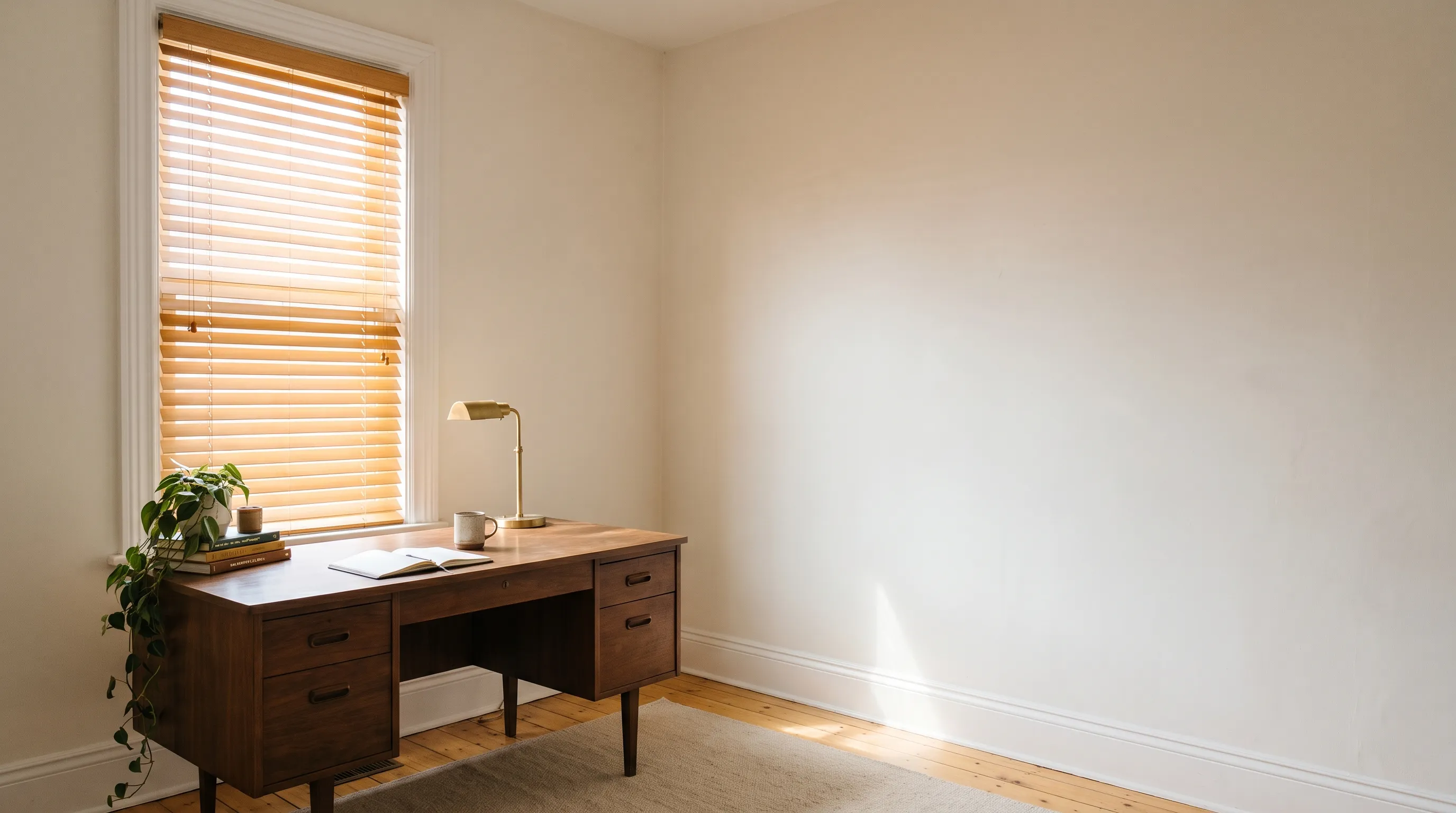
Wood blinds
Basswood venetian slats, stained or painted, on the same tilting mechanism as any other. Chosen for what timber is — light for its size, warm, and never quite uniform — and specified around the one thing it does that composite does not: it moves.
Blinds Company · Rated 4.8 out of 5 on Google
Free in-home measure · open 8am–9pm, 7 days
In short
A wood blind is a venetian with real basswood slats. Timber is about half the weight of composite for the same slat, which is why wood is the only material that spans a wide window comfortably by hand. It also takes up and gives off moisture, so it belongs in dry rooms and fails in bathrooms. In a dry room where the window is worth looking at, it is the nicest object we make.
Book
Let's measure your light.
We come to you, measure at your own windows, and go through fabrics and fits together. The visit costs nothing.
$99 off when you order three or more blindsApplied to your written quote at the measure.
Rather just talk?(437) 782-5452Open 8am–9pm, 7 days
The short version
Is this right for your window?
Yes — if the room is one of these.
- Dry rooms where the window is worth looking at
- Wide windows that have to be lifted by hand
- Rooms with existing timber the blind should agree with
Where it is wrong is below, and that half is the useful one.
And this is what you would be getting.
- 01
- Real basswood, 50mm and 63mm slats
- 02
- Stained, painted or natural finishes
- 03
- Half the weight of composite for the same slat
- 04
- Cordless as standard, wand tilt
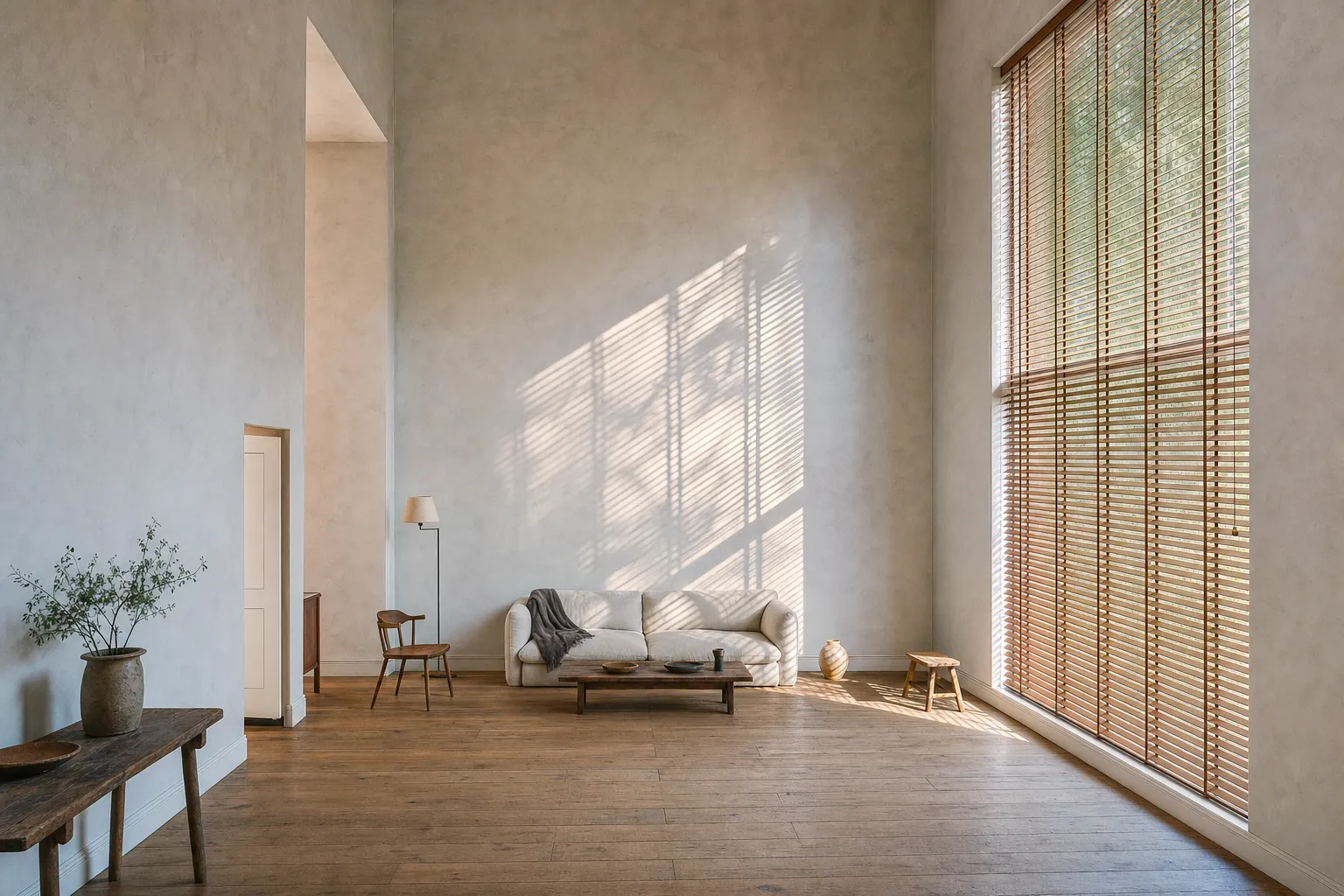
In a room
What wood blinds look like once they are up.
The product, not our installations — a gallery of rooms we did not fit would be somebody else's portfolio with our name on it.
What you are actually buying
A wood blind is a venetian — how it tilts, how it stacks, where the light gets through and how it is measured are on the venetian blinds page, and the general question of composite against timber is on the faux wood page.
This page is about the timber itself, because with a real wood blind the material is the reason to buy it and the reason to be careful with it.
What you get for the money is that no two slats are the same. Grain runs at a different angle on each one, takes a stain slightly differently, and catches light differently as the blind tilts. That variation is invisible in a photograph and obvious in a room, and it is the entire difference between a wood blind and a very good imitation of one.
What you accept is that timber is a material that responds to its environment. Everything below follows from that.
Basswood, and why it is the slat timber
Almost every real wood venetian in the world is basswood, and the reasons are practical rather than traditional.
It is light. Roughly half the density of a PVC composite of the same size, which is what makes a wide wood blind liftable by hand when the faux version is not.
The grain is fine and even. Open-grained timbers — oak, ash — take a stain unevenly on a thin section, so a light stain blotches. Basswood takes colour consistently, which is why it can be offered in pale finishes at all.
It stays flat. A slat is a very thin, very wide section of wood, which is the geometry most prone to cupping. Basswood is unusually stable for its weight, and kiln drying before machining takes most of the rest of the movement out.
It machines cleanly. The ladder holes and the routed edges come out sharp rather than furry, which is what makes the closed blind sit tight.
Other timbers exist in this product and they are specialities rather than upgrades. If somebody offers you oak slats, the questions are what it weighs and what the finish is doing to hold the grain closed.
Stain, paint, and the decision that is actually being made
Three finishes, and they are three different products in how they behave.
Stained. Colour soaked into the timber with a clear coat over it. The grain stays visible and the variation between slats stays visible. This is the finish people mean when they say they want real wood, and it is the one where the material is doing the work.
Painted. An opaque coat over the timber. It looks — deliberately — very like a painted composite slat, because a painted surface hides the grain that was the difference. If the room wants white slats, this is the honest moment to say that faux wood will look the same and cost less, and we will say it.
Natural or oiled. Minimal finish, maximum grain, and the least protection. It ages, it takes marks, and some people want exactly that. It is not a finish for a window somebody touches every day.
The decision underneath all three is what the blind is agreeing with. A wood blind in a room is a horizontal timber surface, and the room usually has others — a floor, a table, a door. The blind can match one of them, sit deliberately away from all of them, or split the difference and look accidental. Only the first two are choices.
Matching wood to wood, which is harder than it sounds
The most common disappointment with this product is a stain that looked right on a sample card and reads wrong in the room, and the cause is nearly always the same.
Different timber under the same stain gives a different colour. A walnut stain on basswood and a walnut stain on oak are not the same colour, because the grain absorbing it is not the same. Matching a floor by stain name will miss.
Light changes it more than the stain does. A north-facing room renders a warm stain cooler; a south-facing one in the afternoon renders everything warmer. A sample judged at the kitchen table is being judged in the wrong room.
Sheen matters as much as colour. A satin slat against a matte floor reads as a different colour even when it is not, because it is returning more light.
So the working method is: hold the sample against the actual thing you want it to relate to, in the room, at the hour the room is used. Then decide whether you are matching or contrasting, and commit. A blind that is clearly darker than the floor looks intentional. One that is a shade off looks like it was meant to match.
Where a wood blind is wrong
A bathroom. Not sometimes — always. The cycle between steam and dry is what makes a thin slat cup, and once one slat has cupped it fouls its neighbour and the blind stops closing evenly. It is gradual, it is not repairable, and any supplier willing to sell you basswood for a bathroom is a supplier worth a second question.
Directly over a kitchen hob or sink. Same moisture problem, plus grease, which a stained finish absorbs and a wipeable one does not.
In front of a radiator. Dry heat on one face and room air on the other is a cupping condition. Above a radiator is fine; in front of one is not.
On a very short window. The stack is the issue: a 50mm slat on a short drop parks a band of solid slats across the top, and on a basement or small bathroom window it takes a fifth of the glass and never returns it.
In a house where nobody will dust. More surfaces than anything else we make, and a stained slat shows dust more than a painted one. Said plainly at the visit, because a blind somebody resents is a bad sale.
The width advantage, which is the practical reason to choose timber
This is where wood wins on engineering rather than looks.
Force required to raise a venetian is the weight of the slats, and timber is roughly half the weight of composite for the same slat size. On a narrow window that is invisible. On a wide one it is the difference between a blind somebody raises casually and a blind that needs both hands and a deliberate effort.
The practical numbers: a composite venetian past about 2.2 metres wants a centre support and starts to be genuinely heavy. The same blind in basswood is comfortable well beyond that, and the limit becomes the headrail rather than the person.
So on a wide window in a dry room, timber is not the luxury option. It is the one that works.
Re-cording, which is why these outlast everything
The part of a wood blind that fails is the string, and that is good news.
A venetian has two cord systems doing constant work: the lift cords running through the holes in every slat, and the ladder cords the slats sit in. Both are under tension every time the blind moves, both abrade slightly at every slat, and after enough years one of them lets go. What almost never fails is the timber, and what rarely fails is the headrail.
So the failure people describe as “the blind broke” is usually a blind that needs re-cording — and on a well-made wood blind that is worth doing before you replace it, because the slats are worth keeping.
Two practical points.
It is worth doing on timber and rarely on anything else. Re-cording is labour, and it costs a meaningful fraction of a new blind. On a cheap aluminium venetian the sums do not work. On a stained basswood blind cut to a window in a room that was decorated around it, they do — and the replacement would not match the sun-aged originals anyway.
Ladder tape changes the calculation. A blind with cloth ladder tapes rather than bare cords hides the slat holes and spreads the load, and those blinds tend to reach the re-cording point later.
If you have a wood blind that has stopped lifting evenly, or where one side climbs faster than the other, that is cords rather than timber. We do not re-cord or service blinds ourselves — we measure, supply and install new made-to-measure blinds — but a blinds re-cording specialist can usually renew the strings while the slats stay. If the slats themselves are past saving, we will measure for a new one that matches the room.
The stack, in numbers, because timber changes it
A wood blind stacks shorter than the composite version of the same window, and this is the second practical advantage of the material after weight.
Slat thickness is the reason. A basswood slat is thinner than the composite one it would be replacing, so the same number of slats gather into a shorter pile under the headrail. Across a typical drop the difference is not large in absolute terms — a few centimetres — but it lands exactly where it matters, across the top of the glass.
Two windows where that decides something:
A window with a view worth keeping. The stack is permanent when the blind is up, so a shorter stack is more sky.
A window with a transom or a decorative head. A stack that reaches into a divided upper pane looks like an error. The few centimetres timber saves are sometimes the difference.
And a third case where it does not matter at all: a tall window in a plain room, where the stack is proportionally invisible and the material choice should be made on everything else on this page.
Living with them
Dusting. A soft brush attachment, slats closed one way, then closed the other. Twice a year keeps a blind indefinitely. A dry microfibre glove is faster and less thorough.
Marks. Spot-clean with the least damp cloth that will do it and dry immediately. Water sitting on a stained slat lifts the finish, and that is the one piece of damage that shows permanently.
A cupped slat. Not recoverable, and individual slats can be replaced on a well-made blind. If several have cupped, the room is telling you something about its humidity.
Sun. A stained slat fades on the face that takes the sun, and the bottom slats go first because they are exposed in every position. Over many years a blind that lives half raised will show a line when fully lowered. It is slow, it is normal, and a UV-inhibiting topcoat slows it further.
Lifespan. Long. The mechanism outlives the room’s decoration and the timber outlives the mechanism, which is why re-cording a wood blind, rather than replacing it, is common and sensible.
Last updated .
Timber is chosen against the room's other wood, not against the window. Bring us both.
Our commitment
We matched the stain in your own light, so a blind that reads wrong in the room is ours.
If it does not fit, we remake it
You never held the tape.
Nothing owed before you agree
No deposit, no card.
Licensed and insured
Both, before we come in.
Your date, in writing
Set at the quote. It does not move.
We will tell you not to buy
If a stock size does it, you hear so.
Cordless where a child sleeps
Standard, at no extra charge.
Reviews on Google
What people said afterwards.
Rated 4.8 out of 5 — the ones below are quoted in full, with a link to check each on Google.
Nick has delivered the greatest service as I recently moved in to my new townhome and needed to have blinds for all three floor windows. Not only the price was the best, but he accommodated all my requests in the process. Definitely worth every penny
Anton KovunovI was blown away by the exceptional customer service from Blinds Company! Their staff was knowledgeable, friendly, and helped me find the perfect blinds for my living room. The installation was quick and flawless. I highly recommend them!
Merdan Berdiyev
Real names, real dates, and a link to all of them — including the ones we would not have picked.
Read them on GoogleQuestions
Before you book
Why basswood rather than oak or maple?
Because a slat has to be thin, light and stable, and basswood is unusually good at all three. It is light for its strength, it has a fine even grain that takes a stain without blotching, and it stays flat. A slat cut from oak would be heavier, would show open grain through a light stain, and would be more inclined to move. Basswood is not the budget option here; it is the correct timber for the job.
Will the colour match my floor?
Close, and never exactly, and it is worth deciding whether you want it to. A stain on basswood and the same stain on oak flooring read differently, because the grain underneath is different. In practice a blind that is deliberately a shade away from the floor looks considered, and one that is trying to match and missing by a little looks like an error. We hold the samples against the actual floor at the visit.
How much does timber move?
Enough to matter in a bathroom and not enough to notice in a living room. Wood takes up moisture from the air and gives it back, and a thin slat responds across its width — it cups. In a room that swings from steamy to dry several times a day that happens within a couple of years and is permanent. In a dry room with normal seasonal humidity it does not happen at all.
Is a wood blind heavy?
Lighter than the composite version by roughly half for the same slat, which is the reason it is the material of choice on a wide window. A 2.5 metre wood venetian can be raised comfortably by hand where the same blind in faux wood needs real effort or a motor.
Can wood blinds go over a radiator?
Above one, yes. Directly in front of one, we would rather not. Dry rising heat on one face of a slat and room air on the other is exactly the condition that makes timber cup, and the bottom slats take it first. Stopping the blind at the sill above the radiator solves it, and it is a decision made at the measure.
Are the slats real all the way through, or veneered?
Ours are solid basswood, stained or painted through the finish rather than wrapped in a printed foil. It matters for two reasons: a solid slat can be cleaned without lifting a wrap, and the grain runs differently on every slat, which is the thing you are paying for.
Not this one?
The rest of the range.
Each of these is the wrong answer somewhere, and its page says where. That is usually the faster way to find the right one.
If the room has oak floors and walnut furniture and you cannot decide, that is a five-minute conversation with the samples in your hand rather than online.