Guide
The types of blinds, and what each one is actually for
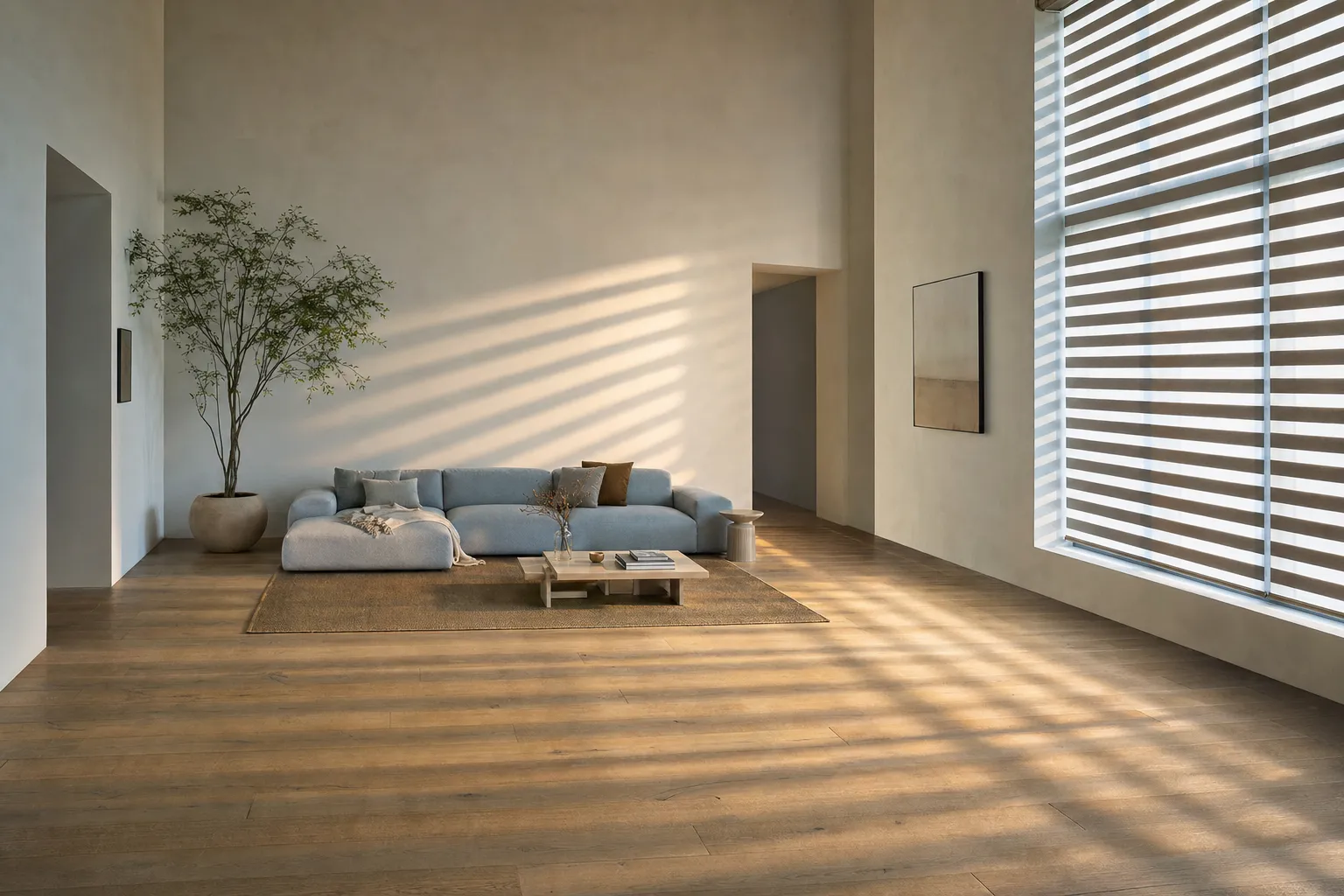
There are six mechanisms, and the choice is decided by the room rather than by taste. A roller is one flat plane and the cleanest thing on a modern window. A zebra alternates sheer and solid bands so one blind covers day and evening. A venetian tilts, so it aims light instead of only blocking it. A roman gathers into fabric folds and is the only one that makes a window read as furnished. A vertical hangs in vanes and is the answer for a sliding door. A cellular traps air in its honeycomb and is the one that changes what a room costs to heat.
9 min readUpdated
ByAlex KikLead installer & window covering specialist
Start from the window, not the catalogue
Almost every bad window covering starts the same way: somebody chose a product they liked the look of, then tried to make it do a job it is not built for. So before the list, three questions that decide most of it.
What is the actual complaint — glare, heat, being overlooked by day, being overlooked at night, or a room that will not go dark? Those are five different problems and only one product solves more than two of them at once.
How deep is the reveal? It decides whether an inside mount is possible at all, and whether a blackout blind can have side channels.
How wide is the opening? Width is what eliminates options fastest.
Roller shades
One flat plane of fabric on a tube. The cleanest line you can put across glass, and the most fabric choice of any product — from a 10% open screen that keeps the view to a full blackout.
Wins at: large modern windows, condos, anywhere you want the covering to disappear when it is up. Loses at: partial positions. It is up or down; there is no angle.
Zebra and day-night blinds
Alternating sheer and solid bands on one roller, so the two layers slide past each other. Everything between clear view and full privacy is available.
Wins at: daytime privacy without losing daylight — the narrow-lot front room problem. Loses at: night privacy with the lights on, where the bands reverse and show silhouettes.
Venetian blinds — aluminium, wood, faux wood
Horizontal slats you can tilt as well as raise. The only common product that lets you aim light rather than remove it, which is a genuinely different capability: you can bounce daylight onto a ceiling and keep the room bright while killing the glare at eye level.
Wins at: precise control, small windows, kitchens and bathrooms in faux wood. Loses at: dust. More surfaces, more cleaning. Real timber and steam are a slow-motion argument, so wet rooms get faux wood.
Cellular and honeycomb shades
Fabric folded into cells that trap air against the glass. The only product in common use whose main argument is thermal rather than visual.
Wins at: cold rooms, north walls, and anywhere the complaint in February is the draught coming off the window rather than the light coming through it. Many run top-down as well as bottom-up, which gives you privacy at eye level and daylight above it. Loses at: looking like anything. The face is plain, deliberately.
Roman shades
Fabric that folds into horizontal pleats as it rises. The most textile-looking option that still operates like a blind.
Wins at: rooms where a flat panel reads cold — bedrooms, dining rooms, anywhere the window should feel furnished. Loses at: view. The folds stack over the top of the glass, so a raised roman still covers part of the window.
Vertical blinds and drapery
Both stack sideways rather than upwards, which is why both are still the right answer for very wide openings and patio doors. Verticals tilt as well as draw; drapery gives the best night privacy of anything here when it is lined and the returns are wrapped to the wall.
Wins at: width, patio doors, full-height glass. Loses at: verticals swing in a draught and carry a dated reputation; drapery needs wall to stack onto, which a lot of modern rooms do not have.
The short version
If the room must go dark, you are choosing between blackout roller with channels and a lined roman. If the room is too bright but you want the view, you are choosing an openness factor on a screen fabric. If the room is cold, cellular. If the window is very wide, vertical or drapery. If you want to aim the light rather than block it, venetian.
And if two of those are true at once, the answer is usually two products on one window rather than one product doing both badly.
Inside mount or outside mount
The choice is made once, at the measure, and it changes more than the look.
Inside mount sits within the reveal. It looks built in, keeps the sill clear and shows off a window worth showing. Every inside-mounted blind has to be cut narrower than the opening — three to six millimetres a side — or it would bind, and that clearance is a slot of daylight. On a screen fabric nobody notices. On a blackout in a bedroom it is the whole problem.
Outside mount hangs on the wall above the opening and overlaps it on all sides. It kills the side gaps, it makes a small window look larger, and it covers a reveal that is out of square. It also sits proud of the wall and covers the trim, so on a window with mouldings worth seeing it is the wrong answer.
Reveal depth decides it more often than taste does. Under about 50mm and most products cannot sit inside at all; a zebra needs more again because its fabric wraps the tube twice.
What each product costs you in stack
Every covering parks somewhere when it is open, and that parked bulk is the thing people forget to picture.
- Roller and zebra — smallest of all. The tube and a slim cassette, a few centimetres at the head.
- Cellular — very small when compressed, which is why it suits a window you want completely clear.
- Venetian — roughly a tenth of the drop in slats, more on a 63mm slat. A visible band at the top.
- Roman — about a fifth of the drop in folds, more if hobbled. The largest of the horizontal products.
- Vertical — nothing at the top; a hand’s width at one or both ends instead, which is why it is the one that works on a door.
On a short, wide window over a sink, the difference between a roller and a roman is the difference between seeing the garden and not.
Layering, and when one window needs two products
The most common mistake is asking one blind to solve two problems. Softness and total darkness pull against each other; view and privacy pull against each other at different times of day.
Two products on independent brackets in the same opening solves both cleanly, and it is less expensive than most people assume because the second one is usually a plain roller.
- Screen roller behind a roman. Glare control by day, texture always, and the roman never has to be lowered to fix the sun.
- Blackout roller behind anything. The reliable way to get a dark bedroom while keeping a window that looks like a room rather than a hotel.
- Sheer and solid on one track. What a zebra does inside one fabric, which is why a zebra is often the cheaper way to reach the same place.
If a room needs two of the answers in the short version above, price the pair before compromising on one.
Motorization, briefly
Worth it for windows you cannot reach, for a bank of blinds that should move together, and for any room where the sun problem happens while you are out.
The practical questions are power and noise. A battery inside the tube runs for months and has to be recharged, which means reaching the blind — think about that on a window above a stairwell. Hardwiring is neater, needs an electrician, and is far easier before the drywall than after. And every motor is audible, which nobody minds in a living room and everybody minds in a bedroom at six in the morning.
Motorizing one easily-reached blind is a preference rather than an upgrade, and we will say so.
Which room usually gets which
A shortcut, with the reasoning attached so you can disagree with it.
Bedroom. Blackout roller with side channels if the room genuinely has to be dark; a lined roman if it mostly has to be dark and has to look like a bedroom. The fabric is about sixty per cent of the result and the perimeter is the rest, which is why a blackout blind with a gap at each side disappoints people who paid for the fabric.
Living room. A screen roller or a zebra, chosen on openness factor rather than colour. The question is what you want at four in the afternoon, not what you want at midnight.
Home office. Venetian if the glare is at eye level and the room is not bright to begin with; zebra if you want to keep the view and lose the beam.
Kitchen. Faux wood venetian or a PVC roller, because both wipe. Fabric over a hob ages faster than anyone expects.
Bathroom. Faux wood or PVC again, and nothing that holds damp in a fold.
Patio or sliding door. Vertical or drapery, because both stack sideways and leave the door usable.
Nursery. Whatever else is true, cordless — and the blind’s fabric matters less than where the cot is. Move the cot away from the window first.
Five questions worth asking any quote
- Inside or outside mount, and why that one? A quote that does not say has not measured the reveal.
- What is the total drop including the stack? The number that decides how much window you keep.
- Is it cordless, and if not, what holds the cord? A tensioner is a bracket, and a bracket can be removed by whoever repaints.
- Who installs it? The person who measured and the person who fits should be the same person, or the measurement has been handed over twice.
- What happens if it does not fit? You never took the measurement, so you cannot have got it wrong.
Measuring: what a professional does that a form cannot
Every online retailer asks for a width and a drop. Two numbers describe a rectangle, and very few windows are one.
Three measurements each way, and the tightest one wins. Width at the top, middle and bottom; drop at the left, centre and right. A century semi commonly varies half an inch between the top and the bottom of the same opening, and a blind cut to the average binds at the narrow end.
Squareness, separately. Measure both diagonals. If they differ, the opening is a parallelogram, and that decides inside versus outside mount before anything else does.
Depth, before the fabric conversation. How far back the glass sits determines whether a blind can mount inside at all, whether a cassette fits, and whether a zebra is even possible.
Obstructions. A crank handle on a casement, a deep sill trim, a radiator below, an alarm sensor in the corner. Each one changes the mount or the roll direction, and none of them appears on a form.
Which way it opens, and which way you walk. Especially on a door.
This is not an argument that measuring is hard. It is an argument that it takes somebody standing in the room, which is why the visit is free.
What a written quote should contain
You should be able to read a quote a week later and know exactly what you agreed to. Ours is itemised per opening, and these are the lines worth checking on anybody’s.
- The room and the window, named, so you can walk the house with the quote.
- Mount type per opening — inside or outside — not a blanket note.
- The product, the fabric or slat, and its finish, by name rather than by number.
- The control: cordless, wand, chain, or motor, and if motor, how it is powered.
- Who installs, and whether that is the person who measured.
- What happens if it does not fit.
A quote that gives one total for a whole house is not a quote, it is a number.
Two things worth ignoring
“Energy-saving” claims on ordinary fabric. A cellular shade genuinely traps air and genuinely slows heat loss off the glass. A standard roller does very little, and the difference is the cell, not the marketing.
Fabric names. Every supplier renames the same handful of base cloths. What tells you how a screen behaves is its openness factor and its colour, both of which are numbers you can compare. The name is not.
Questions
Still asked
What is the difference between a blind and a shade?
In ordinary use, a blind has slats or vanes you can tilt and a shade is a continuous panel that goes up and down. The trade uses the words loosely and so do manufacturers, so it is safer to describe what you want the window to do than to name a category.
Which type is best for a bedroom?
Anything opaque, plus attention to the edges. A blackout roller with side channels is the most complete answer; a lined roman gets you most of the way with more texture. The fabric is roughly sixty per cent of it — the perimeter is the rest.
Which type is cheapest?
Aluminium venetians and basic rollers sit at the bottom of most ranges, but the spread inside one product type is wider than the gap between types. Fabric choice moves the number far more than mechanism does.
What works on a very wide window?
Vertical blinds and drapery handle width best because they stack sideways. Wide rollers are possible up to the point where the tube deflects, after which the opening gets split into two blinds on one bracket line.
About this guide
Alex Kik, Blinds Company's Lead installer & window covering specialist, writes from the same questions encountered while measuring and fitting Toronto and GTA homes. Each guide names the trade-offs that can be defended at the window and leaves out prices, ratings and credentials that have not been confirmed.
The product this one is about: Zebra blinds
Read it all and your window is still the exception? Describe it on the phone — that is the fastest way to an honest answer.
Book
Let's measure your light.
We come to you, measure at your own windows, and go through fabrics and fits together. The visit costs nothing.
$99 off when you order three or more blindsApplied to your written quote at the measure.
Rather just talk?(437) 782-5452Open 8am–9pm, 7 days