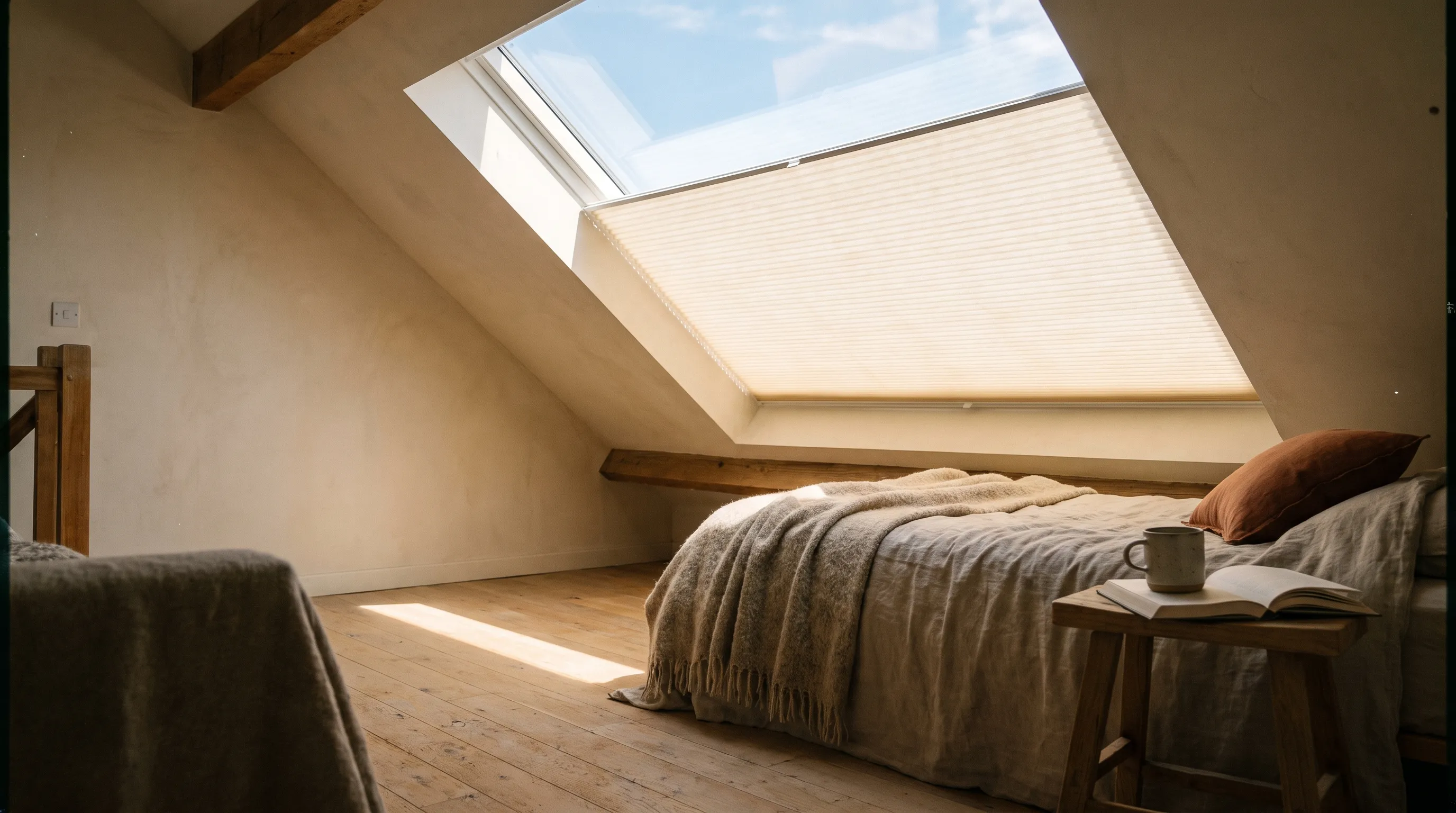
Skylight blinds
Blinds for roof glass and sloped windows, held against the glass by side channels rather than by gravity. A different engineering problem from every other window in the house, and the one where an ordinary blind physically cannot work.
Blinds Company · Rated 4.8 out of 5 on Google
Free in-home measure · open 8am–9pm, 7 days
In short
A skylight blind runs in side channels that hold the fabric against sloped or overhead glass. That is the whole difference: every ordinary blind stays flat because gravity pulls it down against a vertical window, and on a roof light gravity pulls it away instead. Roof glass also gains far more heat than a wall window of the same size, which is usually the reason people ring rather than privacy or light.
Book
Let's measure your light.
We come to you, measure at your own windows, and go through fabrics and fits together. The visit costs nothing.
$99 off when you order three or more blindsApplied to your written quote at the measure.
Rather just talk?(437) 782-5452Open 8am–9pm, 7 days
The short version
Is this right for your window?
Yes — if the room is one of these.
- Rooms that overheat under roof glass in summer
- Loft bedrooms that never get properly dark
- Stairwells and landings lit from above
Where it is wrong is below, and that half is the useful one.
And this is what you would be getting.
- 01
- Side channels that hold the fabric to sloped glass
- 02
- Blackout and solar-screen fabrics
- 03
- Pole-operated or motorized
- 04
- Made for the specific roof window model
In a room
What skylight blinds look like once they are up.
The product, not our installations — a gallery of rooms we did not fit would be somebody else's portfolio with our name on it.
The problem is gravity, not the fabric
Every ordinary blind in a house works because it hangs. Fabric under its own weight falls straight down, and a vertical window is straight down, so the two agree and the blind lies flat against the glass.
Turn the window through forty-five degrees and they stop agreeing. The fabric still falls plumb; the glass now leans away from it. The blind ends up suspended in the room with a widening wedge of air between it and the pane, and at the bottom of the window that wedge can be a hand’s width.
That is the entire reason a skylight blind is a different product. It has side channels — slim tracks down both sides of the window — and the edges of the fabric run inside them, so the blind is physically held to the slope rather than left to hang. The mechanism above and below is otherwise ordinary.
Two things follow from this that people should know before buying.
Anybody selling a plain roller for a sloped window is selling something that will not work. It is not a matter of quality or price. It is geometry.
The channels are not an upgrade, they are the product. The cost of a skylight blind is largely in the tracking and the fitting, which is why it is not priced like a roller of the same size.
Heat is usually the real reason
People ring about skylights in July, and almost never about privacy.
Roof glass takes the sun differently from a wall window. Through the middle of the day the sun is high, so it strikes a horizontal or shallow-pitched pane close to straight on while a south-facing wall window is receiving it at a glancing angle. The same area of glass therefore admits substantially more solar energy through the roof than through the wall.
The practical result is familiar: a loft, a converted attic or a kitchen extension with roof lights becomes the hottest room in the house, and stays hot into the evening because the heat has gone into the fabric of the room.
What a blind can do about it is real but bounded. A blind sits on the inside, so the energy has already come through the glass before the fabric sees it. It stops that energy becoming light and glare in the room, and a reflective-backed fabric returns some of it back out through the pane — but a portion has already been absorbed by the glass itself.
So the honest ranking, and we will say this at the visit rather than after:
External shading beats any internal blind for heat, because it stops the energy before it arrives. If the roof light is accessible and heat is the whole problem, an external awning or solar-screen is the better engineering answer and we will say so.
A reflective internal blind is the best interior option and makes a substantial difference to comfort.
A dark decorative fabric looks lovely and does the least for heat, for the same reason a dark screen does on a wall window: it absorbs and re-radiates inward.
Getting a room genuinely dark
The other half of the work, and the one where roof blinds outperform.
A loft bedroom with an uncovered roof light is the brightest bedroom in a house at 5am in June, because the sky is directly overhead and there is nothing between the two. Curtains cannot be hung on a slope. This is the single most common reason for a blackout skylight blind and it is the case where the product is transformative rather than incremental.
It works better than a blackout on a wall window because the same channels that solve the gravity problem also enclose the fabric’s edges. On a vertical window, side channels are an optional extra that many people skip; on a skylight they are inherent, so the light path down each side is closed by design.
What remains is the head and the foot. A well-fitted blind closes both with a cassette at the top and a bar seating into the bottom channel, and the difference between a good fit and an adequate one on a roof light is almost entirely there.
Which fabric, for which problem
Blackout with a reflective backing. The default for a bedroom. Dark on the room side, silver or white on the glass side so it reflects rather than absorbs. Does both jobs — the room goes dark and the heat gain drops.
Solar screen. For a kitchen, a stairwell or a landing where you want the light and not the glare. Keeps the sky visible, cuts the harshness.
Cellular. The one we suggest where winter matters as much as summer. The cells trap air against the glass and roof glass is where a house loses heat fastest at night, because warm air rises straight to it. In a converted loft used year round this is often the right answer even though it is the dearest.
Anything decorative. Fine on a landing. Not on the roof light in the room somebody sleeps in.
Reaching it
The unglamorous constraint that decides whether the blind gets used.
Within reach or close to it. A telescopic pole with a hook. It works, it costs almost nothing, and it lives in a cupboard. Be honest with yourself about whether it will be fetched twice a day.
Above about three metres, or in a room used daily. A motor. On a roof light this is a stronger argument than on a tall wall window, because a roof blind needs adjusting with the sun rather than once a day, and nobody adjusts anything with a pole four times.
Where the roof window has its own control rod — some manufacturers’ units do — we work with what is there rather than adding a second system.
Power is the practical question above a stairwell: a battery motor has to be recharged, and if getting a cable to the blind is itself a ladder job then hardwiring during any other work is far cheaper than doing it later.
What we need to know before quoting
More than for any other product, because roof windows are made to models rather than to sizes.
The brand and model code. Usually on a plate inside the frame, visible when the window is open, sometimes on the glass edge. A tracked blind made for that unit fits precisely and clips to the frame without fixings into plaster.
The pitch. How steeply the window leans. It changes the channel specification and, on a shallow pitch, whether the bottom bar needs weighting to keep the fabric taut.
The reveal. Roof windows usually sit in a plastered shaft that flares — vertical at the top, angled at the bottom, or splayed on all four sides. The blind fits the window, not the shaft, and knowing the shaft’s shape decides whether it will be visible around the blind.
The reach. Measured to the bottom of the window from the floor, standing where a person would stand.
None of that can be supplied over the phone reliably, which is why this is a product we quote after a visit rather than before.
Where we would tell you not to bother
A roof light over a bathroom. Steam rises, and a blind against roof glass sits in the wettest air in the house. If the room is properly ventilated it is fine; if it is not, the blind will show it.
A small roof light in a hallway. If nobody is under it and nothing is fading, it is doing its job by being uncovered.
A north-facing roof light in a cool room. It is not a heat problem, it is not a glare problem, and covering it removes the daylight it was cut into the roof to provide.
Last updated .
Roof glass is measured differently and reached differently. It needs a visit, not a form.
Our commitment
We measured the slope and the reach, so a blind that sags away from your glass is ours.
If it does not fit, we remake it
You never held the tape.
Nothing owed before you agree
No deposit, no card.
Licensed and insured
Both, before we come in.
Your date, in writing
Set at the quote. It does not move.
We will tell you not to buy
If a stock size does it, you hear so.
Cordless where a child sleeps
Standard, at no extra charge.
Reviews on Google
What people said afterwards.
Rated 4.8 out of 5 — the ones below are quoted in full, with a link to check each on Google.
I'm thoroughly impressed with Blinds Company. From the initial consultation to the final installation, their team delivered exceptional service, expertise, and quality.
Oleksandr StakhurskyiHighly recommend Nick and his team. They installed blinds in my house. Looks wonderful, cheers
Timur Shafikov
Real names, real dates, and a link to all of them — including the ones we would not have picked.
Read them on GoogleQuestions
Before you book
Why can't I just use a normal blind on a skylight?
Because an ordinary blind hangs. It stays flat against a vertical window because gravity pulls it down the glass; on a sloped or overhead window gravity pulls it away from the glass, so it hangs in mid-air and the gap between the fabric and the pane grows with the angle. A skylight blind solves it with side channels that physically hold both edges to the frame.
How much heat does a skylight actually let in?
Considerably more than a wall window of the same size, because the sun is more nearly overhead for more of the day — roof glass takes near-direct sun through the middle of the day when a south wall window is getting it at a steep angle. That is why a room with a modest skylight can be the hottest room in a house, and why the reason people ring about roof blinds is usually heat rather than light.
Can a skylight blind make a loft bedroom dark?
Yes, and better than most blinds can on a wall window — because the channels that hold the fabric to the slope also enclose its edges. A blackout skylight blind in proper channels is one of the darkest results available anywhere in the house. The remaining leak is at the head and the foot rather than the sides.
How do I reach it?
A telescopic pole for anything within about three metres of the floor, or a motor above that. Poles are perfectly good and they are used far less often than people intend, so on a roof light in a room used daily we would rather quote a motor and have it actually get used. Some roof windows have a manufacturer's control rod already, which we work with.
Does it fit any skylight?
Tracked blinds are made to the specific roof window, so we need the brand and the model code — usually on a plate inside the frame, visible when the window is open. Where a skylight is a builder's fixed unit with no brand, the blind is made to the measured opening instead and the channels fix to the plaster reveal rather than to the frame.
Will it help in winter as well?
Yes, and this is the part people do not expect. Roof glass loses heat quickly at night — warm air rises straight to it — so a room with a skylight can be warm in the day and cold at night for the same reason. A cellular skylight blind closed at dusk makes a measurable difference to that, and it is the one case where we would put a honeycomb fabric overhead.
Not this one?
The rest of the range.
Each of these is the wrong answer somewhere, and its page says where. That is usually the faster way to find the right one.
If a room with a skylight is unbearable in July, that is a solvable problem — and the answer is not always a blind. Ring and describe the roof.