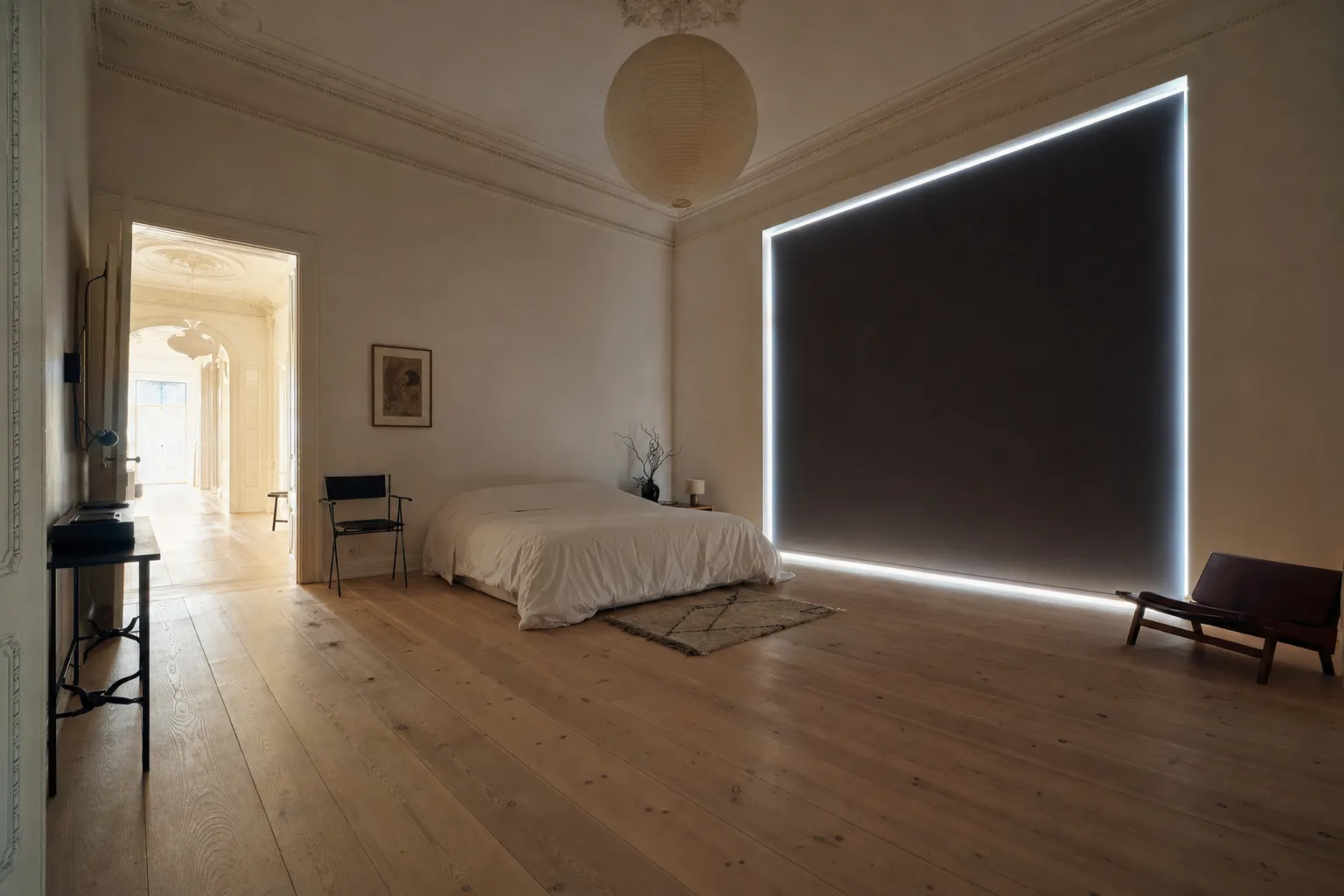
Blackout blinds
An opaque panel is only part of it. Most of the light that wakes you at five in the morning comes around the edges, not through the fabric, so the edges are what we build.
Blinds Company · Rated 4.8 out of 5 on Google
Free in-home measure · open 8am–9pm, 7 days
In short
Blackout blinds are made to your exact opening and installed across Toronto and the GTA. They suit bedrooms on an east wall, where sunrise ends the night in june. The in-home measure is free and carries no obligation.
Book
Let's measure your light.
We come to you, measure at your own windows, and go through fabrics and fits together. The visit costs nothing.
$99 off when you order three or more blindsApplied to your written quote at the measure.
Rather just talk?(437) 782-5452Open 8am–9pm, 7 days
The short version
Is this right for your window?
Yes — if the room is one of these.
- Bedrooms on an east wall, where sunrise ends the night in June
- Nurseries where a daytime nap has to survive full daylight
- Media rooms, where stray light lands on the screen and takes the contrast
Where it is wrong is below, and that half is the useful one.
And this is what you would be getting.
- 01
- Opaque fabric, no pinholes, no light bleed through the panel
- 02
- Side channels where the reveal will take them
- 03
- Sealed cassette at the head instead of an open roll
- 04
- Cordless as standard in any room a child sleeps in
In a room
What blackout blinds look like once they are up.
The product, not our installations — a gallery of rooms we did not fit would be somebody else's portfolio with our name on it.
Fabric is about sixty per cent of the job
People buy a blackout blind, install it, and are surprised to still be awake at 5:20 in June. The fabric did its job. The problem is that every roller blind must be slightly narrower than the opening it sits in, or it would bind on the way up, and that clearance is a slot of daylight down each side. At dawn, with the sun low and directly on that wall, the slot is bright enough to read by.
So the products that actually darken a room are the ones that address the perimeter: side channels that the fabric runs inside, a cassette that closes the gap at the head, and enough overlap at the sill. None of that is exotic. It is just the part that gets left off a quote to make the number look better.
What we check at the measure
The reveal depth decides everything. Channels need somewhere to land, and a shallow reveal — common in condos and in anything with a deep sill trim — may not have it. In that case the honest options are an outside mount that overlaps the whole opening by a good margin, or accepting a visible edge line. We will tell you which one your window is, and if the answer is that you cannot get true blackout in that opening, you will hear that too.
We also look at where the light is actually coming from. An east bedroom with a streetlight outside has two different problems and they are not solved by the same thing: sunrise is a perimeter problem, and a streetlight at head height is often a top-of-blind problem.
Blackout without the equipment look
Blackout is a lining, not an aesthetic. If you want the room dark but you do not want the room to look like a hotel, the lining goes behind something else:
- Roman shades with a blackout liner keep fold and texture on the face.
- Cellular shades with a foil liner block the light and slow the heat loss off the glass at the same time, which is worth having on a north wall in February.
- Drapery with a blackout lining and the returns wrapped to the wall handles the perimeter by geometry rather than by hardware.
Each of those trades a little darkness for a lot of softness. Which one is right depends on whether the room is for sleeping or for living, and we would rather ask that question than assume it.
Children’s rooms
Cordless is our default in any room a child sleeps in, and there is no upcharge for it. A spring mechanism or a motor replaces the chain entirely, so there is nothing hanging at a height a child can reach. Where an existing blind in the house still has a cord, a tensioner fixed to the wall is the minimum.
Made to your opening
Every panel is cut to the measurement taken in your home, not rounded to the nearest stock width and trimmed on site. On a blackout blind that difference is not cosmetic — a blind that is a quarter-inch narrow gives you a quarter-inch of daylight down each side for the next decade.
The measure is free, it takes under an hour, and it costs you nothing if you decide the answer is a stock size from a big-box store. Sometimes it is.
Blackout, room-darkening, dimout: the words are not interchangeable
Three terms get used as if they were one, and the gap between them is where most disappointment comes from.
Blackout describes a fabric that passes no light at all. Hold it up to a bare bulb and you see nothing through it — not a glow, not a hot spot. It gets there by being either a tight weave with an acrylic foam backing, or a fabric with a thin vinyl layer laminated inside it.
Room-darkening passes some light and is honest about it. A dense weave with no backing will look opaque on the roll and still glow at the window at noon. It is a perfectly good product for a living room. It is not what you want over a bed.
Dimout is a marketing word with no fixed meaning. When you see it, ask which of the first two it is.
There is a test you can do with a sample in your hand, and we bring samples so you can do it: put it flat against the window in daylight and look at it from 30cm away, in a room with the lights off. Blackout fabric goes the colour of the fabric. Anything else goes the colour of the sky.
The important sentence, though, is that none of this describes the blind. A genuine blackout fabric in an assembly with a 5mm gap down each side gives you a dark room with two bright lines in it. The fabric spec and the room result are different claims, and only one of them is worth paying for.
The room that has to go dark in the middle of the day
Night shift is a different brief from a bedroom, and it is worth saying so because the usual advice is written for sunrise.
At three in the afternoon the sun is high and strong, the whole wall is lit, and every weakness in the perimeter shows at once — not just the side gaps, but the sliver above a top-mounted roller and the line where the fabric stops short of the sill. Sunrise forgives more than midday does, because at dawn the light is coming in almost horizontally and a decent overlap at the sides catches most of it.
For a daytime sleeper the answer is usually the full assembly rather than a better fabric: channels down both sides, a cassette closing the head, and the blind running past the sill rather than to it. If the reveal cannot take channels, an outside mount with a generous overlap on all four sides gets closer than most people expect, and it costs less than the hardware.
We would rather set that expectation at the measure than after installation. A room can be made properly dark. It just takes the perimeter seriously, and the quote has to say so.
Side channels: what they cost and what they buy
If the perimeter is where a blackout wins or loses, side channels are the piece of hardware that settles it, and they are almost never offered unless you ask.
A channel is a slim aluminium section fixed to the reveal or the wall on each side of the blind. The edge of the fabric runs inside it, so there is no line of sight from the room to the glass at the sides. On a coated blackout in a properly channelled opening, the difference between the blind down and the lights off is close to genuine darkness rather than “dark enough”.
What they cost you is threefold, and all three are worth knowing before you commit.
Depth. Channels need the blind to sit far enough back that the fabric can enter them, so on a shallow reveal the whole assembly moves onto the wall face — which works, and looks like equipment rather than like a blind fitted to a window.
Friction. A fabric running in a channel does not free-fall. The blind is slower and needs a more deliberate pull, and a spring mechanism has to be tensioned for it. On a window operated many times a day that is a real change in feel.
Permanence. Channels are screwed to the reveal. Removing them later leaves fixings in the trim. In a rental or on original woodwork worth keeping, that alone can be the deciding fact.
Where they are unambiguously right: a bedroom for somebody who sleeps during the day, a nursery, a room with a projector, and any window where the alternative would be blackout curtains over the top of a blind that never quite worked.
Where they are usually not worth it: an ordinary bedroom used at night. The gain over a well-fitted outside-mounted blackout with a generous overlap is small, and the loss in feel and reversibility is not.
The gap at the top, which nobody mentions
Everyone talks about the sides. The head of the blind leaks more light than the sides do on most installations, and it is the one people are surprised by.
The mechanism has to sit above the fabric, so there is always a strip between the top of the cloth and the top of the opening. On an inside mount that strip is inside the reveal, above the glass, and light coming through the window travels down behind the blind and out into the room over the top edge — which is why a blackout can look perfect from the front and still put a soft glow on the ceiling.
Three fixes, in ascending order of effort.
Mount higher. The cheapest and most effective. Fixing the blind above the opening rather than inside it puts the head of the blind above the head of the glass, so there is no window behind the strip at all. This is why so many genuinely dark rooms have blinds that look slightly oversized.
A cassette. Wrapping the tube closes the path down behind the fabric. It needs depth, and on an inside mount it needs depth you may not have.
A pelmet or a deep fascia. Effectively a board across the front of the head. It is what a curtain pelmet has done for a century, and it works for the same reason.
If a room has to be properly dark, the order of operations is: mount high, overlap generously at the sides, then consider channels — not the reverse. Most rooms never need the third step if the first two are done deliberately.
Blackout in a place you cannot drill
Rentals, heritage trim, and steel frames all rule out the usual fixings, and this comes up often enough to be worth stating.
Perfect-fit frames. For uPVC double glazing with a rubber gasket, a slim frame clips into the bead around the glass and the blind lives inside it, touching the glass. No screws anywhere. Because the fabric sits inside a frame on all four sides, the light control is very good — better than a conventional inside mount — and it comes out when you leave, leaving nothing behind.
Tension fittings inside the reveal. Only sensible on narrow windows, and only where the reveal is square and sound. On an old opening they slip.
Free-standing over the recess. A blind on a batten fixed to a pelmet board that is itself held by removable fixings. Fiddly, and occasionally the only answer on protected woodwork.
What we would not do is fix a channel to original mouldings on a house where the trim is the point, and we will say so rather than take the order.
What it does to heat, in both directions
Nobody buys a blackout blind for thermal reasons and almost everybody notices the effect.
In July, on a west-facing window, a light-coloured blackout blind lowered before the sun comes around reflects a real fraction of the heat back through the glass before it reaches the room. A dark blackout blind absorbs it instead and re-emits much of it inward — the room still gets the heat, just later and more gently. Colour is doing that, not opacity, which is why the darkest fabric is not automatically the coolest room.
In February the effect runs the other way and comes with a caveat worth knowing. A well-fitted blind over a cold window creates a still pocket of air against the glass, which is genuinely useful insulation. It also means the glass runs colder than it otherwise would, and on an older window that is already prone to it, you can get more condensation on the pane, not less. If you have a window that streams in winter, say so at the measure — the answer is usually to leave a deliberate gap at the top, and it is easier to build that in than to retrofit it.
Last updated .
Dark is a perimeter problem, not a fabric problem. We will show you where yours leaks.
Our commitment
We chose the mount for the darkness you asked for, so a room that stays light is ours.
If it does not fit, we remake it
You never held the tape.
Nothing owed before you agree
No deposit, no card.
Licensed and insured
Both, before we come in.
Your date, in writing
Set at the quote. It does not move.
We will tell you not to buy
If a stock size does it, you hear so.
Cordless where a child sleeps
Standard, at no extra charge.
Reviews on Google
What people said afterwards.
Rated 4.8 out of 5 — the ones below are quoted in full, with a link to check each on Google.
Nick has delivered the greatest service as I recently moved in to my new townhome and needed to have blinds for all three floor windows. Not only the price was the best, but he accommodated all my requests in the process. Definitely worth every penny
Anton KovunovI was blown away by the exceptional customer service from Blinds Company! Their staff was knowledgeable, friendly, and helped me find the perfect blinds for my living room. The installation was quick and flawless. I highly recommend them!
Merdan Berdiyev
Real names, real dates, and a link to all of them — including the ones we would not have picked.
Read them on GoogleQuestions
Before you book
Why is my room still light with the blind fully down?
In order of likelihood: light over the top of the blind travelling down behind it, light around the two sides, then light under the bottom rail, and only last the fabric itself. Almost nobody guesses that order, which is why people replace a cloth that was never the problem. Stand in the room in the dark with the blind down and find the brightest edge — that is the one to fix.
Does a blackout blind help keep a room cool?
A little, and less than people hope. It stops sunlight becoming heat inside the room, which is real on a west window in July. But the fabric itself warms up and radiates inward, and a blind hanging inside the room is on the wrong side of the glass to stop much. If heat is the whole problem rather than light, the honest answers are outside the window, not inside it.
Will the room be completely dark?
With side channels on a window whose reveal can take them, close to it — dark enough that you cannot read by the light at noon. Without channels, expect a visible outline of daylight around the blind. We measure the reveal depth at the visit and tell you which of those two you are getting, before you order rather than after.
Why does my current blackout blind still let light in?
Almost always the gap between the fabric and the wall rather than the fabric itself. A roller has to be narrower than its opening to move, and that clearance becomes a bright line at sunrise. Fabric is roughly sixty per cent of the job; the edges are the rest.
Do side channels look industrial?
They are slim aluminium and they disappear into a deep reveal. On a shallow reveal they have to sit proud of the wall, which some people dislike. That is a conversation at the measure with the actual window in front of us.
Can you swap a blind that was never dark enough for a real blackout?
Yes, and it is one of the commonest replacement jobs we do — a blind sold as "blackout" that still lets the morning in. The upgrade is rarely just the cloth. We measure the opening fresh rather than reusing the old blind's dimensions, because those dimensions usually are the fault: a panel cut slightly narrow leaks a line of daylight down each side for its whole life. Nor does the new blind have to mount where the old one did — an inside mount that always glowed at the edges often comes back as an outside mount with a generous overlap, a darker result from the same fabric. The outgoing blind comes down at the installation and leaves with us.
Can I have blackout without losing the fabric I like?
Yes — blackout is a lining, not a look. A roman shade or a drapery panel can carry a blackout liner behind the face fabric, so the room goes dark and the window still reads as textile rather than as equipment.
Not this one?
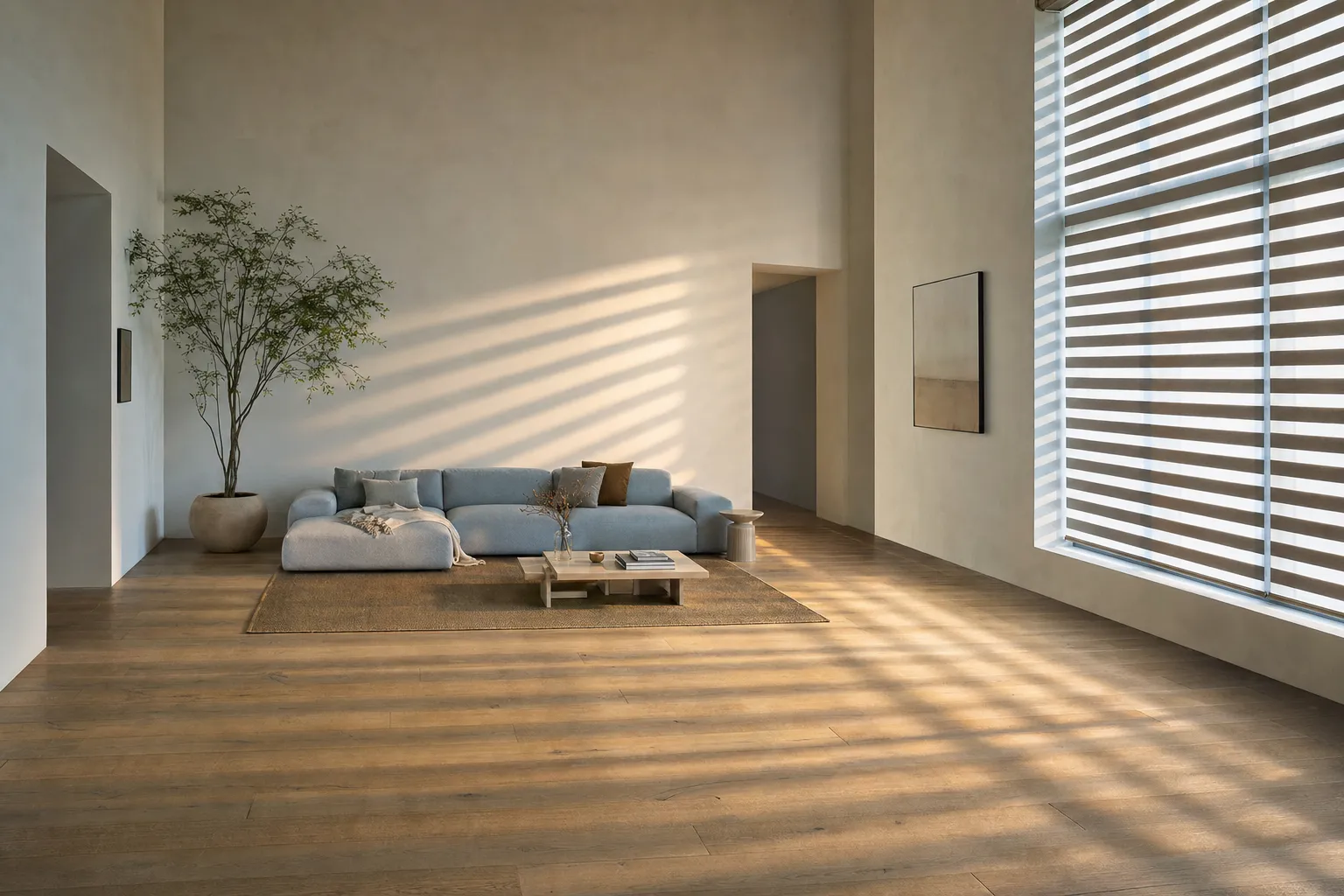
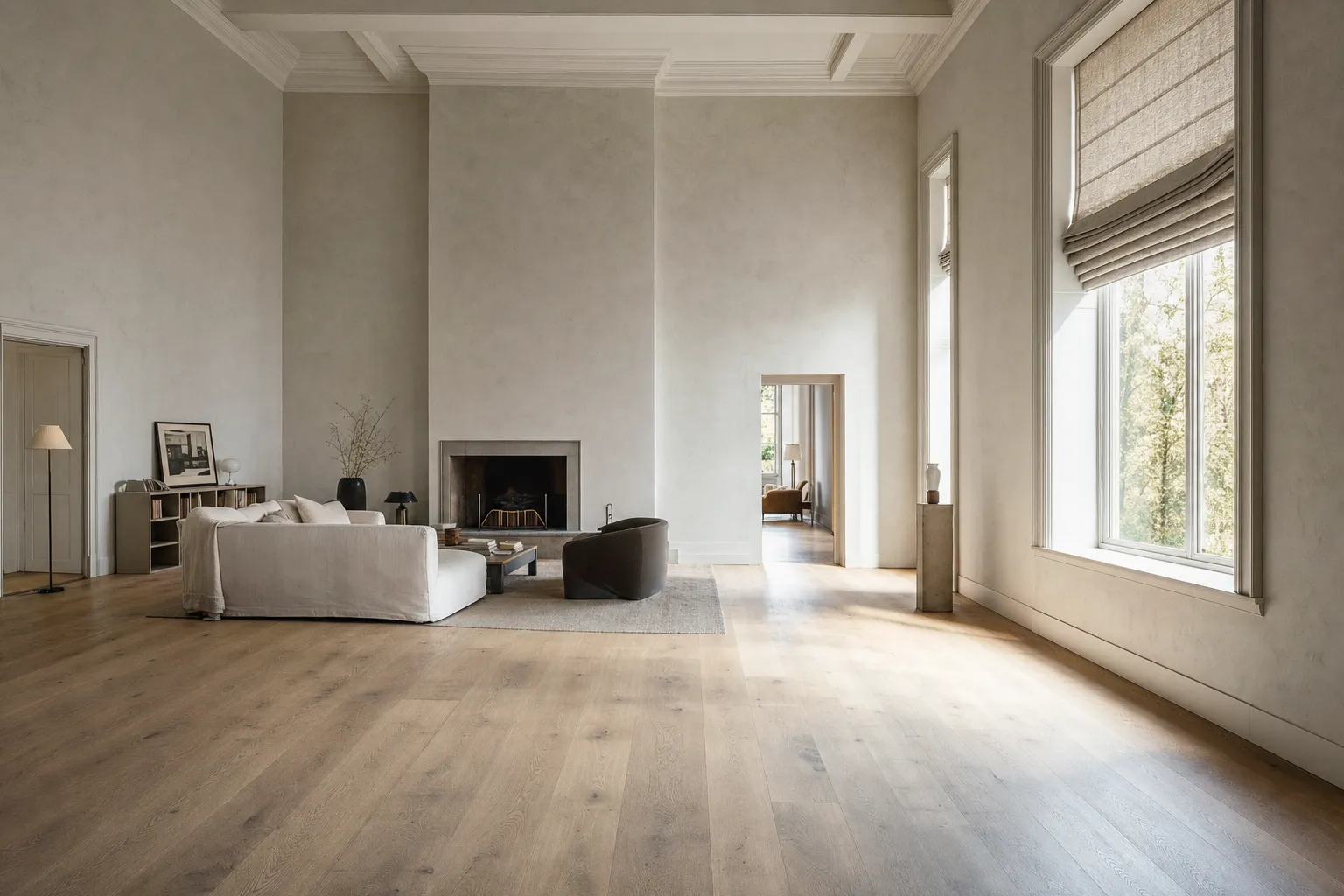
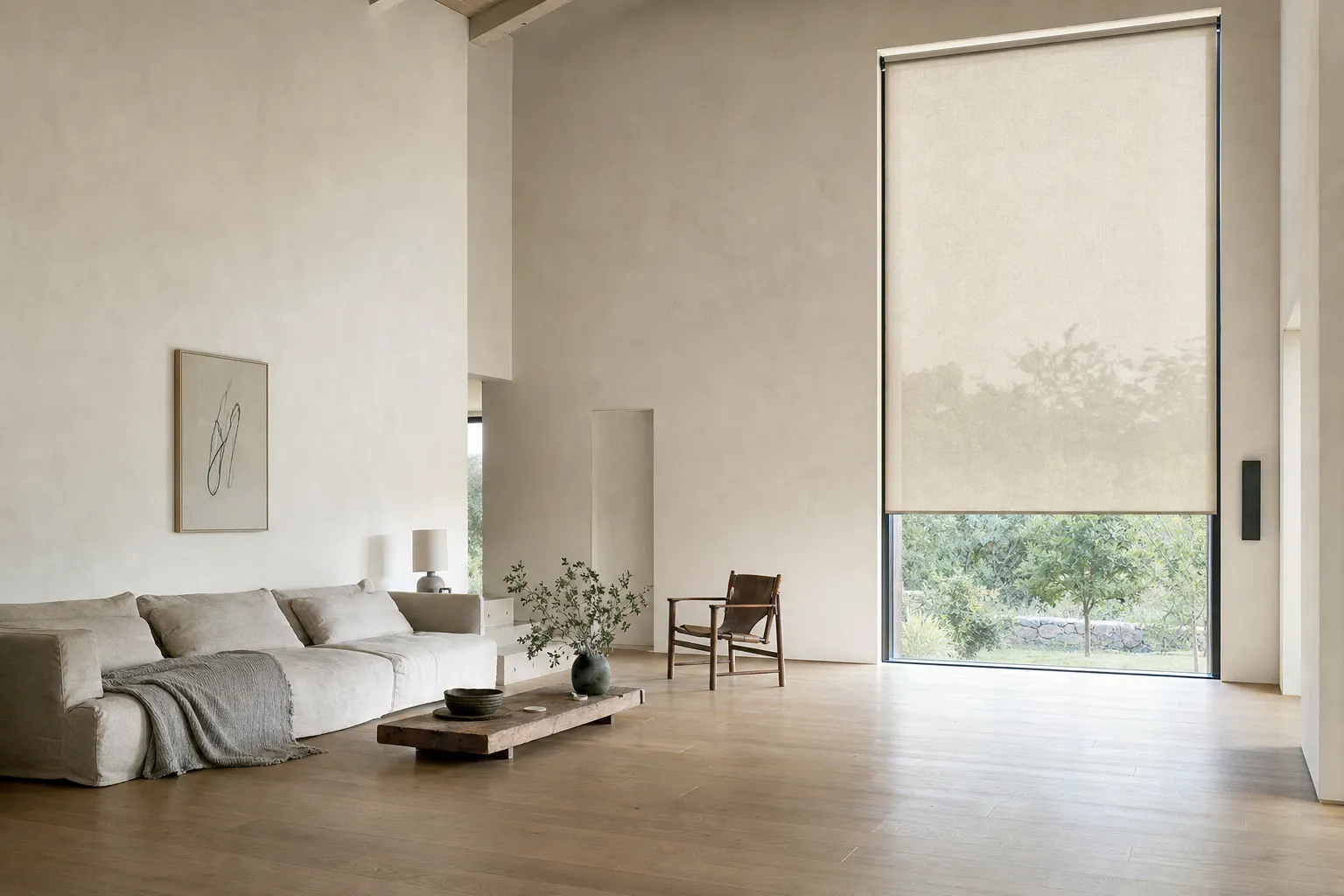
The rest of the range.
Each of these is the wrong answer somewhere, and its page says where. That is usually the faster way to find the right one.
If a blackout blind you already own is not working, describe the leak — top, sides or bottom — and the fix is usually smaller than a new blind.