
Curtains and drapery
Made-to-measure curtains and drapery, measured and hung by the same crew that fits the blinds. Two things they do that no blind can: stop the cold coming off an old window, and soften a room rather than fitting it.
Blinds Company · Rated 4.8 out of 5 on Google
Free in-home measure · open 8am–9pm, 7 days
In short
Curtains draw sideways and hang in folds, which gives them two capabilities no blind has. They close against the wall on both sides and at the floor, so they stop the draught coming off a cold window in a way a blind on brackets cannot. And they are the only window treatment that reads as furnishing rather than as equipment. What they cost you is glass: even fully open, the stack sits over part of the window, and on a narrow opening that is a real loss.
Book
Let's measure your light.
We come to you, measure at your own windows, and go through fabrics and fits together. The visit costs nothing.
$99 off when you order three or more blindsApplied to your written quote at the measure.
Rather just talk?(437) 782-5452Open 8am–9pm, 7 days
The short version
Is this right for your window?
Yes — if the room is one of these.
- Cold or draughty rooms, where a blind cannot seal
- Tall formal windows a blind would read as a flat panel
- Rooms that already have textiles and need the window to join in
Where it is wrong is below, and that half is the useful one.
And this is what you would be getting.
- 01
- Pinch pleat, wave, eyelet and tab headings
- 02
- Lined, blackout-lined or interlined
- 03
- Tracks, poles and motorised tracks
- 04
- Measured to the track, not to the glass
In a room
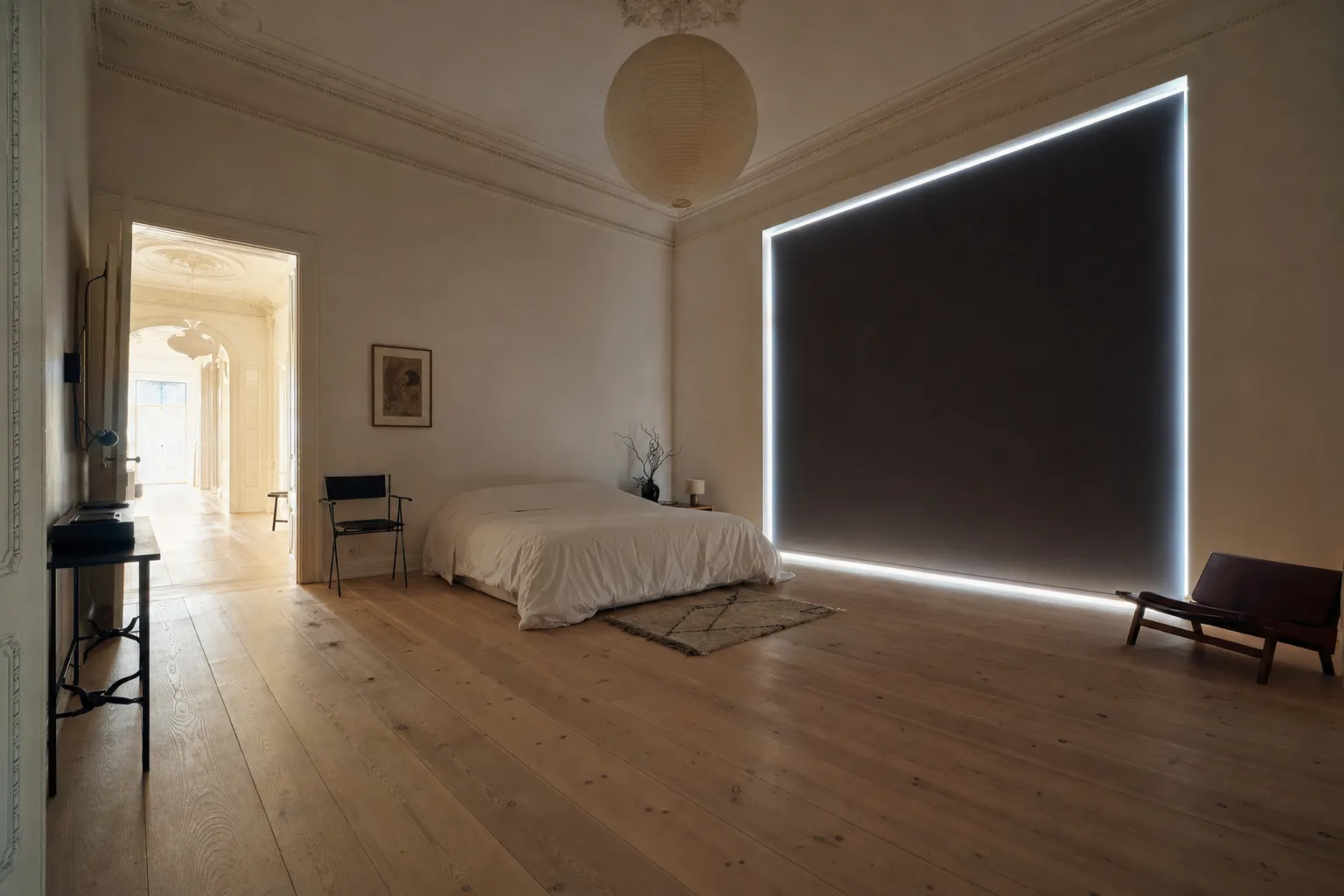
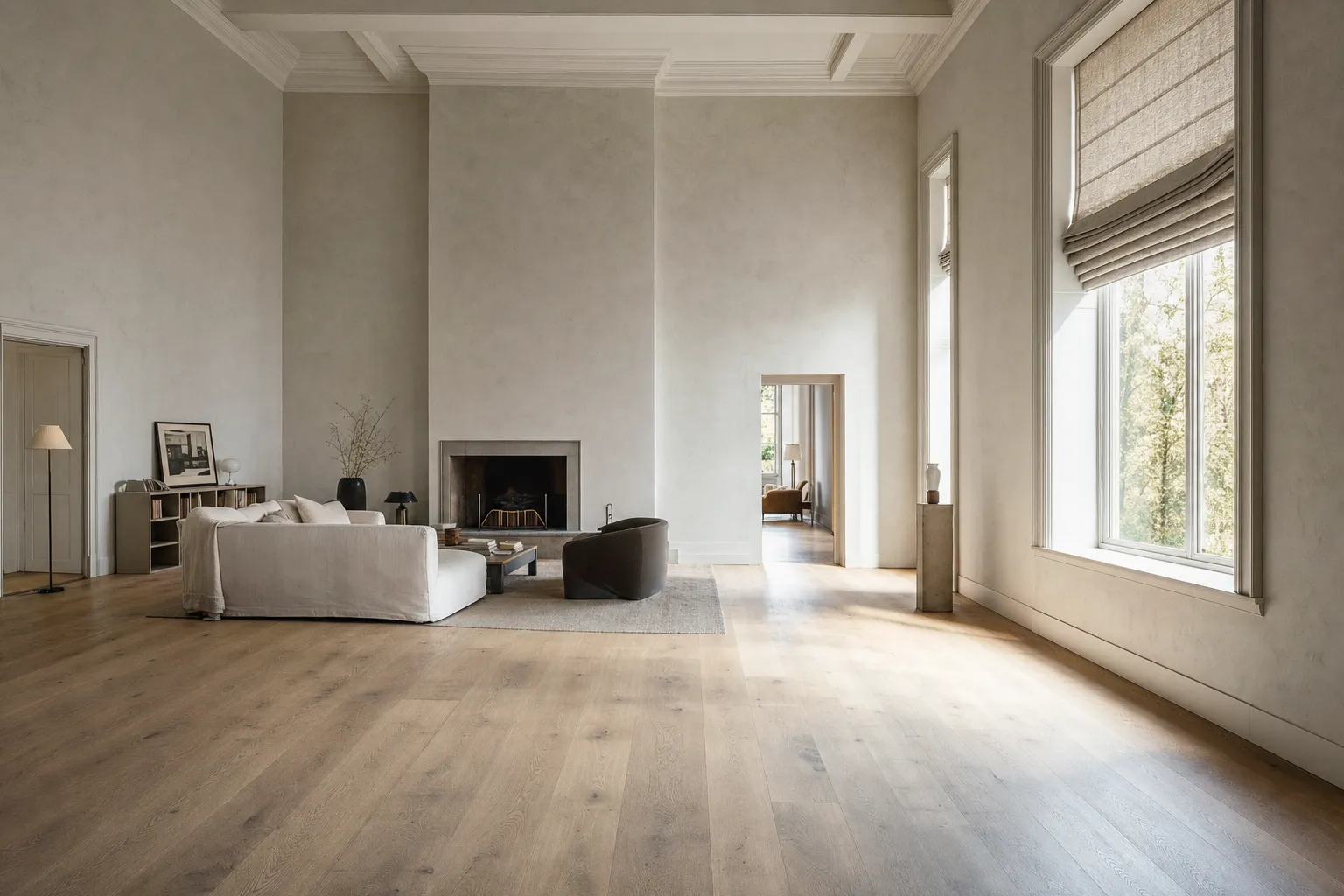
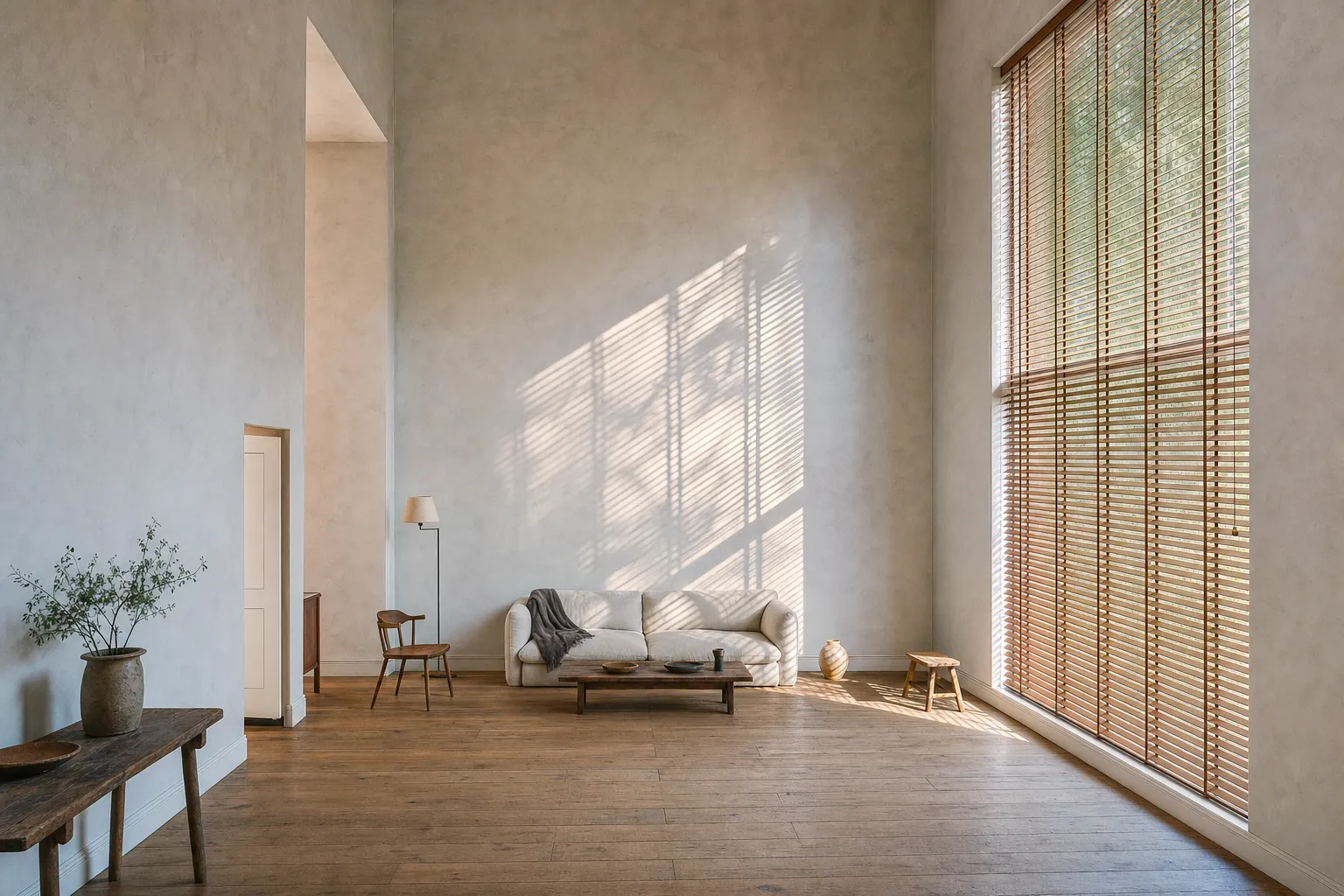
What curtains and drapery look like once they are up.
The product, not our installations — a gallery of rooms we did not fit would be somebody else's portfolio with our name on it.
What a curtain does that a blind cannot
Two things, and everything else on this page follows from them.
It seals. A blind hangs from brackets inside or above an opening, with a clearance gap down each side because it has to run. Air moves through those gaps freely. A curtain closes against the wall on both sides, overlaps itself in the middle, and reaches the floor — so the cold air falling off a cold pane has nowhere to go except back where it came from. On an old window that is the difference between a room that feels draughty and one that does not, and no fabric on a blind achieves it.
It softens. Every blind in our range is a flat plane or a stack of straight lines, and it reads as part of the building. A curtain hangs in vertical folds that catch light differently along their length, moves slightly when somebody walks past, and reads as furnishing. In a room with a sofa, a rug and textiles, the window either joins in or stays the one hard surface.
What you give up is glass. Even fully drawn back, a curtain sits somewhere — that stack takes up part of the wall and, if the track is not wide enough, part of the window. A blind rolls or stacks to almost nothing at the head. On a narrow opening in a small room, that trade goes to the blind almost every time.
The measurement is the track, not the window
This is the single most common mistake in curtains, and it is made before anybody touches fabric.
A curtain is not sized to the window. It is sized to the track, and the track is deliberately wider and higher than the opening.
Wider, by 15 to 25 cm each side, so that when the curtains are open they sit on the wall rather than over the glass. That overhang is the stack allowance, and it is what stops a curtain permanently covering a strip of window it should have cleared.
Higher, often by 10 to 15 cm above the opening, which does two things: it hides the top of the window frame, and it makes the window read as taller than it is. Hanging a track tight to the head of a window is the fastest way to make a room look lower than it is.
Then the fabric is cut to a multiple of the finished track width — the fullness — and that multiple is the next section, because it is where quotes diverge.
What “made to measure” actually changes
Worth setting out, because custom curtains and a ready-made pair from a shop look like the same object hanging on the same pole, and the price difference invites the obvious question.
Six things are cut to your window rather than to a standard, and each one is a place a ready-made compromises.
The drop. A ready-made comes in three or four lengths and you choose the nearest. Nearest is either short of the floor, which reads as a mistake, or pooling on it, which collects dust and gets stood on. Made to measure, the drop is taken from your track to your floor — and those two numbers differ across a single window in most older houses, which is why the hem is set to the longest point and levelled.
The width, which is not the window’s width. A curtain is sized to the track plus the returns plus the overlap in the middle, then multiplied by the fullness. A ready-made is sized to a pole length somebody guessed at. This is the difference between a pair that closes properly and a pair that meets in the middle and stops.
The fullness. The next section is entirely about this. A ready-made is what it is; yours is a number you choose.
The heading. Pencil pleat, pinch pleat, wave or eyelet, matched to the track and to the room rather than to what was in stock.
The lining. Chosen for what the room needs — plain, thermal, blackout, interlined — rather than whatever came sewn in.
The pattern match. On anything with a repeat, the two halves of a pair are cut so the pattern runs across the join and continues at the same height. A ready-made pair is cut from a roll wherever the roll happened to be.
Curtain installation is the seventh thing, and it is not a separate service we sell — it is the last step of what we made. The track goes up, the drop is checked against the finished floor rather than the subfloor, the curtains are dressed into their folds and left to hang. A pair that has never been dressed hangs flat for months, which is the commonest reason somebody thinks their fabric was a disappointment.
Fullness, which is the number nobody is told
A curtain’s cost is mostly cloth, and how much cloth is in it is a specification with a number. It is almost never on a quote.
1.5x track width. The curtain looks stretched. Folds are shallow and the fabric reads as a flat sheet with creases in it. This is what makes cheap curtains look cheap, and it is not the fabric’s fault.
2x. The standard for made-to-measure and what we quote unless told otherwise. Proper folds, hangs correctly, and the pattern is still readable across the width.
2.5x. Generous. Right for a formal room, for a sheer where the folds are the whole effect, and for heavy interlined curtains where the extra weight helps them hang.
The practical warning: two quotes for “made-to-measure lined curtains” can differ by a third on price and be describing genuinely different products, and the difference is usually here rather than in the cloth. Ask what fullness a number is based on before comparing anything.
Headings, and what each one is for
The heading is the top of the curtain — how the fabric is gathered onto the track or pole. It sets the look more than the fabric does.
Pinch pleat. Fabric hand-gathered into groups of two or three at fixed intervals, sewn permanently. The traditional heading and the most formal. Holds its shape indefinitely, needs 2 to 2.5x fullness, and is the one that reads as tailored.
Wave. A continuous S-curve running the width, held by a corded tape on a purpose-made track. Contemporary, very even, and it stacks tightly because the folds are uniform. It only works on a track — never a pole — and it is the heading that suits modern rooms and large glass.
Eyelet. Metal rings punched into the fabric, sliding directly on a pole. Casual, quick to draw, and the folds are deep and soft rather than crisp. Right in a bedroom or a family room, wrong in a formal one, and it needs a pole rather than a track.
Tab top and pencil pleat. Tab is the most informal of all and the slowest to draw, because the tabs bind on the pole. Pencil pleat is gathered by a drawcord — adjustable, economical, and the least precise-looking of the four.
Which one is right is decided by the room and by whether you want a pole or a track, which is the next decision and not a separate one.
Track or pole
A track is a slim channel, usually fixed to the ceiling or just under it, and the curtain hangs from carriers inside it. It disappears — you see fabric and nothing else. It is the only option for wave heading, the only sensible option for a bay, and the only one that can be motorised. It also lets the curtain go ceiling-to-floor, which makes a room read taller than a pole does.
A pole is visible and intentional, in timber or metal with finials at each end. It is part of the look rather than hidden, and it suits eyelet and pinch pleat in a room with some period character. It cannot bend around a bay without a specialist corner joint, and it cannot be motorised.
The deciding question is usually whether you want to see the hardware. In a room where the window is architecture, a track and a curtain that seems to hang from the ceiling is quieter. In a room with mouldings and character, a pole belongs.
One practical constraint that catches people: a track fixed to the ceiling needs something solid to fix into, and in a plaster ceiling in an older Toronto house that means finding the joists, which decides exactly where the track can sit.
Lining, interlining, and the thermal argument
A curtain is two or three layers, and the ones you do not see do most of the work.
Unlined. The cloth alone. It glows when the sun is behind it, offers no privacy at night, does nothing thermally, and lets the sun reach the face fabric directly — which is what fades a curtain. Legitimate for a sheer, rarely for anything else.
Lined. A cotton or poly backing. Steadies the hang, protects the face cloth, gives night privacy, and adds a little warmth. This is the default and it is the right answer for most rooms.
Blackout lined. An opaque backing. In a bedroom this is what makes the room dark, and — unlike a blind — a curtain with returns wrapped to the wall has no side gap to leak through. A blackout-lined curtain closing to the wall is genuinely darker than a blackout blind hanging in a reveal.
Interlined. A soft blanket layer between face and lining. It is the expensive option and it does two things nothing else does: the folds become full and heavy so the curtain hangs beautifully, and the still air trapped in that layer makes it the warmest thing you can hang at a window.
That last point is the one worth taking seriously in this city. An old sash window loses heat by air movement as much as by conduction, and an interlined curtain that closes against the wall on both sides and reaches the floor stops that movement. It is a bigger difference than any blind can make, and it is why the answer to a cold room is often a curtain rather than new glass.
Length, and the three that are right
Only three lengths look considered, and one very common one does not.
Floor length, kissing. The hem just touches. The most formal and the hardest to achieve, because floors are not level and a curtain cut to one corner will hover at the other. It is measured at several points and cut to the shortest.
Floor length, breaking. One to two centimetres of fabric resting on the floor, so it always meets regardless of the floor. Softer and far more forgiving, and what we suggest in most houses.
Sill or below-sill length. Right where floor length is impractical — a kitchen, a window over a radiator, a window with a window seat or a deep sill. It reads as informal and it is a decision rather than a compromise.
Anything hovering an inch or two above the floor reads as a mistake, because the eye assumes the curtain shrank. If a floor-length curtain will not work in a room, go to sill length deliberately rather than stopping short.
Curtains and blinds on one window
The arrangement most older Toronto houses were designed around, and the one we fit most often in the rooms that get both.
The division of labour is clean. The blind handles daylight: glare in the afternoon, privacy while it is brighter outside than in, and the fine adjustment somebody makes several times a day. The curtain handles the evening and the cold: drawn at dusk, it gives complete privacy, a warm room and a soft surface where a bare window would be a black rectangle.
Neither product does both well, which is why asking one to is the usual source of disappointment.
What has to be planned together is space. The blind’s brackets, the curtain track and the stack all want the same wall above and beside the glass, and there is a finite amount of it. A track fixed without allowing for a blind’s headrail will not clear it; a blind fitted after a track is already up sometimes cannot go inside the opening at all.
That is a five-minute conversation at the measure and an expensive discovery afterwards, and it is the main practical reason to have one crew specify both.
Living with them
Cleaning. Vacuum on low with an upholstery head, top to bottom, twice a year. Most made-to-measure curtains are dry clean only, and interlined ones certainly are — the layers shrink at different rates in water and the curtain never hangs the same again. Take the hooks out first; every dry cleaner has a story.
Dressing. A new curtain is “dressed” after hanging — the folds are set by hand and tied loosely for a few days so the fabric learns them. It is the difference between a curtain that falls into neat folds for twenty years and one that never quite does. We do it at installation and it costs nothing.
Sun. The face fabric fades where the sun reaches it, and on a curtain that lives half open the leading edge takes the most. A lining protects it substantially, which is one more argument for having one.
Adjustment. Hems can be altered and headings can usually be remade, so a curtain that moves house is often worth taking. That is not true of most blinds, and it is a reasonable argument for spending more on cloth you will keep.
Last updated .
Blinds for the daylight, curtains for the evening and the cold. One visit specifies both.
Our commitment
We measured the track, not the window, so a curtain that does not meet is ours.
If it does not fit, we remake it
You never held the tape.
Nothing owed before you agree
No deposit, no card.
Licensed and insured
Both, before we come in.
Your date, in writing
Set at the quote. It does not move.
We will tell you not to buy
If a stock size does it, you hear so.
Cordless where a child sleeps
Standard, at no extra charge.
Reviews on Google
What people said afterwards.
Rated 4.8 out of 5 — the ones below are quoted in full, with a link to check each on Google.
Highly recommend Nick and his team. They installed blinds in my house. Looks wonderful, cheers
Timur ShafikovNick has delivered the greatest service as I recently moved in to my new townhome and needed to have blinds for all three floor windows. Not only the price was the best, but he accommodated all my requests in the process. Definitely worth every penny
Anton Kovunov
Real names, real dates, and a link to all of them — including the ones we would not have picked.
Read them on GoogleQuestions
Before you book
Do you make curtains as well as blinds?
Yes, and the same crew measures and hangs both. That matters more than it sounds on a window getting both a blind and a curtain, because the two have to be planned together — the blind's brackets, the track position and the stack all compete for the same wall above and beside the glass, and deciding them separately is how a curtain ends up unable to close over a headrail.
How much wider than the window should a curtain be?
Much wider than people expect, and it is measured to the track rather than to the glass. A track normally runs 15 to 25 cm past the opening on each side, so the curtain has somewhere to sit when it is open — that is the stack. Then the fabric itself is cut to between two and two and a half times the track width, because a curtain with less fullness than that hangs flat and reads as a sheet.
What does "fullness" mean and why does it cost more?
It is how much cloth is gathered into the width. At two times the track width a curtain has proper folds; at one and a half it looks stretched, and at two and a half it looks generous. It is the single biggest driver of both how a curtain looks and what it costs, because it is literally how much fabric is in it — and it is the number most often quietly reduced to make a quote competitive. Ask what fullness a price is based on.
Do curtains actually help with heat?
More than any blind, and for a reason a blind cannot copy: a curtain can close against the wall on both sides and reach the floor, so it stops warm room air circulating onto cold glass. A blind hangs on brackets with gaps all round. An interlined curtain with returns wrapped to the wall is the most effective thing you can hang inside a window, and on an old Toronto sash it makes a noticeable difference in February.
Should curtains touch the floor?
In a formal room, yes — either just kissing the floor or breaking slightly on it. Sill length reads as informal and is right in a kitchen or over a radiator where floor length would be wrong for practical reasons. What looks like a mistake is a curtain finishing an inch or two above the floor, because the eye reads it as one that shrank.
Can curtains and a blind share one window?
Very commonly, and it is often the best answer in an older house: the blind handles daylight and privacy through the day, the curtain handles the evening and the cold. The catch is space — both need somewhere to fix, and a track set too close to a blind's headrail will not clear it. That is a five-minute decision at the measure and an expensive one afterwards.
Are motorised curtain tracks a real thing?
Yes, and they suit very wide or very tall windows where drawing by hand means walking the length of the room. The track carries a motor that moves the leading carrier, and it is quieter than most motorised blinds. Everything else about motors — battery against wired, remotes, schedules — works the same way and is on the motorized blinds page.
Not this one?
The rest of the range.
Each of these is the wrong answer somewhere, and its page says where. That is usually the faster way to find the right one.



If a room is cold and you have blamed the window, the fix is often a lined curtain rather than new glass. Say which room and which way it faces.