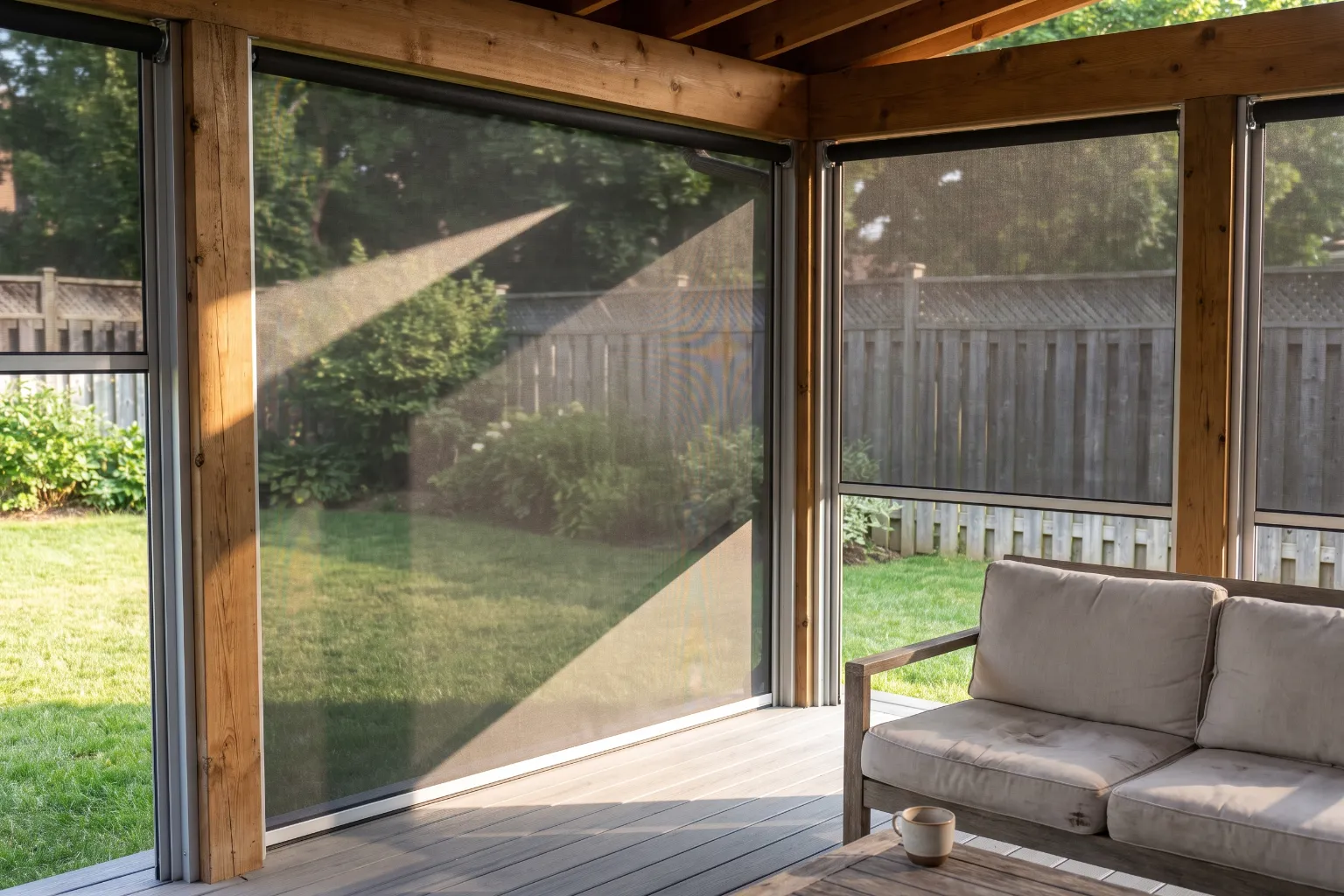
Outdoor blinds
Outdoor blinds fail for reasons indoor blinds never face. The sun is four to five times stronger on the patio side of the glass, the wind has leverage on anything hanging in the open, and the whole thing has to survive a winter that swings sixty degrees. Everything worth knowing about specifying them comes from those three facts.
Blinds Company · Rated 4.8 out of 5 on Google
Free in-home measure · open 8am–9pm, 7 days
In short
Outdoor blinds are shades fitted on the outside of a window, patio or deck, made from weatherproof mesh or PVC and fixed to the building's structure rather than to the window frame. Specified properly for Ontario, they cut solar heat before it reaches the glass and extend a patio's usable season at both ends.
Book
Let's measure your light.
We come to you, measure at your own windows, and go through fabrics and fits together. The visit costs nothing.
$99 off when you order three or more blindsApplied to your written quote at the measure.
Rather just talk?(437) 782-5452Open 8am–9pm, 7 days
The short version
Is this right for your window?
Yes — if the room is one of these.
- West and south-facing patios that become unusable by mid-afternoon
- Decks and porches open at the sides, where wind decides the specification
- Cutting solar heat before it reaches the glass, rather than after
Where it is wrong is below, and that half is the useful one.
And this is what you would be getting.
- 01
- Mesh, clear PVC or solid acrylic, chosen by what the space is for
- 02
- Fixed to structure — posts, beams, joists — not to a window frame
- 03
- Sized with the wind path considered, not just the opening
- 04
- Manual crank or motorised, with a wind plan either way
Why outdoor blinds are a different product
An indoor blind manages light in a room. An outdoor blind manages weather on a structure, and almost every decision changes as a result.
Start with the sun, because it is the reason most people call. Glass transmits a large share of the sun’s energy and then traps the heat it becomes. An indoor blind can only intercept that energy after the conversion has already happened inside the room — it shades your eyes, holds some warmth against the window, and the room still gains heat. An exterior shade intercepts the same energy on the outside, where the heat it produces simply dissipates into open air.
That is the whole argument, and it is why a west-facing living room that stays uncomfortable behind good indoor blinds often becomes comfortable behind a mesh shade costing less than the window it protects.
Then the wind, which is what actually determines the specification. A blind hanging in an open span is a sail, and wind load climbs with the square of the speed: doubling the wind quadruples the force. A fabric edge left free to billow will beat itself against its own hardware until something gives. Every serious outdoor system answers this the same way — by holding the fabric at both vertical edges, in tracks or on tensioned cables, so it cannot balloon.
Then the winter, which is the part most quotes skip. Sixty degrees of annual swing, freeze-thaw cycling, wet snow that weighs far more than dry, and ultraviolet exposure at levels no interior fabric ever sees. Materials that are perfectly good in a Mediterranean climate are not automatically good here.
The three fabrics, and what each one costs you
Open mesh. A woven screen with a stated openness — the percentage of the weave that is literally holes. Lower numbers mean denser fabric: more shade and glare control, less view. This is the default for a patio that is too bright rather than too exposed. You keep the view and the breeze; you do not keep the rain out or the wind off.
Clear PVC. A transparent panel that blocks wind and rain almost entirely while keeping essentially the whole view. This is what turns an open porch into a space usable in April and October. It does nothing for heat — glazing a patio in clear vinyl on a south wall makes a greenhouse, which is welcome in shoulder season and unbearable in July. Most porches that get PVC also want a mesh or a solid for the hot months.
Solid acrylic or PVC. Full shade, full privacy, no view. The right answer for a west elevation where the sun is the entire problem, for a hot tub or a patio overlooked by a neighbour, and for anywhere the blind is really acting as a wall.
The failure mode is choosing on looks. A mesh on a windy deck disappoints; clear PVC on a sun-trap patio makes the heat worse; a solid on the one side with the good view removes the reason the patio exists. Which of the three is right follows from what the space is actually short of, and that is a conversation better had standing in it.
What we measure that an indoor job does not
Where the load goes. An indoor blind is carried by the window frame. An outdoor blind is carried by the building, and we measure the structure that will hold it: post spacing, beam depth, what the fixings land in. A blind is only as sound as the timber it is bolted to.
The wind path. Whether the space is enclosed on three sides or open across, whether it sits above the roofline of its neighbours, which direction the weather arrives from. An enclosed courtyard and an exposed second-floor deck take different specifications at the same width.
Fall and drainage. Water has to leave. Where the blind sheds and where that water lands matters on a deck, and it is the difference between a shaded space and a permanently damp one.
The reach. How the blind will actually be operated, and by whom. Outdoor blinds are big, and a crank at three metres that needs a stepladder is a blind nobody lowers.
The season. Whether it stays up all year or comes down in November, because that decides both the mounting and how much handling the fabric is specified to take.
Three things they are not
They are not insect screens. A mesh shade and a bug screen look similar and do different jobs: shade mesh is woven for solar performance, not to an aperture that stops a mosquito, and an outdoor blind almost never seals at the bottom. If the patio’s real complaint is insects rather than sun, this is the wrong product to solve it with.
They are not a roof. A vertical blind on the sunny side does nothing about sun arriving from overhead, which on a south-facing patio at midday is most of it. Where the space has no cover above, shade at the sides helps in the afternoon and not at noon.
They are not a substitute for indoor blinds. An exterior shade stops heat and glare before the glass, but it is raised whenever you want the view, and it gives no privacy inside the room after dark. Most windows that get one still want something indoors as well.
What we can tell you now, and what waits for the visit
Outdoor is the part of our range where the honest answer most often is “we need to see it”. Indoor blinds are a window with known dimensions; an outdoor blind is a structure, an exposure and a use, and only the first of those can be given over the phone.
So: we make outdoor blinds, we fit them across Toronto and the GTA, the in-home visit is free, and the quote is written line by line at the patio with a date on it. The system, the fabric openness and the mounting are specified once somebody has stood in the space and looked at what holds it up.
If your patio is unusable from two o’clock, or your porch is three weeks of the year short at each end, that is the problem to describe when you ring. Everything else follows from it.
The indoor half of the same problem — heat and glare that has already come through the glass — is covered on the blackout blinds and roller blinds pages, and the two are often specified together on the same elevation.
Last updated .
Tell us which direction the patio faces and whether it is open at the sides. Those two facts decide most of this, and the visit is free.
Our commitment
We size to the structure, not the opening — a blind the wind takes down is ours.
If it does not fit, we remake it
You never held the tape.
Nothing owed before you agree
No deposit, no card.
Licensed and insured
Both, before we come in.
Your date, in writing
Set at the quote. It does not move.
We will tell you not to buy
If a stock size does it, you hear so.
Cordless where a child sleeps
Standard, at no extra charge.
Reviews on Google
What people said afterwards.
Rated 4.8 out of 5 — the ones below are quoted in full, with a link to check each on Google.
Highly recommend Nick and his team. They installed blinds in my house. Looks wonderful, cheers
Timur ShafikovNick has delivered the greatest service as I recently moved in to my new townhome and needed to have blinds for all three floor windows. Not only the price was the best, but he accommodated all my requests in the process. Definitely worth every penny
Anton Kovunov
Real names, real dates, and a link to all of them — including the ones we would not have picked.
Read them on GoogleQuestions
Before you book
Do outdoor blinds actually reduce heat inside the house?
Considerably more than an indoor blind does, and the reason is physics rather than marketing. An interior blind stops sunlight only after it has already passed through the glass and become heat inside the room; the best it can do is hold that heat near the window. An exterior shade stops the sun before it reaches the glass at all, so the heat never enters. On a west-facing wall of glass this is the single most effective thing you can do short of replacing the windows, and it is why the technique is standard across southern Europe and still uncommon here.
Will they survive an Ontario winter?
The fabric and hardware are built for weather, but snow load and ice are a different question from rain and sun, and they are what actually breaks outdoor blinds here. The honest answer depends on the system and how it is mounted, which is one of the things we settle at the measure rather than in a brochure. Plan on the assumption that a retractable outdoor blind is raised and secured for the winter the way patio furniture is put away — anything left extended under wet snow is carrying a load it was never specified for.
What happens in high wind?
Wind is the thing that takes outdoor blinds down, not rain, and any quote that does not raise it is incomplete. A blind hanging in an open span acts as a sail: the load rises with the square of wind speed, so a gust that is merely noticeable at ground level is several times the force the fabric felt in a light breeze. The answers are mechanical — side tracks or cables that hold the fabric at both edges rather than letting it billow, a system rated for the exposure, and the discipline of raising it when weather is coming. A motorised blind can be fitted with a wind sensor that retracts it on its own; a manual one relies on somebody being home.
Mesh, clear PVC or solid — which do I want?
It depends on what you want to keep and what you want to lose. An open mesh cuts glare and a large share of solar heat while you can still see the garden through it, which is what most people picture when they say patio blinds. Clear PVC does the opposite: it blocks wind and rain and keeps almost all of the view, which turns a porch into a three-season room but does nothing about heat. A solid fabric gives full shade and privacy and no view at all. The mistake is choosing on appearance and discovering the space now has the wrong problem.
Can they be motorised?
Yes, and outdoor is the application where motors earn their cost most clearly. Outdoor blinds are usually large, often mounted above reach, and want to be moved in response to weather rather than on a schedule — all three of which are tedious by hand and trivial with a motor and a remote. The practical constraint is power: the motor needs a supply at the mounting point, and running that to a detached pergola is an electrical job to plan for rather than an afterthought at installation.
Can you fit them to a pergola or gazebo?
Usually, and it is one of the most common requests, but the structure decides it rather than the fabric. Outdoor blinds are fixed to posts, beams and joists, so what matters is whether the frame can take the load — a light aluminium gazebo is not the same proposition as a built cedar pergola, and a wind-loaded blind can pull a weak structure out of true. This is exactly the kind of thing that has to be looked at rather than described over the phone.
How much of the view do I lose?
With an open mesh, less than people expect. Looking out through mesh in daylight you see the garden clearly, because your eye is in the darker space and the view is the bright one; the same fabric reads as nearly opaque from outside in the day, which is where the privacy comes from. That reverses after dark once the lights are on inside, exactly as it does with an indoor screen fabric. If evening privacy on a lit patio matters, it needs a solid fabric, not a mesh.
Not this one?
The rest of the range.
Each of these is the wrong answer somewhere, and its page says where. That is usually the faster way to find the right one.
If you have been quoted for outdoor shade and nobody mentioned wind or winter, get a second opinion. Ring and describe the space.