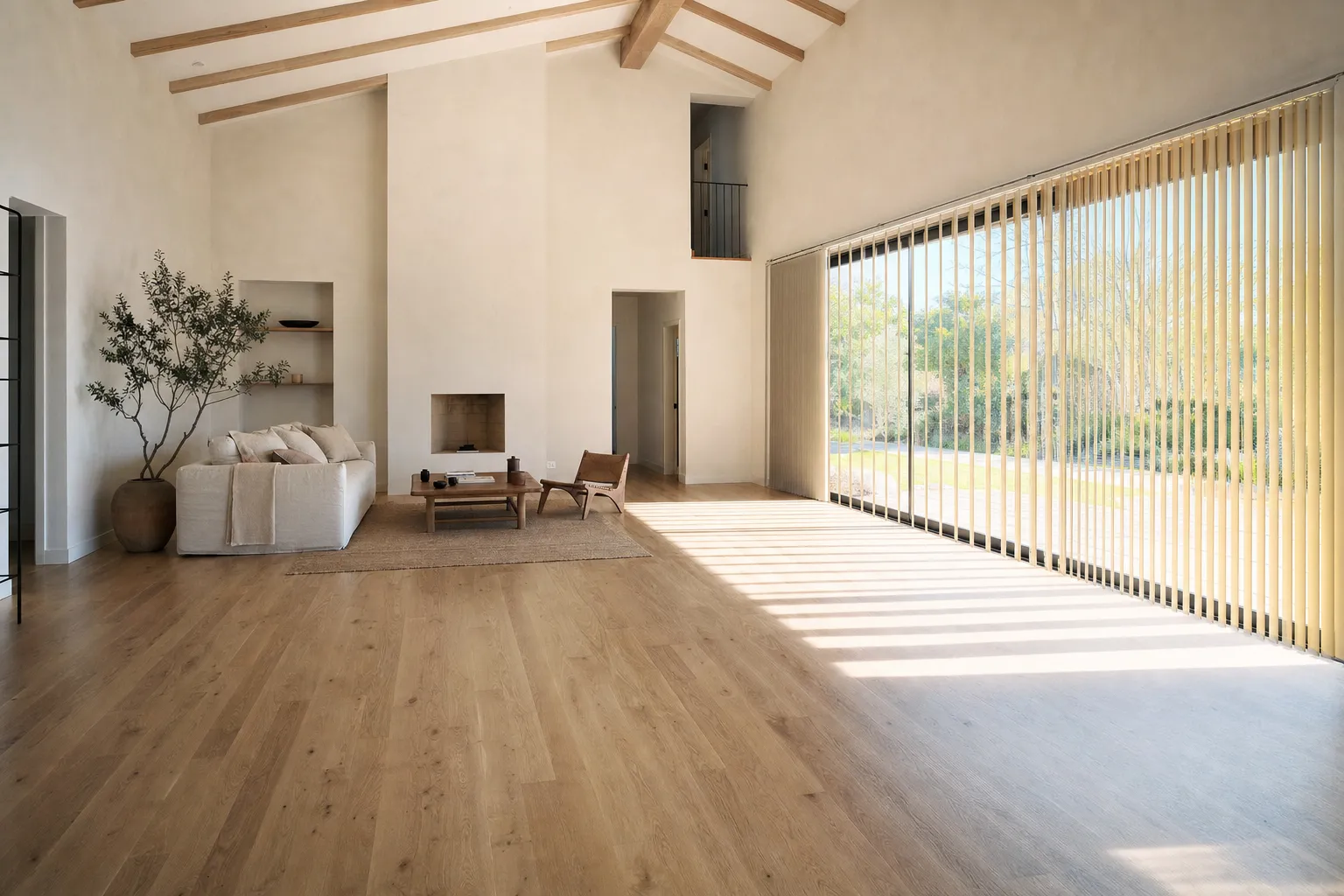
Vertical blinds
Vanes hung from a top track that tilt and draw sideways. Still the most practical answer for a patio door or a very wide window, and still the product people are most embarrassed to ask about.
Blinds Company · Rated 4.8 out of 5 on Google
Free in-home measure · open 8am–9pm, 7 days
In short
Vertical blinds are made to your exact opening and installed across Toronto and the GTA. They suit patio and sliding doors, where the covering has to move out of the way. The in-home measure is free and carries no obligation.
Book
Let's measure your light.
We come to you, measure at your own windows, and go through fabrics and fits together. The visit costs nothing.
$99 off when you order three or more blindsApplied to your written quote at the measure.
Rather just talk?(437) 782-5452Open 8am–9pm, 7 days
The short version
Is this right for your window?
Yes — if the room is one of these.
- Patio and sliding doors, where the covering has to move out of the way
- Windows wider than about two and a half metres
- Basements and utility rooms with awkward, wide openings
Where it is wrong is below, and that half is the useful one.
And this is what you would be getting.
- 01
- Stacks sideways, so width costs nothing
- 02
- Tilt for light, draw for access
- 03
- Fabric or PVC vanes, PVC for wet rooms
- 04
- Wand control, no chain across a doorway
In a room
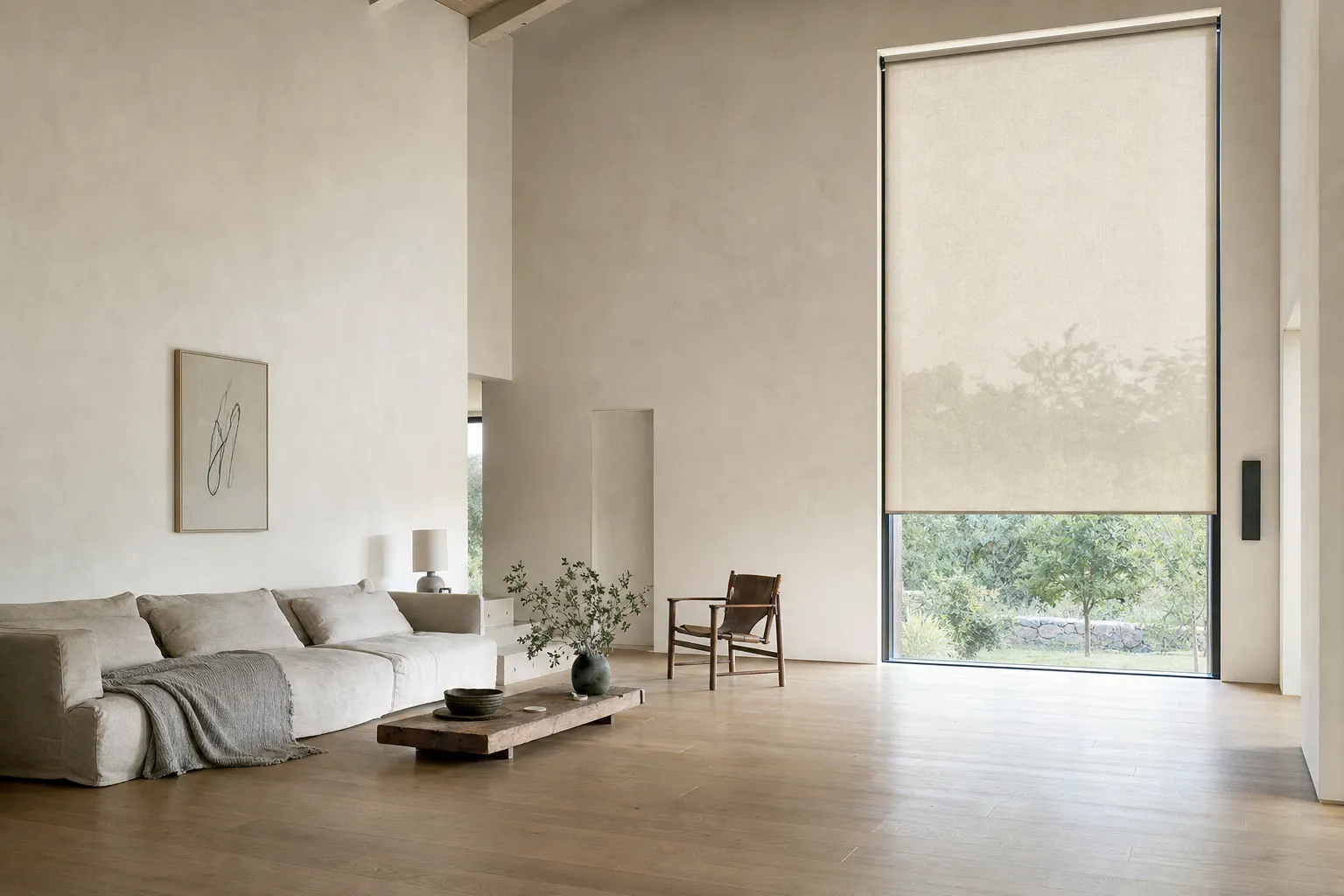
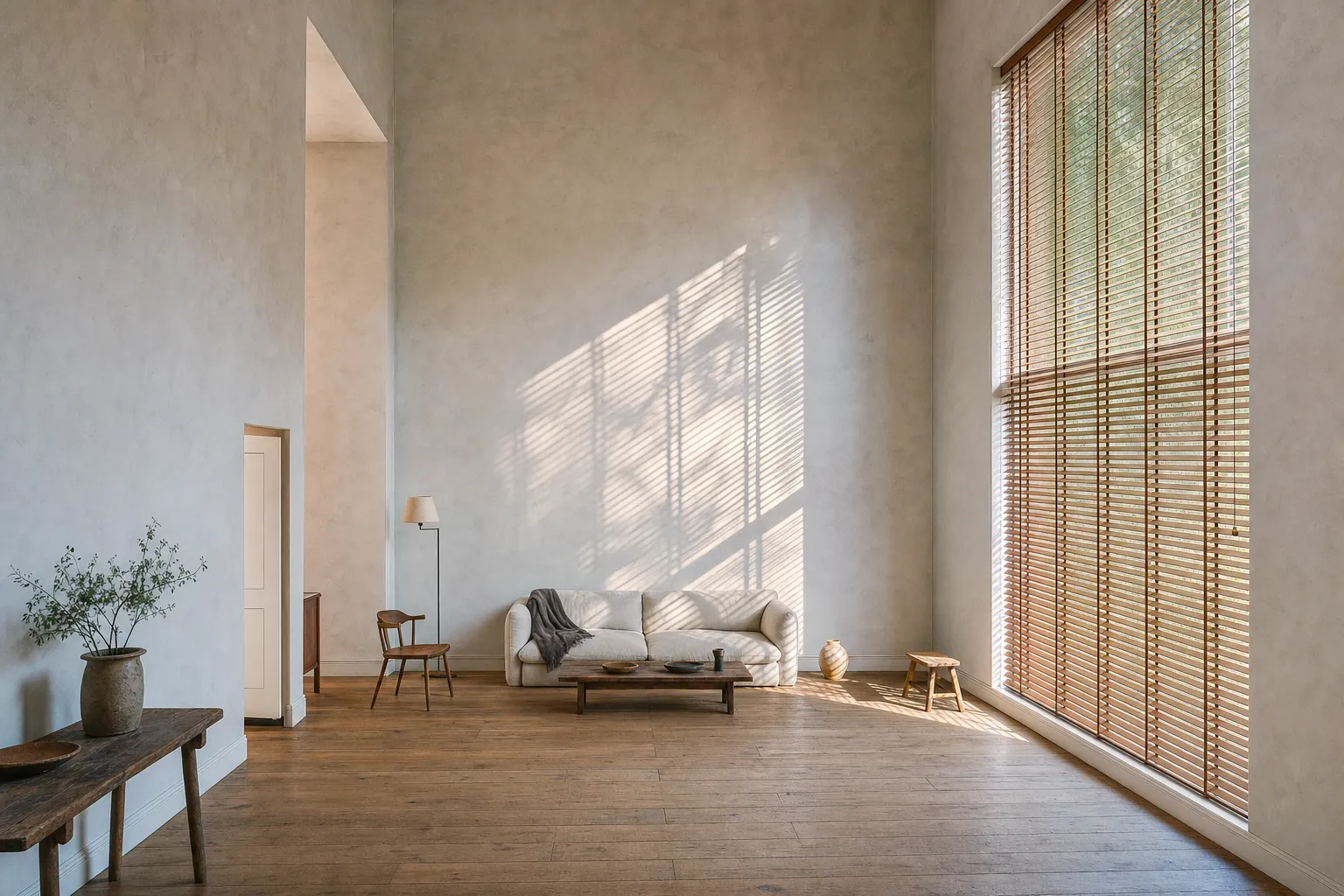
What vertical blinds look like once they are up.
The product, not our installations — a gallery of rooms we did not fit would be somebody else's portfolio with our name on it.
The one thing they do that nothing else does
Every horizontal covering stacks upward. That is fine on a window and a problem on a door, because the covering has to be fully raised before you can walk through — and on a two-metre-wide slider that means operating the whole blind every time you step outside.
Verticals stack sideways. Draw them to one end and the door is clear, with the stack sitting against the frame taking up a hand’s width. That is the entire argument, and on a patio door it usually wins.
The reputation, addressed honestly
Most people picture a specific thing: narrow, glossy, cream PVC louvres in a 1990s office, one of them bent, another missing. That product existed and it deserved its reputation.
What has changed is the vane. Wider vanes in real fabric, in colours that belong to a house rather than a reception area, read completely differently — closer to a drapery panel than to a blind. The mechanism underneath is the same, because the mechanism was never the problem.
If you would rather not have them, that is a legitimate preference and we are not going to argue you out of it. But it is worth seeing a current fabric vane before deciding, and that costs nothing at the measure.
Where they are genuinely the wrong choice
A window you look through constantly. Even fully tilted, vertical vanes break the view into stripes. On a picture window with something worth looking at, that is a real loss.
A draughty door in summer. They swing and they click. Weighted hems and a linking chain help; if the door is open all day, they will still move.
Anywhere the room is already busy. Vertical lines are strong. In a room with panelling, shutters elsewhere or a lot of pattern, they add a third rhythm and the room gets noisy.
Fabric or PVC
PVC wipes, tolerates a wet basement or a laundry room, and is the cheaper of the two. It is also the one that reads as commercial if you pick a narrow, glossy vane.
Fabric hangs better, softens the room, and comes in openness factors like a roller — so you can have a vane that filters light rather than blocking it. It is the version that changes people’s minds about the product.
How we build them
The track is cut to the opening measured in your home, and we set the stack side deliberately — towards the wall, away from the handle, or split to both ends — because on a door that decision is the difference between using it comfortably and shoving fabric aside every time.
Wand control as standard rather than a chain, since a chain hanging across a doorway is both a nuisance and a hazard. Manufactured under our own name, installed by the crew that measured, and the visit costs nothing.
Which way it should stack, and why we ask
This is the question that decides whether you like the blind, and it is the one almost nobody is asked before installation.
Draw to one side puts the whole stack against one end. It is right when one side of the door is the side you walk through and the other has a wall or a piece of furniture the stack can live in front of. Say which side at the measure, because it is set in the track and changing it afterwards is a rebuild.
Split draw parts the vanes in the middle and stacks half at each end. It looks symmetrical, it halves the depth of each stack, and on a wide slider it means neither side loses much glass. The cost is that opening the door needs both halves moved.
Stack in front of the wall, not the glass. On a door with a fixed panel and a sliding panel, the stack should end up in front of the fixed panel. Get it the other way round and the blind is permanently in the way of the part that moves.
We walk the door with you and open it the way you actually open it. People usually discover they use one side ninety per cent of the time, and that answers the question in about ten seconds.
Vane width, and the strip of light between them
Standard vanes are 89mm or 127mm. The narrower one gives more vanes, a tighter closure and a deeper stack; the wider one gives fewer vanes, a cleaner look on a big opening, and a stack that is noticeably slimmer.
Either way, closed does not mean sealed. Vertical vanes overlap rather than interlock, so a closed vertical blind passes a thin line of light down each overlap and a wider one at each end of the track. On a patio door that is rarely a problem — it is a living space, not a bedroom. On a bedroom sliding door it is, and the honest answer there is a blackout roller or panel track over the door with the verticals dropped from the plan.
There is also a floor gap by design. The vanes hang about 12mm clear of the floor so they do not drag, catch or wear at the hem, and on a door threshold that gap is visible. Asking for them to touch the floor produces a blind that looks right for a month and frayed after a year.
One damaged vane is not a damaged blind
Every other product in the range is a single assembly: damage it and the whole blind is what gets replaced.
A vertical is a track and a set of individual vanes hanging from carriers. A vane creased by a door, chewed by a dog or stained by a plant lifts off its carrier and a new one clips on — by you, in seconds, with no tools and nobody visiting. We supply vanes to match what we made; the track outlives several sets of them.
That is worth real money on a patio door, which is the window most likely to take physical damage in a house, and it is the reason verticals are still specified for rentals and for family rooms long after the aesthetic argument has been lost elsewhere.
On a window rather than a door
Most verticals are sold for sliding doors, which is where their one unique capability matters. On an ordinary window they are a different proposition and it is worth being straight about when they are the right call.
Where they win on a window. A tall, narrow opening — a stairwell light, a window beside a front door — suits vertical vanes because the proportion matches: long vertical lines in a long vertical opening look intentional, where a horizontal product cuts it into slices. A very wide window with no reveal also suits them, because a vertical track can span further than most tube-based products without any sag: the weight hangs from a carrier rather than being carried across a span.
Where they lose. A standard, roughly square domestic window. There a vertical reads as commercial, because for thirty years that is where the product lived. That is a fashion judgement rather than an engineering one and it is changing, but it is real and we would rather say it than pretend otherwise.
The one thing to check on a window installation is what happens at the bottom. On a door the vanes hang free to floor level. On a window they finish above a sill, and a vane hanging free above a sill will swing into the reveal in any draught and tap. Either the vanes finish clear of the opening on an outside mount, or they get a bottom chain, or the drop is set so they sit just inside the sill line.
The bottom chain, in one paragraph
A light chain linking the bottom of every vane keeps the spacing even and stops individual vanes swinging out of line. It is also a loop at child height, which is why we fit chainless with weighted vanes as standard in any room a child uses. The regulation behind that, and what it means on a door specifically, is on the patio door page — a floor-level chain across a doorway is the clearest example of the thing the rules were written about.
The track, and the part that wears out
Worth knowing because it is what separates a vertical that is still smooth in eight years from one that is not, and it is never on a quote.
The vanes hang from carriers — small trolleys that run inside the headrail and are linked to each other so they space themselves as the blind draws. Everything about how the product feels is in those carriers.
What a cheap one does. Plastic carriers running in a thin aluminium track. They work perfectly at first, then the linking spacers stretch, the vanes stop spacing evenly, and one carrier eventually binds. The symptom people describe is “it does not close properly any more” — the vanes have drifted, so the overlaps are uneven and light comes through in one place.
What a good one does. More substantial carriers, a heavier extruded track, and a control mechanism that turns every carrier through the same angle. On a wide door the difference is measurable at installation: cheap gear tilts the far end a few degrees behind the near end, so the vanes at one end of a three-metre door are never quite closed when the others are.
The one part that genuinely fails. The tilt rod, on very wide blinds. It runs the full length of the headrail and it is doing the work of turning thirty carriers at once. Past about three and a half metres we would rather split the run than trust one rod, and that is a manufacturing decision made before the order.
None of this is visible when you look at a sample vane. It is the reason two verticals that appear identical can be twice the price, and it is the right question to ask about anybody’s quote, ours included.
What a wall of vanes does to a room’s sound
Rarely mentioned, and on a big room it is the reason some people prefer this product to a roller without being able to say why.
A large modern room with hard floors, a flat ceiling and a wall of glass is acoustically live — speech and television sound bounce, and the room is tiring in a way people usually blame on the layout. Soft surfaces fix it, and the largest soft surface available at a window is the covering.
A vertical in fabric is unusual here because it presents a folded, articulated surface rather than a flat one. Sound arriving at an angle meets vane edges and gets scattered rather than reflected straight back, and in a room with a large glazed wall the difference between bare glass and closed fabric vanes is genuinely audible.
Two practical notes. PVC vanes do very little of this — the benefit is a fabric one. And the effect only exists when the vanes are closed, so it helps most in exactly the rooms where the blind is closed in the evening, which is when a television is on.
It is not a reason on its own to choose a vertical. It is a reason to choose fabric over PVC in a big room, and that decision is usually made on price alone.
What they cost you in maintenance, and what they do not
The carriers are the moving part. Each vane hangs from one, and the carriers ride in the track linked together so they tilt as a set. They are plastic, they wear, and on a door used every day they are the thing that eventually needs attention — usually one carrier, usually years in.
What does not need attention is the fabric, provided the vanes are not dragging. Fabric vanes take a vacuum brush; PVC takes a damp cloth. Neither needs taking down.
The bottom chain is optional and it is a genuine choice rather than a detail. It keeps the vanes evenly spaced and stops them swinging in a draught. It is also a loop at child height, so in a house with a toddler we leave it off and accept that the vanes move a little when the door is open.
Last updated .
A door has to keep working. That is the measurement, and it takes one visit.
Our commitment
We set the stack clear of your door, so a vane that fouls the track is ours.
If it does not fit, we remake it
You never held the tape.
Nothing owed before you agree
No deposit, no card.
Licensed and insured
Both, before we come in.
Your date, in writing
Set at the quote. It does not move.
We will tell you not to buy
If a stock size does it, you hear so.
Cordless where a child sleeps
Standard, at no extra charge.
Reviews on Google
What people said afterwards.
Rated 4.8 out of 5 — the ones below are quoted in full, with a link to check each on Google.
I was blown away by the exceptional customer service from Blinds Company! Their staff was knowledgeable, friendly, and helped me find the perfect blinds for my living room. The installation was quick and flawless. I highly recommend them!
Merdan BerdiyevI'm thoroughly impressed with Blinds Company. From the initial consultation to the final installation, their team delivered exceptional service, expertise, and quality.
Oleksandr Stakhurskyi
Real names, real dates, and a link to all of them — including the ones we would not have picked.
Read them on GoogleQuestions
Before you book
Are vertical blinds dated?
The 1990s office version is. The product is not — it is the only common covering that stacks sideways, which is why it survives on doors. What dates it is usually the vane: a narrow, shiny, off-white PVC louvre reads as a waiting room. A wider fabric vane in a colour that belongs to the room does not.
Do the vanes stay lined up over the years?
If the carriers are decent, yes. The vanes hang from small trolleys inside the headrail that are linked so they space themselves, and on cheap gear those links stretch — the vanes drift, the overlaps go uneven, and the blind stops closing cleanly in one place. That is the usual cause of a vertical that "does not close properly any more", and it is a hardware question rather than a fabric one.
Can I cover a patio door with something else?
Yes — a wide roller, panel glides, or drapery on a track. Each has a cost: a roller has to be raised entirely to use the door, panels need wall to stack onto, drapery needs more. Verticals are the option that gets fully out of the way in the least space.
Do they work on a bay window?
They can, on a curved or angled track, but each section still stacks somewhere and the stacks land in the corners. On most bays a separate blind per section looks better and works better.
Not this one?
The rest of the range.
Each of these is the wrong answer somewhere, and its page says where. That is usually the faster way to find the right one.
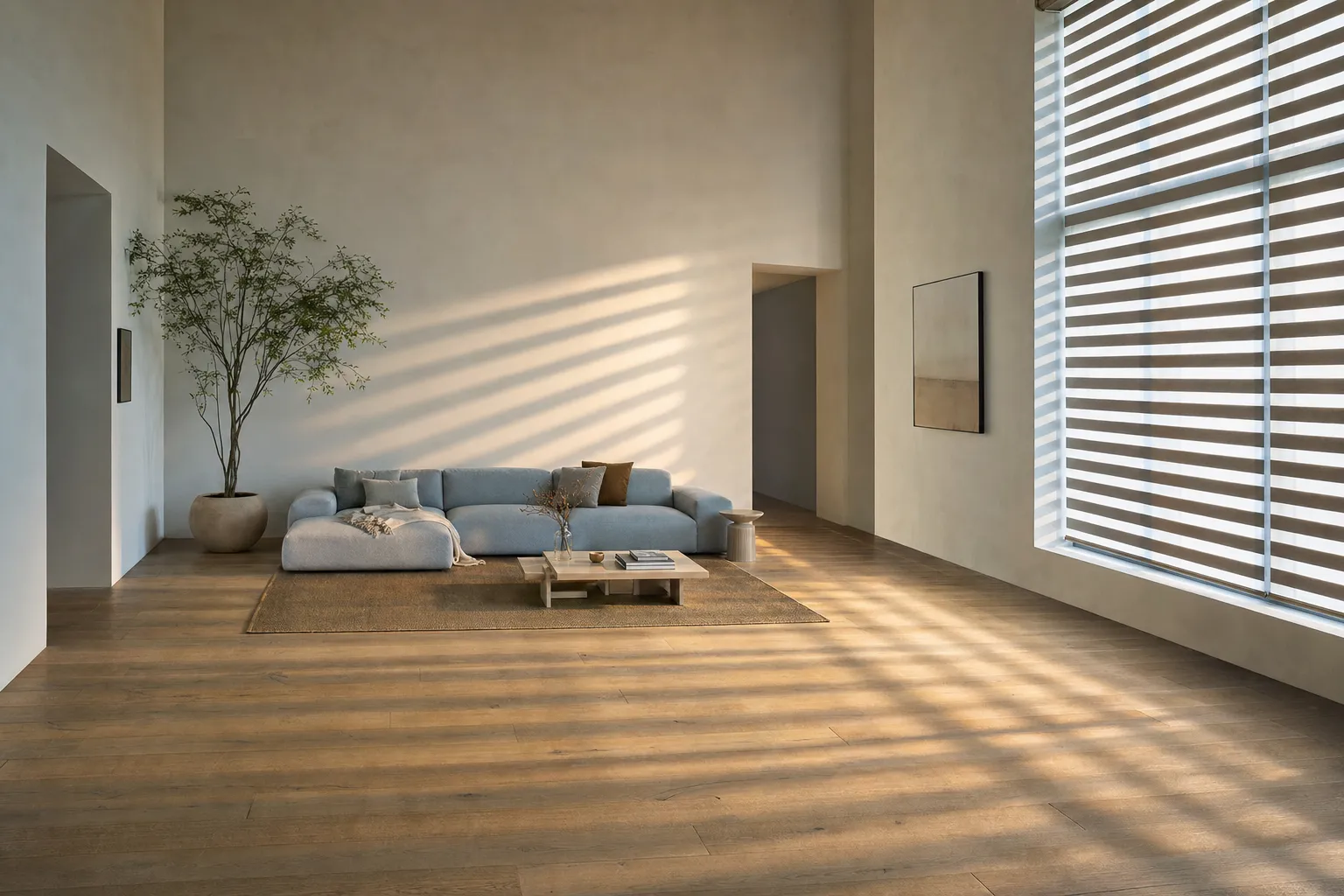
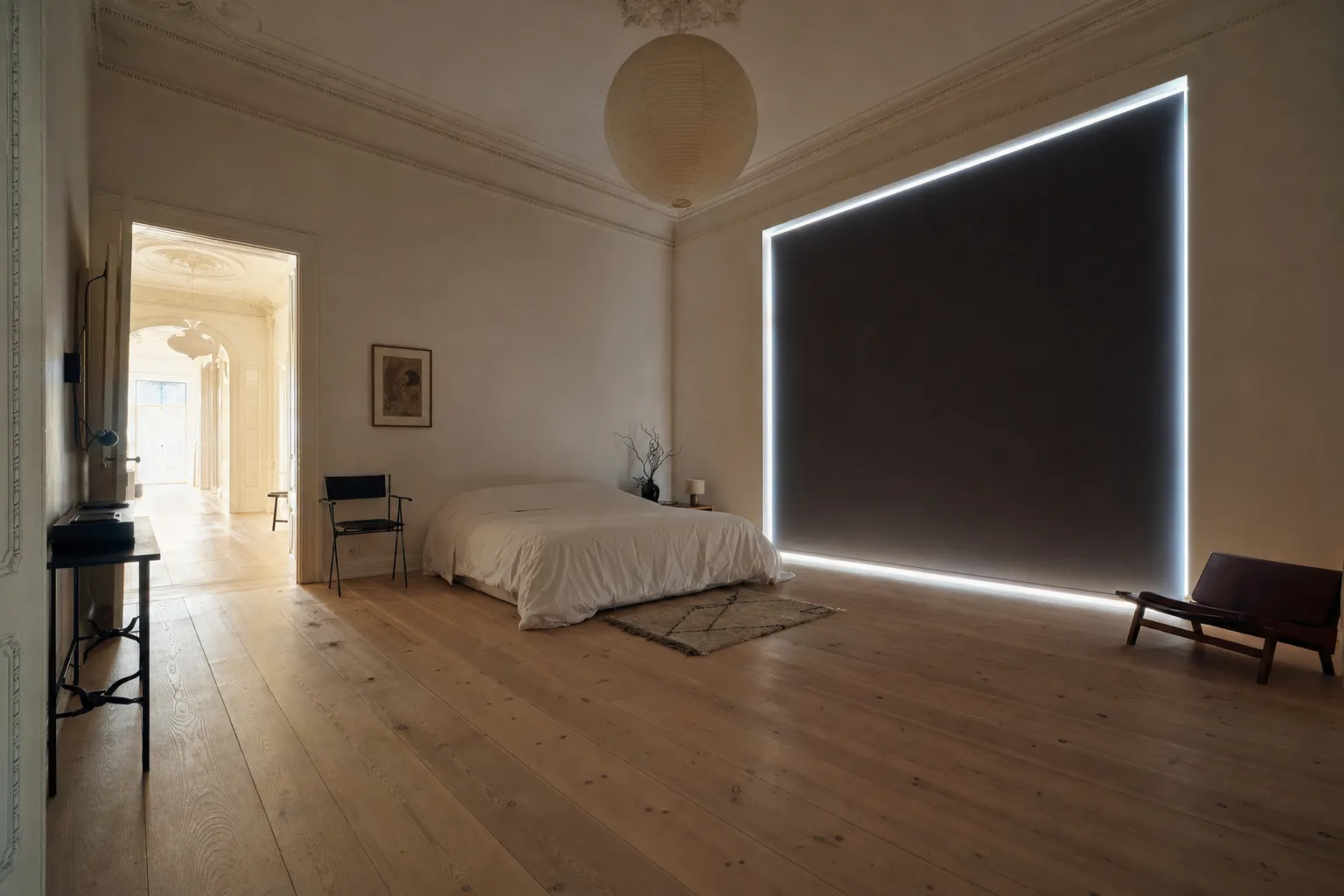
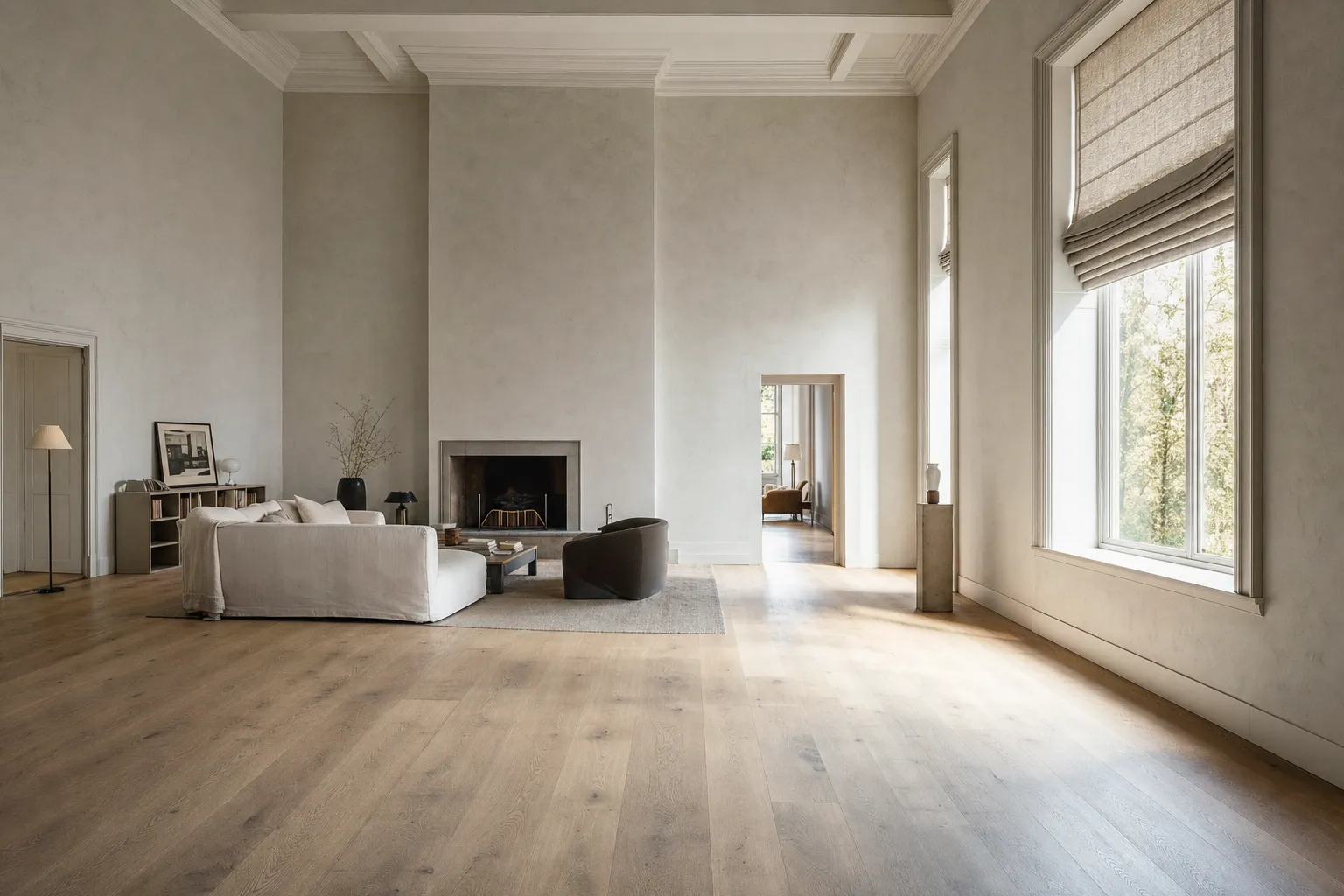

If you have a patio door and every option you have been shown gets in its way, that is a solvable problem. Say which way the door slides.