
Motorized blinds
Blinds with the motor inside the tube — battery or wired, remote or wall switch, on a schedule or not. Worth it on the two or three windows in a house that are otherwise never adjusted, and rarely worth it on the rest.
Blinds Company · Rated 4.8 out of 5 on Google
Free in-home measure · open 8am–9pm, 7 days
In short
A motorized blind has a tube motor hidden inside the roller, so nothing about it looks different from a manual one. Battery versions need no wiring and charge two or three times a year; wired versions never need charging and are quieter. The case for one is not gadgetry — it is any window where the force or the reach required means the blind stops being adjusted, which in most houses is two or three windows out of twenty.
Book
Let's measure your light.
We come to you, measure at your own windows, and go through fabrics and fits together. The visit costs nothing.
$99 off when you order three or more blindsApplied to your written quote at the measure.
Rather just talk?(437) 782-5452Open 8am–9pm, 7 days
The short version
Is this right for your window?
Yes — if the room is one of these.
- Windows above reach — two-storey glass, stair landings, high transoms
- Wide, heavy blinds that are hard to pull whatever their height
- Rooms that need shading while the house is empty
Where it is wrong is below, and that half is the useful one.
And this is what you would be getting.
- 01
- Rechargeable battery or hardwired tube motors
- 02
- Remote, wall switch, app or schedule
- 03
- Groups, so one control closes a whole wall
- 04
- Fitted to rollers, zebras, cellular shades and romans
In a room
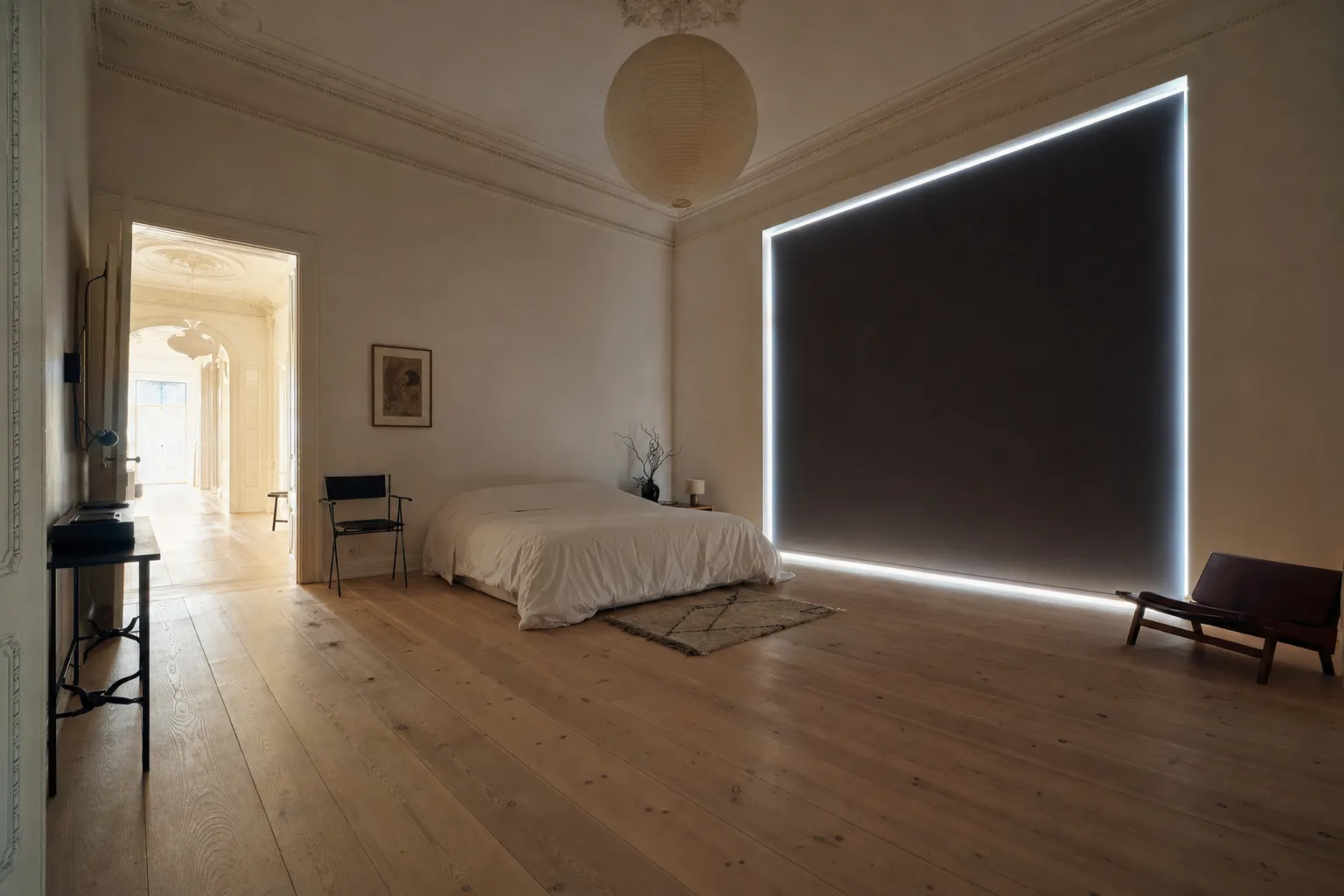
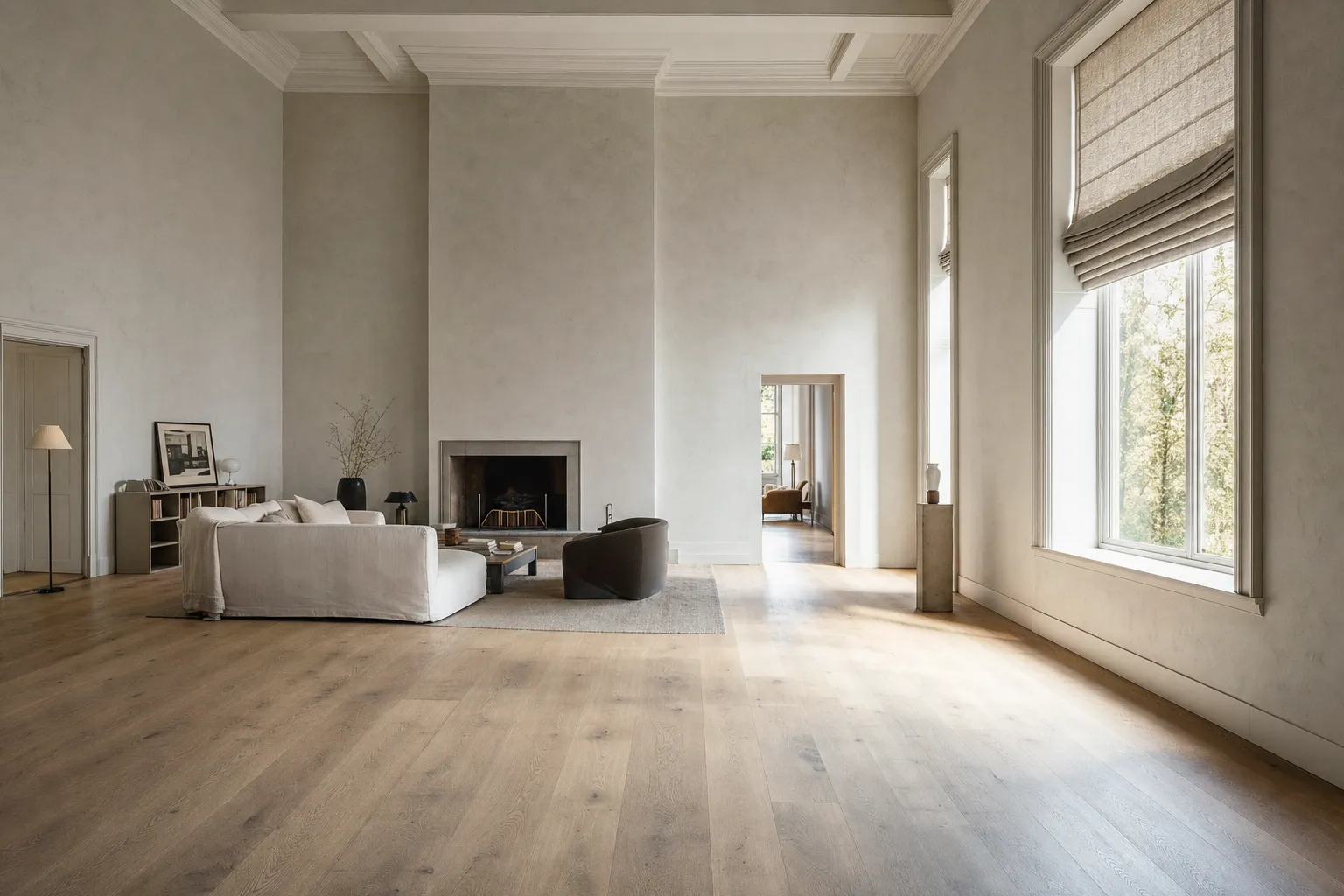
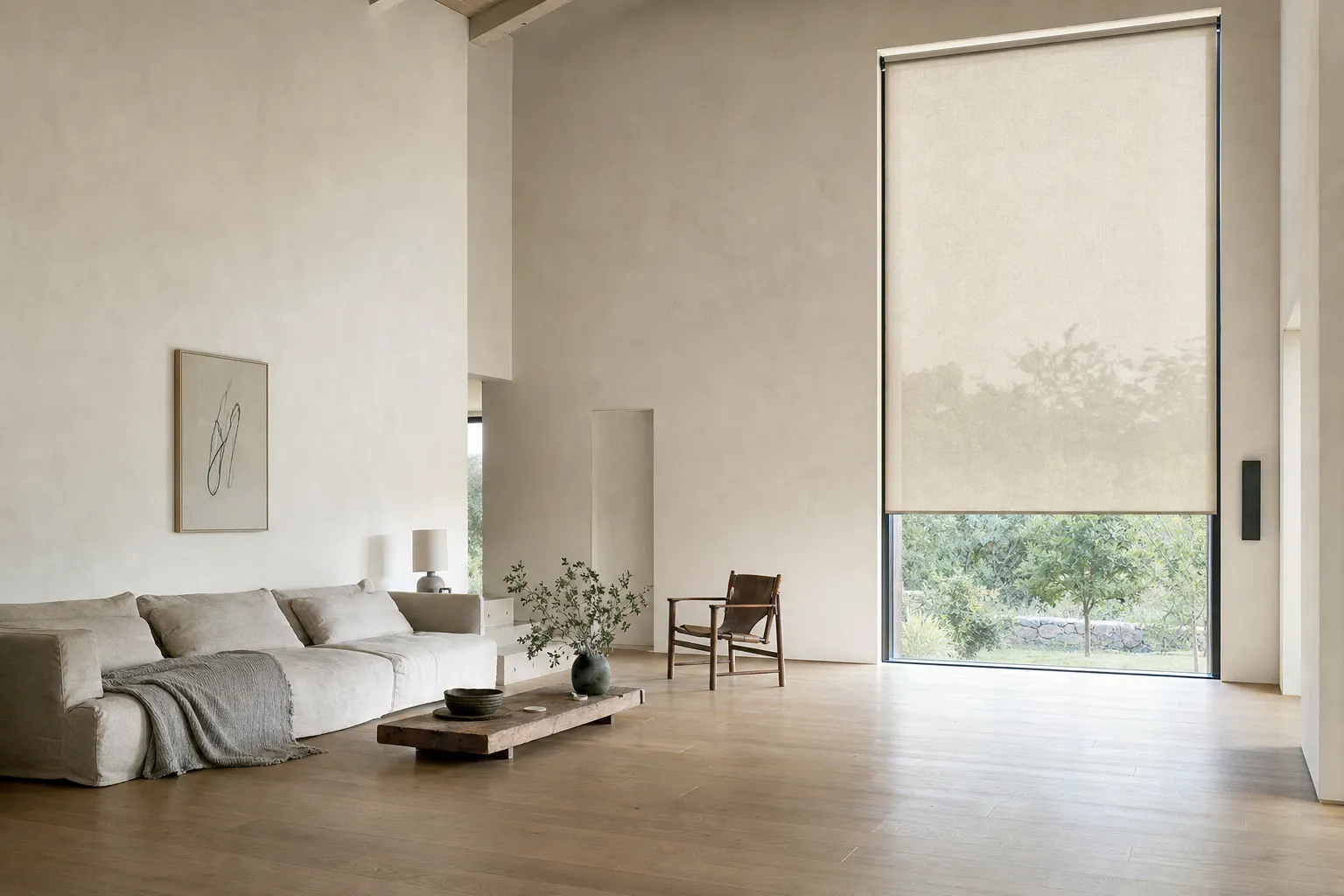
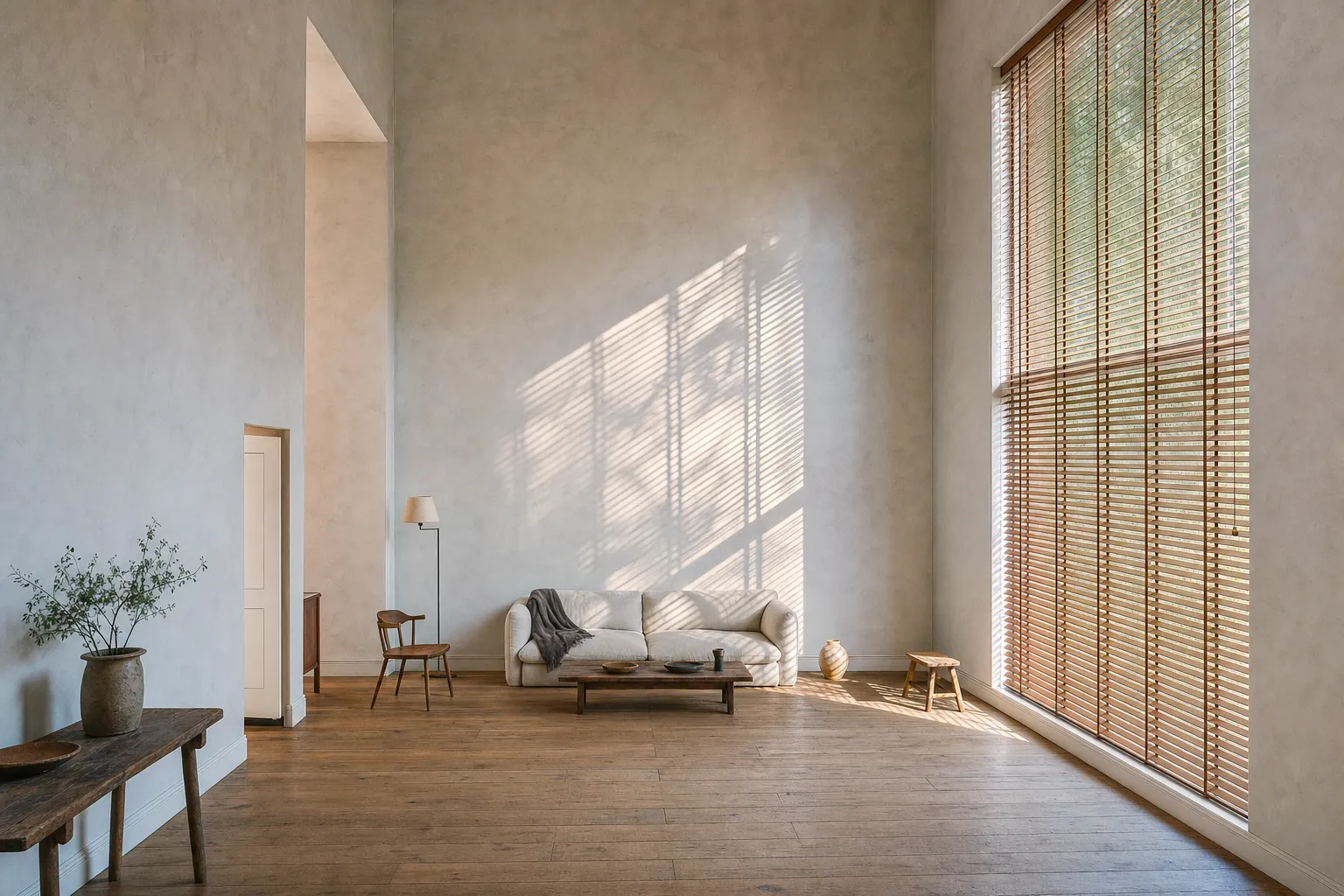
What motorized blinds look like once they are up.
The product, not our installations — a gallery of rooms we did not fit would be somebody else's portfolio with our name on it.
Motorized, automatic, electric, smart — which is which
Four words get used for this product and they do not all mean the same thing. Worth ten seconds because people arrive asking for one and wanting another.
Motorized describes the hardware: there is a motor in the blind instead of a spring or a chain. That is all it claims. A motorized blind can be entirely manual in the sense that a person presses a button every time.
Electric means the same thing and is the older word for it. Nobody in the trade draws a distinction, and if you have been quoted for electric blinds you have been quoted for these.
Automatic and automated describe behaviour rather than hardware: the blind moves without anybody deciding to move it. That needs a motor and a schedule or a sensor. A motorized blind is not automatic until somebody sets it up, and plenty never are — which is fine, and it is the commonest outcome.
Smart means it talks to something else: a hub, a phone, a voice assistant, a home automation system. Every smart blind is motorized; most motorized blinds are not smart and do not need to be.
The practical consequence is the order to decide in. Motor first, because that is the hardware and it is the only part that cannot be added cheaply later. Automation second, because a schedule is software and costs nothing to change. Smart last, and only if you would actually use it.
Where this matters most: somebody who wants an automatic blind — one that closes itself on the west side while the house is empty — is describing a schedule, and a schedule needs no hub, no app and no subscription. It is a setting.
What is actually in there
A motorized roller looks identical to a manual one, because the motor is a sealed cylinder living inside the tube. It replaces the spring or the clutch that would otherwise be at that end, and everything else about the blind — fabric, bar, brackets, cassette — is unchanged.
That matters for two reasons people do not expect. Motorizing does not change how the blind looks, so there is no visual cost to the decision. And the motor is sized to the blind, not the other way round: a motor rated for a small screen will lift a small screen indefinitely and will struggle and fail on a wide blackout. Matching the two is a specification, and it is why a motorized blind bought as a kit and fitted to whatever tube it happens to fit is the version that dies in year two.
Power comes one of two ways.
Rechargeable battery. A lithium pack, sometimes inside the tube with the motor and sometimes in a slim housing at the head. Nothing to install, a cable for a few hours two or three times a year, and no electrician.
Hardwired. A low-voltage supply to the head of the blind. Never needs charging, runs slightly quieter, and is the right choice where a blind is high enough that getting to it with a cable is itself the problem the motor was solving.
The case for one, honestly
Motorized blinds get sold on the wrong argument — convenience — and bought for the wrong reason. Here is the version we use at a measure.
Reach. A bottom bar nine or twelve feet up cannot be operated by a person standing on the floor. Poles exist and get used twice. A blind at that height is either motorized or it is a fixed panel, and we would rather call it a fixed panel than sell something that will never move.
Force. The one people miss. The effort to start a blind moving scales with its width and the weight of the cloth, so a three-metre blackout in a living room can be harder to operate than a small blind at twice the height. On a window used daily by somebody who would rather not pull hard, a motor removes force from the question entirely. This is the argument that matters most in a house where somebody intends to stay.
Absence. A blind that closes at three in the afternoon on the west side is doing something a person cannot: shading a room while the house is empty. Over years, unfiltered afternoon sun fades floor finishes, leather and anything on the wall opposite the glass. That is the one automation with a measurable payback, and it is a better argument than convenience.
Number. Once a wall has three or four blinds, operating them individually is enough of a chore that they get operated as a set or not at all. One control for the wall is worth more than four controls for four windows.
What is not on the list: liking gadgets. That is a perfectly good reason to buy something and it is not a reason we will put in a quote.
How you actually control it
Four ways, and most houses end up using two of them.
A remote. Comes with the blind, works immediately, and is the thing that ends up somewhere else. Fine as a second control, poor as the only one.
A wall switch. Battery-powered and stuck or screwed beside the light switch, with no wiring. This is the control that still gets used in year three, because it is where a hand already goes. Deciding where it lives before the blinds are fitted costs nothing; adding it afterwards means picking a spot that was already taken.
A schedule. Set once — down at three, up at seven — and forgotten. For the absence argument above, this is the whole point. Most systems handle sunrise and sunset rather than clock times, which is what you want in a country where five o’clock in December and five o’clock in June are different situations.
An app or voice. Real, and used far less than it is sold. People who like it use it every day; most people set the schedule and the switch and never open the app again. Worth having because it costs nothing extra on most systems; not worth choosing a system for.
Groups, and why they are the thing worth planning
A single blind on a single control is the least interesting thing a motor does. The useful configuration is a group: several blinds answering one button.
The groups that make sense in a house are almost always the same three — the wall of glass in the main living space, the bedrooms, and the tall architectural window at the front. What makes them worth setting up is that they map to decisions people actually make. Nobody decides to close the third blind from the left. They decide that the sun is on the television.
Two practical notes. Groups are set up at commissioning, so it is worth walking the house and saying out loud which blinds belong together before anybody starts. And a blind can be in more than one group — the family room blinds can answer both the family-room button and an “everything downstairs” button.
Which products take a motor well
Not equally, and it is worth knowing before deciding which window gets one.
Rollers. The best case by a distance. The motor is a cylinder and the tube is a cylinder, so it disappears entirely and the blind is unchanged. Nearly all motorized blinds anywhere are rollers for this reason.
Zebras. Nearly as good, with one caveat: the fabric is a loop passing itself, so the motor has to stop precisely for the bands to align. A motor with coarse limits gives you a blind that is a few millimetres out of register, which on this product is visible. Good systems handle it; it is worth asking.
Cellular shades. Very good. The shade is light for its size, so a small motor does the job, and top-down bottom-up versions can be motorized on both rails — which is one of the few genuinely delightful things in this trade and also one of the dearest.
Roman shades. Possible and more involved. The lift is a cord system rather than a tube, so the motor sits in the headrail and drives a spool. It works well and it puts the mechanism where a batten would otherwise be, which changes the head detail.
Venetians. Two motions, and in practice only one is worth motorizing. Tilt is what you adjust several times a day; height is what you set once a season. A motorized tilt on a wide venetian is genuinely useful and much cheaper than motorizing the lift.
Verticals. Rarely, and usually only on very wide commercial-scale openings. On a domestic patio door the wand is quicker than a remote and never needs charging.
The pattern: the more the blind is a tube, the better a motor suits it, and the more often you adjust one axis rather than another, the more sense it makes to motorise only that axis.
What goes wrong, and what does not
Batteries. The consumable. A pack lasts years before its capacity drops noticeably, and by then it is a part rather than a blind.
Signal. Radio through two masonry walls and a floor is the usual limit. In a large house or one with concrete floors, a hub or a repeater sorts it. Worth mentioning at the measure if the blinds are a long way from where the control will be.
Noise. A tube motor is audible for the few seconds it runs — a low hum. Quality varies more here than in anything else about a motorized blind, and it is the one thing genuinely worth listening to before buying. In a bedroom, on a schedule, at six in the morning, it matters.
Alignment. Blinds in a group do not all reach the bottom at exactly the same instant unless the limits are set carefully. On a wall of matching windows, that is visible. Setting them properly is part of the installation, not an extra.
Hubs and apps, over years. The part of this product most likely to age badly is the software rather than the hardware. Manufacturers discontinue apps and change platforms. This is the reason we would rather a house’s daily control be a physical wall switch that talks straight to the motor: if every app on earth stopped working tomorrow, the blinds would still go up and down.
What it costs you to skip the motor
Worth saying plainly, because the honest advice is usually “not that window”.
On an ordinary bedroom window at ordinary height with a light fabric, a cordless spring blind is a better product than a motorized one. It is cheaper, has nothing to charge, nothing to pair, and no software. Two fingers on the bottom rail and it is done.
The moment that stops being true is when force, height, absence or number enters the picture — and in a typical house that is two or three windows.
A quote for a whole house of motorized blinds is a quote where somebody decided before they measured. We will motorise every window in a house if that is what you want, and we will tell you first which ones we think need it.
How we fit them
The motor is sized against the finished weight of that specific blind — cloth weight by area, plus the tube and the bar — with headroom, so it is never running at its limit. A motor at its limit is a motor with a short life.
Limits are set at installation: the exact top and bottom stop for each blind, matched across a group so a wall lands together. Controls are paired and labelled, groups configured with you standing there, and the wall switch goes where you actually reach rather than where the wiring would have preferred.
Then we show you how to reset it, because at some point in the next ten years a motor will need re-pairing and it takes thirty seconds if you know the sequence and a phone call if you do not.
Last updated .
Which windows in your house never get adjusted? Those are the ones this is for.
Our commitment
We sized the motor to your blind's weight, so one that struggles is ours to replace.
If it does not fit, we remake it
You never held the tape.
Nothing owed before you agree
No deposit, no card.
Licensed and insured
Both, before we come in.
Your date, in writing
Set at the quote. It does not move.
We will tell you not to buy
If a stock size does it, you hear so.
Cordless where a child sleeps
Standard, at no extra charge.
Reviews on Google
What people said afterwards.
Rated 4.8 out of 5 — the ones below are quoted in full, with a link to check each on Google.
Nick has delivered the greatest service as I recently moved in to my new townhome and needed to have blinds for all three floor windows. Not only the price was the best, but he accommodated all my requests in the process. Definitely worth every penny
Anton KovunovI was blown away by the exceptional customer service from Blinds Company! Their staff was knowledgeable, friendly, and helped me find the perfect blinds for my living room. The installation was quick and flawless. I highly recommend them!
Merdan Berdiyev
Real names, real dates, and a link to all of them — including the ones we would not have picked.
Read them on GoogleQuestions
Before you book
What happens to a motorized blind if we sell the house?
It stays and it keeps working. The motors are paired to their handsets and wall switches, not to an account or a subscription, so nothing has to be transferred and nothing expires. Leave the remotes on the counter, and if a schedule was set through an app, clear it first — otherwise the new owner has blinds that move on their own and no idea why.
Can one remote control blinds from different rooms?
Yes. A remote usually has several channels, so one handset can hold the family room on one channel, the bedrooms on another, and everything on a third. It is set up at installation with you standing there, because the grouping that makes sense is the one that matches how you use the house rather than how the windows are numbered.
Do I need an electrician?
Usually not. A rechargeable tube motor drops into the blind and needs nothing but a cable at the headrail two or three times a year. An electrician is only involved if you want it hardwired, which is worth doing when a window is genuinely hard to reach for charging, or when there are enough motorized blinds that charging becomes a chore somebody has to remember.
How often do the batteries need charging?
Several months to a year on a typical window operated once or twice a day. Two things shorten it: a heavy blackout on a wide blind, because the motor works harder every cycle, and a schedule that runs the blind more often than a person would. Charging takes a few hours from a USB cable at the head of the blind.
Which windows are actually worth motorizing?
Three kinds. Anything above reach — two-storey glass, a stair window, a transom. Anything wide and heavy, because force scales with width and cloth weight and a big blackout at ordinary height can be harder to operate than a small blind twelve feet up. And any window that should be shaded while nobody is home, which is the one case where automation does something a person cannot.
Does it work with Alexa, Google or Apple Home?
Most current systems do, through a small hub that bridges the blinds to your network. It is worth being honest that voice control is the least-used feature in practice — people who love it use it daily, and the majority set a schedule and a wall switch and never open the app again. We would not choose a system on its voice support alone.
What happens in a power cut, or if the hub stops working?
A battery motor is unaffected by a power cut and keeps working from its remote. If a hub or an app fails, the remote and the wall switch still operate the blind directly — they talk to the motor, not to the network. The only thing you lose is scheduling.
Is a motor noisy enough to matter in a bedroom?
It is audible for the few seconds it runs — a low hum rather than a whine — and quality varies more here than in anything else about the product. In a living room nobody notices. In a bedroom, on a schedule, at six in the morning, it is the one thing genuinely worth listening to before you buy. Ask to hear one running rather than reading a decibel figure.
Do you install smart blinds?
Yes — smart home blinds are on our list, and in practice they are our motorized blinds with one addition: a hub that connects the motors to your home network, which puts every blind on your phone with app and voice control alongside the rest of the house. The useful part is that it is a layer rather than a different product. The blind, the motor, the remote and the wall switch are identical either way, and the connected part can be added later without touching the window — so choose the motor for the window first, and decide about the app once you know you would use it.
Can you motorise blinds I already have?
Sometimes. It depends on the tube diameter and the blind's construction, and on whether the fabric and brackets are worth building on. We will look and say honestly whether it is a retrofit or a new blind — on a fifteen-year-old blind it is usually the latter.
Not this one?
The rest of the range.
Each of these is the wrong answer somewhere, and its page says where. That is usually the faster way to find the right one.

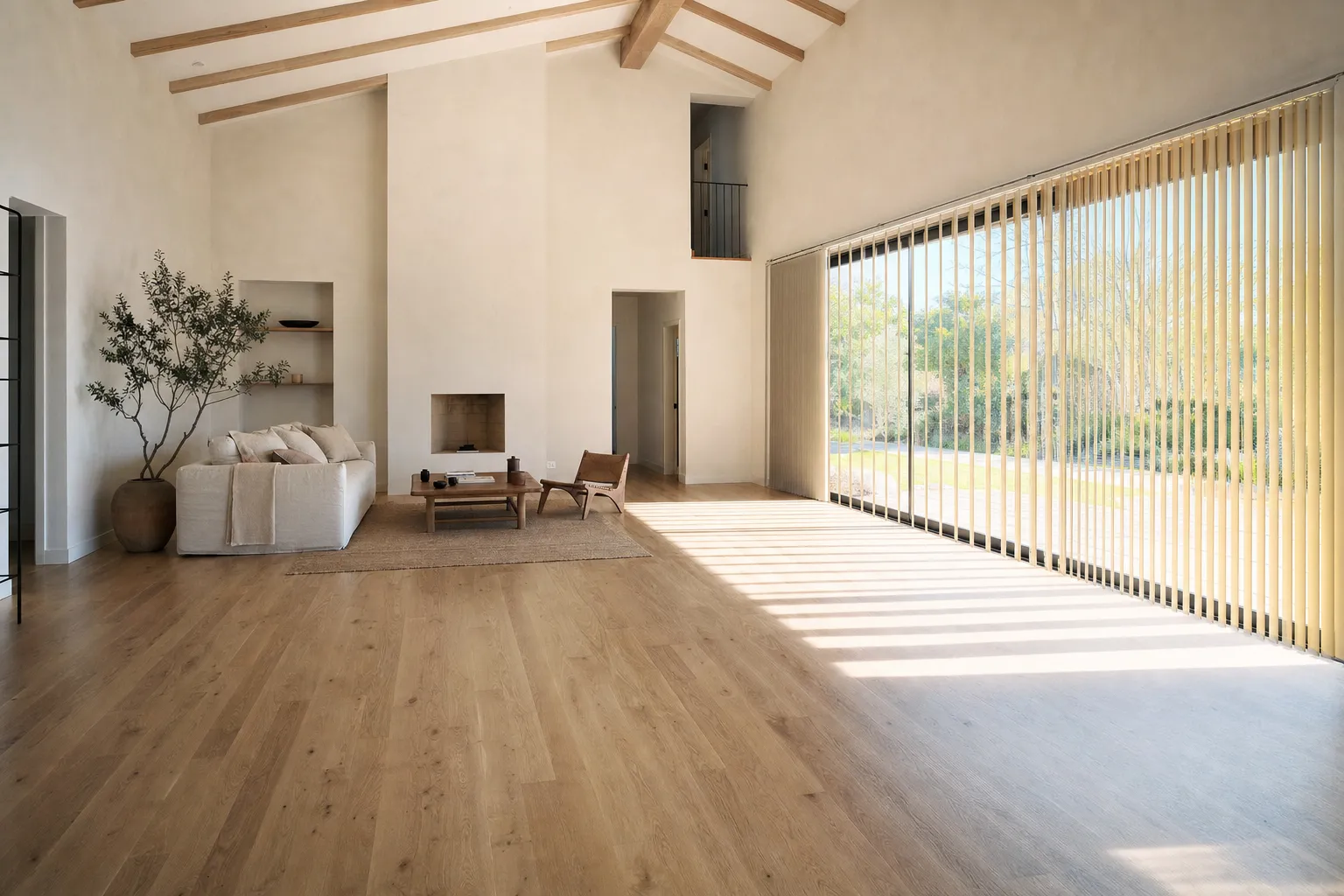
If somebody has quoted you a whole house of motorized blinds, that is worth a second opinion. In most houses two or three windows justify it.