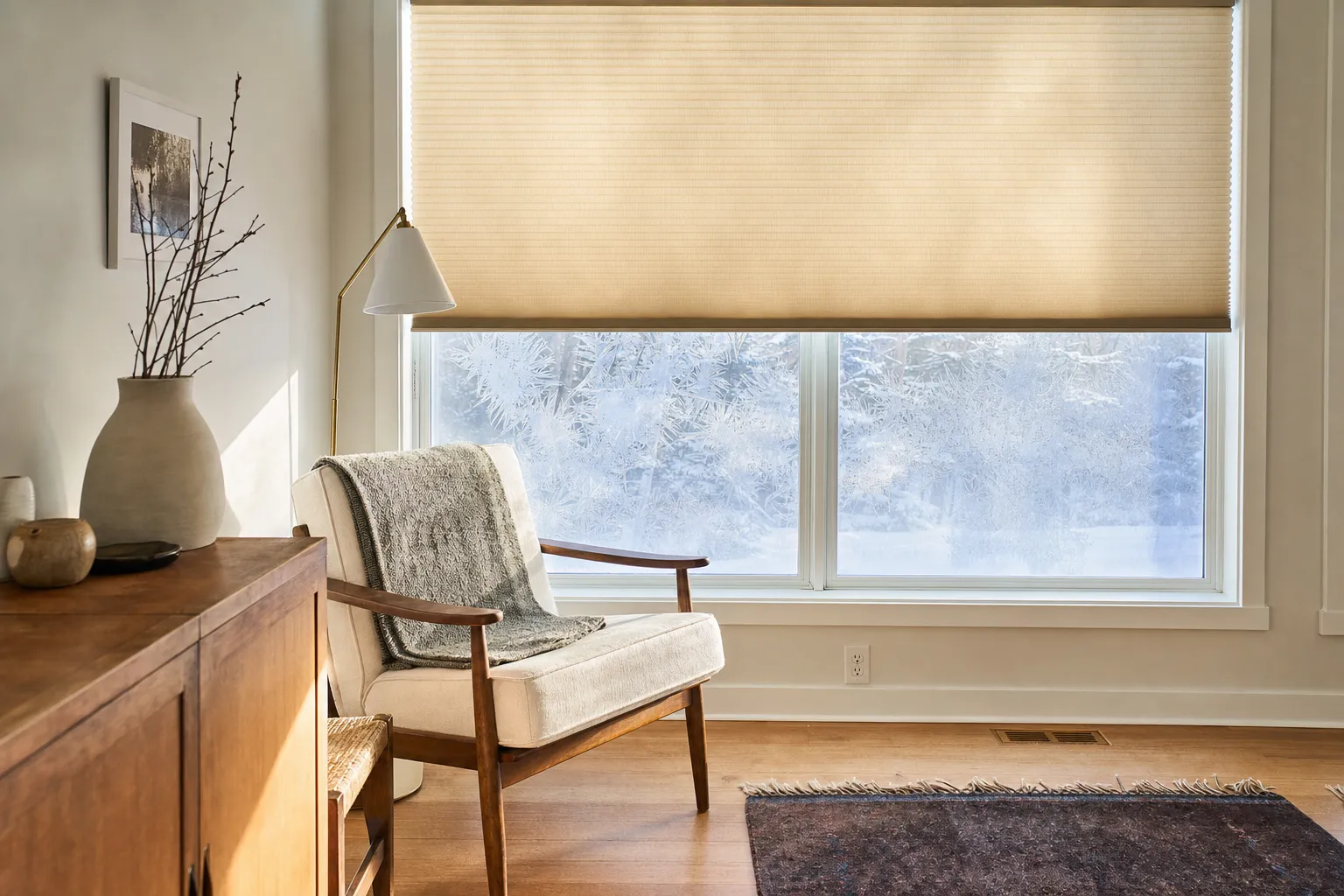
Cellular shades
Honeycomb shades: pleated fabric folded into cells that hold a layer of still air between the room and the window. The only product we make whose main argument is thermal rather than visual, which in a Canadian winter is not a small thing.
Blinds Company · Rated 4.8 out of 5 on Google
Free in-home measure · open 8am–9pm, 7 days
In short
A cellular shade is pleated fabric formed into hollow cells, and the air trapped in those cells is the product. It is the warmest window covering we make and the most compact when raised — a 2.4 metre drop stacks to about 75 millimetres. It is also the one whose performance depends most on the edges: a cellular shade hanging loose in a reveal loses most of its thermal benefit around the sides, so the mount is not a detail here, it is the specification.
Book
Let's measure your light.
We come to you, measure at your own windows, and go through fabrics and fits together. The visit costs nothing.
$99 off when you order three or more blindsApplied to your written quote at the measure.
Rather just talk?(437) 782-5452Open 8am–9pm, 7 days
The short version
Is this right for your window?
Yes — if the room is one of these.
- Cold rooms, and any window somebody sits beside in winter
- Windows where the raised stack has to be as small as possible
- Bedrooms needing darkness without a hard-edged look
Where it is wrong is below, and that half is the useful one.
And this is what you would be getting.
- 01
- Single or double cell, in several pleat sizes
- 02
- Blackout and light-filtering cell fabrics
- 03
- Top-down bottom-up on request
- 04
- Cordless as standard, motorized on request
In a room
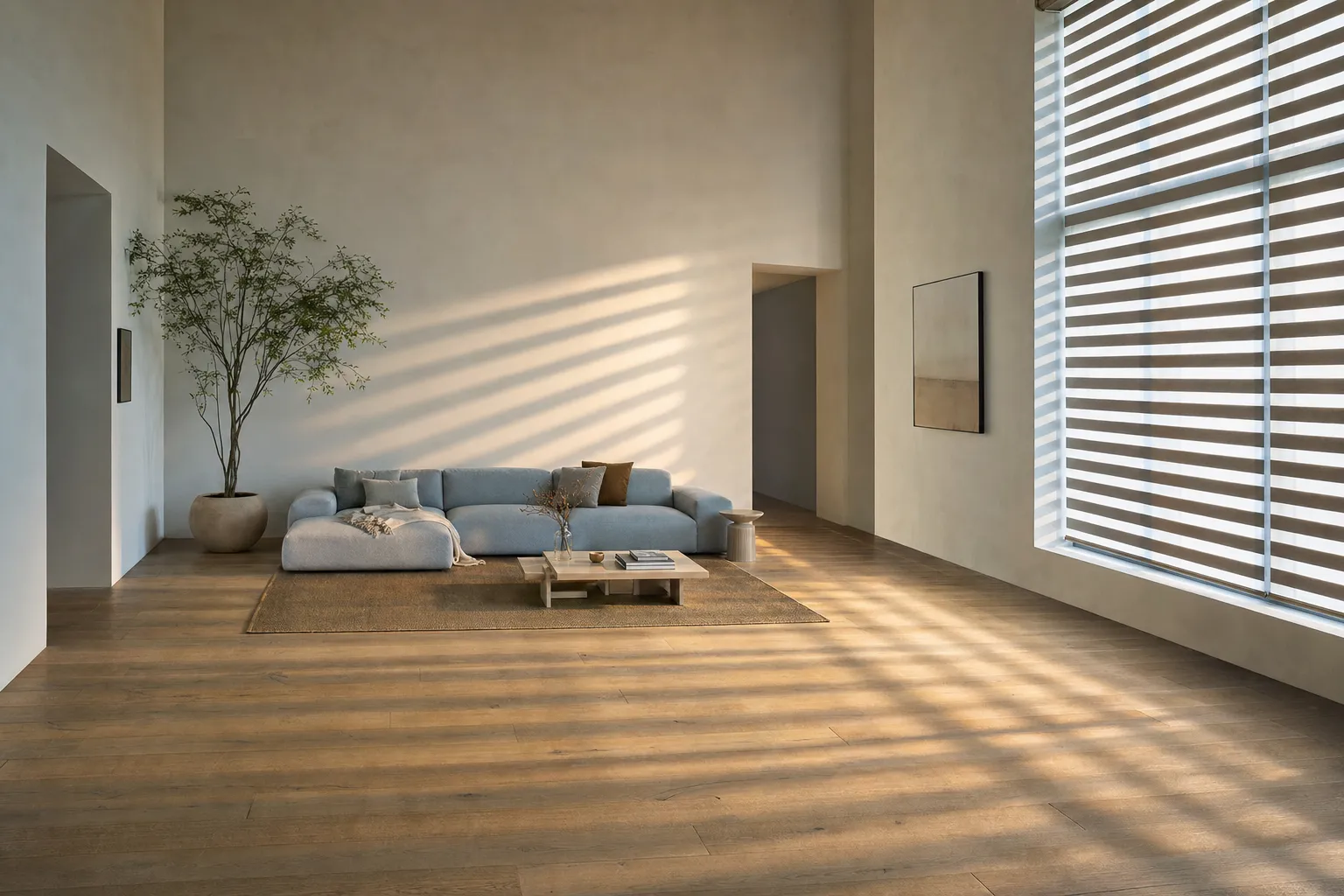
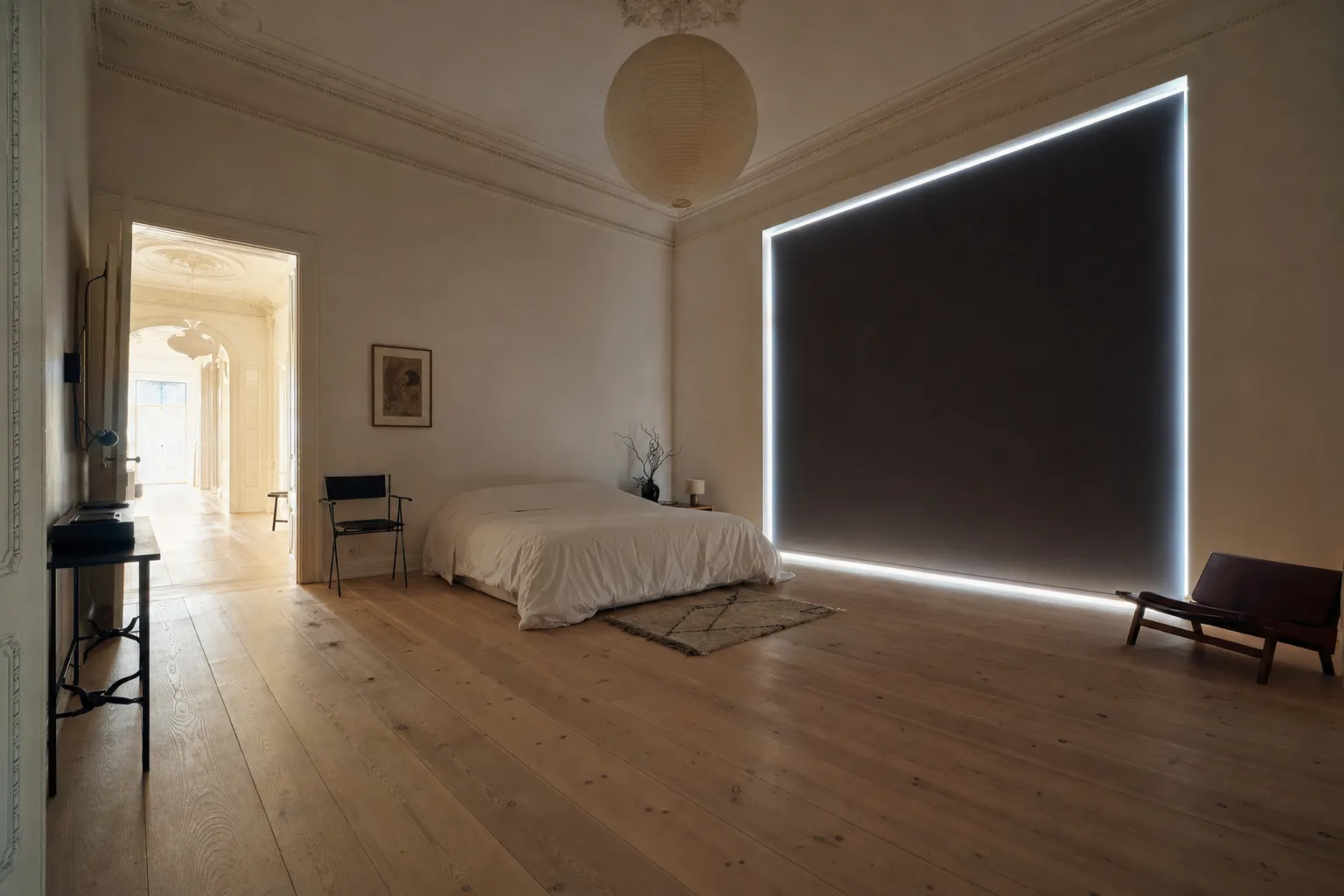
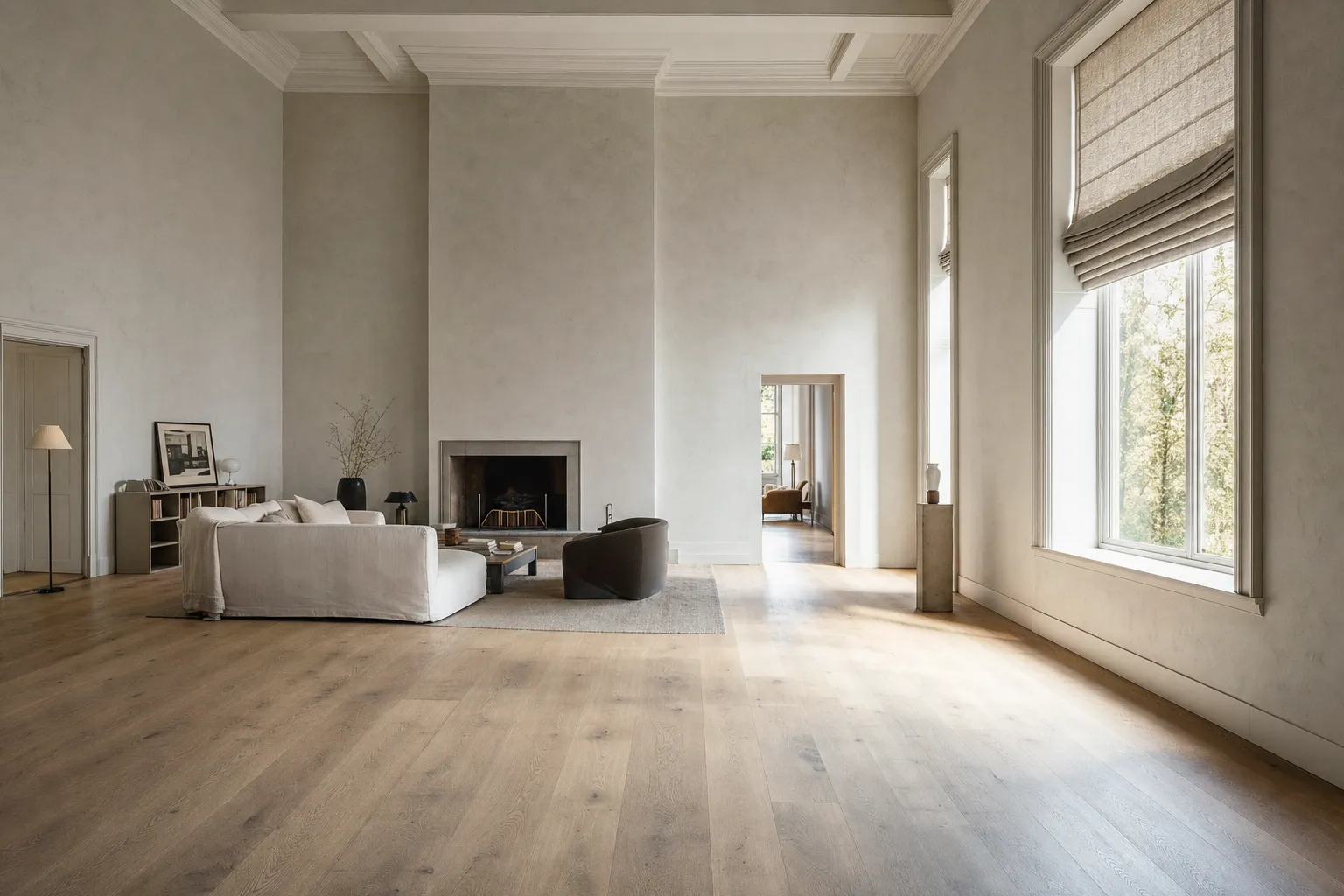
What cellular shades look like once they are up.
The product, not our installations — a gallery of rooms we did not fit would be somebody else's portfolio with our name on it.
What the cells actually do
Hold a cellular shade up to the light from the side and you can see the whole idea: the fabric is pleated and then bonded back on itself so each pleat becomes a closed hexagonal tube running the width of the shade. Those tubes are the product.
The fabric itself is unremarkable — a thin non-woven polyester. What does the work is the air inside the cells, because still air is a very poor conductor of heat. Every insulating material you own works this way: a duvet, a wool coat, the cavity in a double-glazed unit. Trap air so it cannot circulate and it becomes a barrier.
That gives this product a claim nothing else in our range can make. A roller, a venetian and a roman all reduce the light that enters a room and do very little about the heat that leaves through the glass. A cellular shade is a deliberate thermal layer that also happens to control light.
There is a second consequence of the geometry that people notice before they notice the warmth: because the pleats collapse into each other, a cellular shade stacks to almost nothing. A 2.4-metre drop gathers into roughly 75 millimetres at the head. On a window where you want the glass genuinely clear when the shade is up, this is the most compact product we make.
Where the warmth is won and lost
This is the part that decides whether you get what you paid for, and it is not the fabric.
Warm room air moving across a cold pane is what carries heat out of a room. A shade helps by getting between the two. But if the air can go round the shade — through the clearance gap at each side, over the top, under the bottom rail — it will, because a cold pane creates a slow convection current that pulls it there.
So the ranking, from least to most effective, is:
Inside the reveal, standard clearance. The shade is doing something, and around the edges the room is still breathing onto the glass. Better than a roller. Not dramatic.
Outside the opening with a generous overlap. The shade covers the opening and some wall around it, so the path around the edges is much longer and much slower. A real improvement and the cheapest way to get it.
Side channels. Aluminium sections down both sides that the shade’s edge runs inside. This closes the sides properly, and combined with a bottom rail that meets the sill it is close to sealing the window. This is where the numbers people quote for cellular shades actually come from.
Channels plus a closed head. A cassette over the top completes it.
The reason to lay this out is that cellular shades are frequently sold on a thermal claim and fitted in a way that gives up most of it. If a cold room is the reason you are buying, the mount is not a detail to settle at the end of the conversation — it is the conversation.
Single cell, double cell, and pleat size
Three specifications, and only one of them is usually worth paying to upgrade.
Cell count. A single-cell shade has one row of hexagons. A double-cell has two, front and back, so there are two dead-air layers in series. Double insulates noticeably better and is thicker, heavier, deeper and dearer. Our rule: double on a window that is genuinely a problem — a north bedroom, a room over a garage, a basement — and single everywhere else.
Pleat size. How tall each cell is, usually somewhere between about 10 and 25 millimetres. Smaller pleats look finer and are usually preferred on small windows; larger pleats suit large windows and stack slightly more compactly for the same drop. This is an appearance decision, not a performance one, and either is correct.
Fabric. Light-filtering, room-darkening or blackout. The blackout versions carry a liner inside the cell rather than on the face, which is why a blackout cellular shade still looks like fabric from the room rather than like a coated blind. That is the main aesthetic argument for this product in a bedroom.
Top-down bottom-up, which is the best privacy answer we make
Ordinary blinds cover a window from the top down. A top-down bottom-up cellular shade can also come down from the top, so the shade sits as a band across the middle or lower part of the window with clear glass above it.
For a ground-floor room facing a street or a neighbour, that is a better answer than anything else in our range. You cover the part of the window somebody can see through and you keep the part that brings in daylight and sky. No screen, no compromise about openness, no reversal after dark — the covered part is covered and the clear part is clear.
The costs are real and worth knowing. It is a more complex mechanism, so it is dearer. It has two controls, and in a room where nobody would ever use the second one that is a feature you paid for. And when the shade is in the middle position it is stacked at both the top and the bottom, so more of the window is covered by gathered fabric than with an ordinary shade.
Where we suggest it most: front rooms on a raised ground floor, bathrooms, and street-facing bedrooms in older housing.
Where a cellular shade is the wrong product
Being direct about this saves a second visit.
A kitchen or a bathroom. The cells are open at their ends. Steam gets in, cooking grease gets in, and dust settles inside them. The outside of the shade vacuums perfectly well; the inside of a cell is unreachable. In those rooms a faux wood venetian or a PVC roller will outlive a cellular shade by years.
A very wide window. Across a long span the fabric’s own weight begins to distort the cells — they flatten slightly toward the middle, and the shade develops a subtle sag along its lower pleats. There are wide-format constructions that resist it, and past a certain width the honest answer is two shades or a different product.
A window you want to look through constantly. Even light-filtering cell fabric is a diffuser, not a screen. It gives you soft daylight and no view. Where the view is the reason the window exists, a screen roller is the right product and this one is not.
A window that gets a lot of physical contact. Pets, a door that swings past, a busy hallway. The cell structure is sturdier than it looks but a crushed cell does not spring back, and one flattened pleat is visible from across the room.
What they do about sound, and what they do not
Worth a short section because it comes up and because the claims made about it are usually overstated.
A cellular shade does reduce sound reaching a room through a window, and the reason is the same as the thermal one: air trapped in cells absorbs some energy rather than reflecting it. In a room with a large glazed wall it also adds a soft, articulated surface, which reduces the hard echo that makes a modern room tiring.
What it will not do is soundproof anything. Traffic noise, a neighbour’s dog, the airport — those arrive as air pressure through the glass and around the frame, and a fabric shade is not a barrier to them. Anyone selling a window covering as soundproofing is selling something the physics does not support.
The honest summary: a noticeable improvement in how a room sounds, no measurable change in how much outside noise you hear.
How we build and fit them
Cut to the measurements taken in your home, with the head rail sized to the mount we agreed at the visit rather than to the opening on a form. Cordless as standard, because the shade’s low weight makes a spring easy to balance and because a cord on this product is unnecessary.
Where the reason for buying is thermal, we specify the mount first and the fabric second, and we will say plainly when side channels are worth the cost and when they are not.
Installed by the crew that measured. The visit is free, the quote is itemised per opening, and there is no deposit.
Living with one
Cleaning. Vacuum on the lowest setting with a brush head, shade fully lowered, both faces. For a mark, a barely damp cloth and patience — the fabric is thin and scrubbing crushes the pleat.
A crushed cell. Usually recoverable. Raise the shade fully, leave it stacked for a few days, and the pleat memory does most of the work. A hard crease from something heavy is permanent.
Dust inside a cell. Some people use a hairdryer on cool at one end of the shade to blow through the cells. It works reasonably well and it is the only method we know of that does anything at all.
How long they last. The fabric is the limit, as with everything at a window, and in a room with strong sun the visible ageing is a slight yellowing along the lowest pleats. Out of direct sun they last a very long time, because there is almost nothing mechanical to fail.
Last updated .
Cold room, high bill, or a window you sit beside in February? That is this product.
Our commitment
We specified the cell and the mount for your window, so a room that stays cold is ours.
If it does not fit, we remake it
You never held the tape.
Nothing owed before you agree
No deposit, no card.
Licensed and insured
Both, before we come in.
Your date, in writing
Set at the quote. It does not move.
We will tell you not to buy
If a stock size does it, you hear so.
Cordless where a child sleeps
Standard, at no extra charge.
Reviews on Google
What people said afterwards.
Rated 4.8 out of 5 — the ones below are quoted in full, with a link to check each on Google.
Highly recommend Nick and his team. They installed blinds in my house. Looks wonderful, cheers
Timur ShafikovNick has delivered the greatest service as I recently moved in to my new townhome and needed to have blinds for all three floor windows. Not only the price was the best, but he accommodated all my requests in the process. Definitely worth every penny
Anton Kovunov
Real names, real dates, and a link to all of them — including the ones we would not have picked.
Read them on GoogleQuestions
Before you book
Do cellular shades actually make a difference to heat?
Yes, and the size of the difference depends almost entirely on the edges. The cells hold still air, which is a genuinely good insulator — but if warm room air can slip around the sides of the shade and reach the cold glass, it does, and it takes most of the benefit with it. Fitted inside a reveal with the usual clearance gaps, a cellular shade is modestly better than a roller. Fitted with side channels or mounted outside the opening with a generous overlap, it is substantially better.
Single cell or double cell?
Double for a genuinely cold window, single for everywhere else. A double-cell shade has two rows of cells front to back, so there are two air layers instead of one and the fabric is thicker. It insulates better and it costs more, needs more depth, and stacks taller when raised. On an average window in a reasonably warm room the difference is not worth paying for; on a north-facing bedroom over an unheated garage it is.
What is top-down bottom-up, and is it worth it?
It is a shade that can be lowered from the top as well as raised from the bottom, so you can cover the lower half of a window and leave daylight coming in above it. It is the best privacy answer in the range for a ground-floor room facing a street, because you keep the sky and lose the sightline. It costs more and it adds a second control, and in a room where nobody would use the second position it is money spent on a feature.
Can a cellular shade black out a room?
The fabric can — blackout cell fabrics have a foil or opaque liner inside the cell. The perimeter is the same problem it is on any blind, and the honest answer is that a cellular shade in side channels is one of the better blackout solutions available, because the shade is already designed to sit close to the glass.
Where are they a bad idea?
Kitchens and bathrooms. The cells are open at the ends, so steam, cooking grease and dust get inside them and there is no way to clean the inside of a cell. A vacuum takes the outside; the inside is permanent. Also on very wide windows, where the fabric's own weight starts to distort the cells across the span.
Are they cordless?
By default, at no extra charge. It is also the product where cordless is most natural: the shade is light for its size, so a spring mechanism balances it easily and the whole thing operates with two fingers on the bottom rail.
Not this one?
The rest of the range.
Each of these is the wrong answer somewhere, and its page says where. That is usually the faster way to find the right one.
If one room in your house is always colder than the rest, say which window it has. That is usually a five-minute diagnosis and the answer is not always a blind.