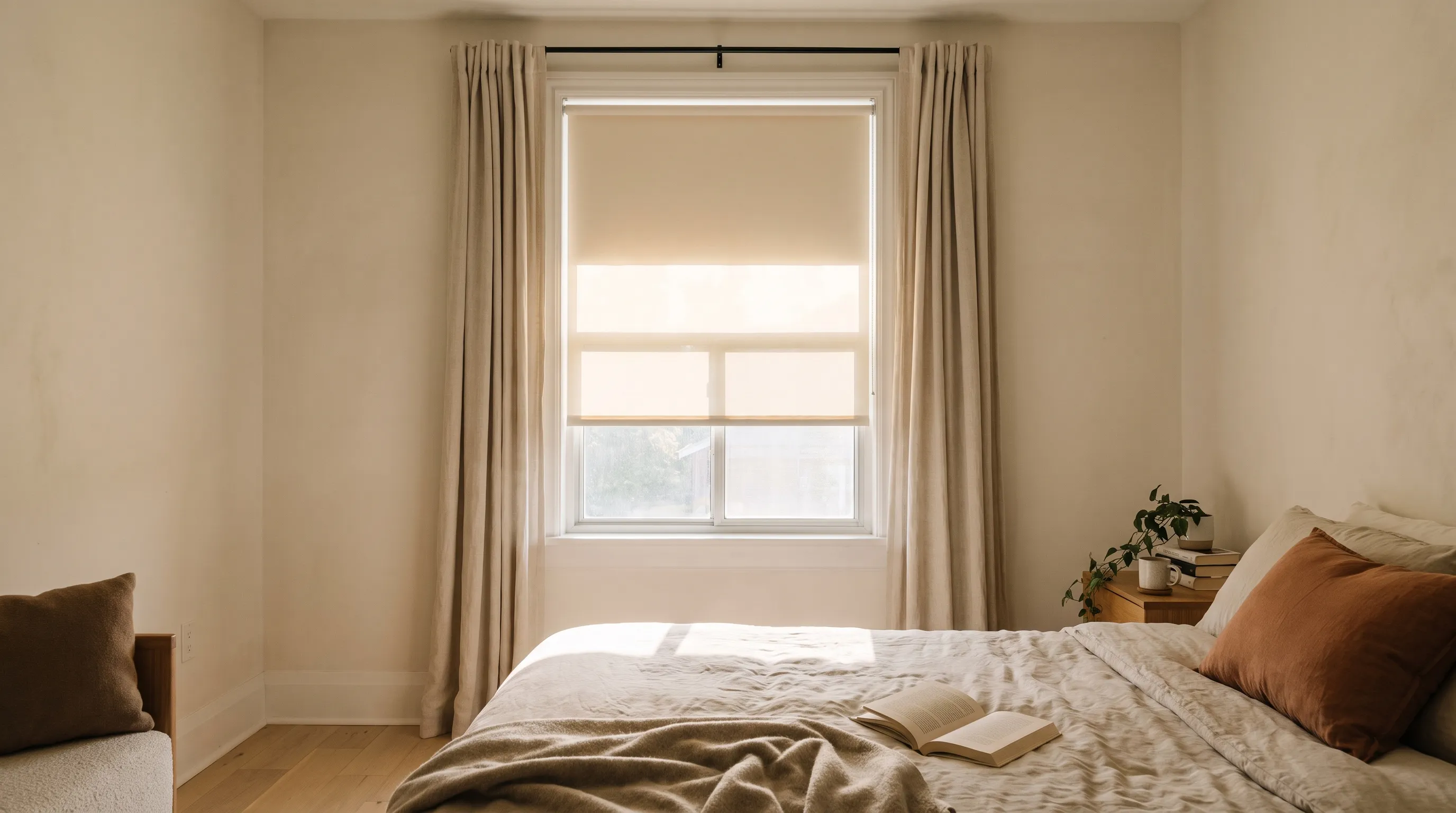
Bedroom blinds and curtains
A bedroom window is the only one in the house with a deadline. Every other room asks how its window should look; this one asks what time you want to be woken up, and everything else follows from the answer.
Blinds Company · Rated 4.8 out of 5 on Google
Free in-home measure · open 8am–9pm, 7 days
In short
Bedroom blinds and curtains are made to your exact opening and installed across Toronto and the GTA. They suit main bedrooms facing east, where the sun arrives before you want it. The in-home measure is free and carries no obligation.
Book
Let's measure your light.
We come to you, measure at your own windows, and go through fabrics and fits together. The visit costs nothing.
$99 off when you order three or more blindsApplied to your written quote at the measure.
Rather just talk?(437) 782-5452Open 8am–9pm, 7 days
The short version
Is this right for your window?
Yes — if the room is one of these.
- Main bedrooms facing east, where the sun arrives before you want it
- Rooms slept in during the day — shift work, babies, jet lag
- Guest rooms, where the honest answer is usually less than you think
Where it is wrong is below, and that half is the useful one.
And this is what you would be getting.
- 01
- Darkness specified as a level, not a word
- 02
- A control you can work from the bed, in the dark
- 03
- Cordless as standard in any room a child uses
- 04
- Blind and curtain layered, where the room needs both
In a room
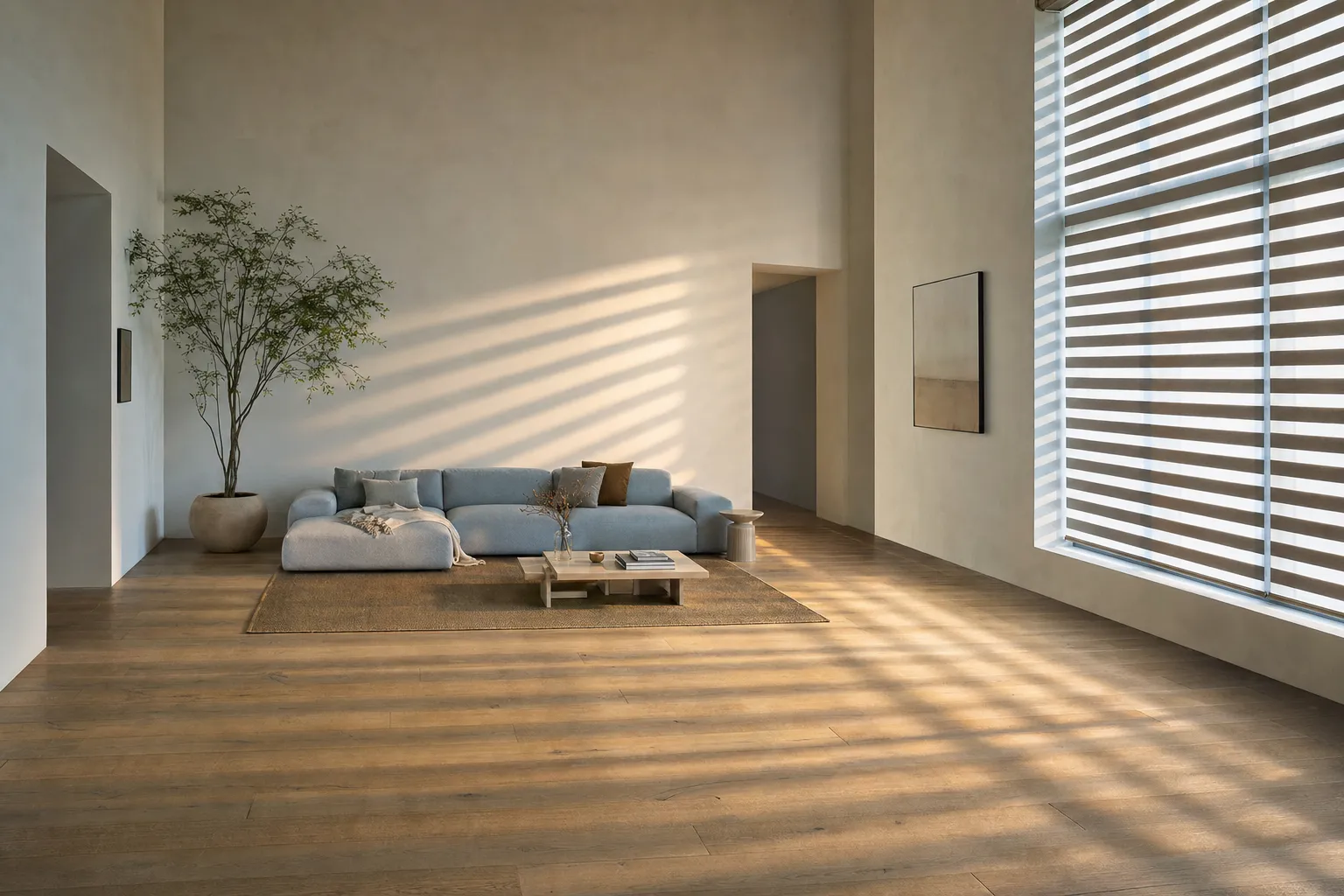
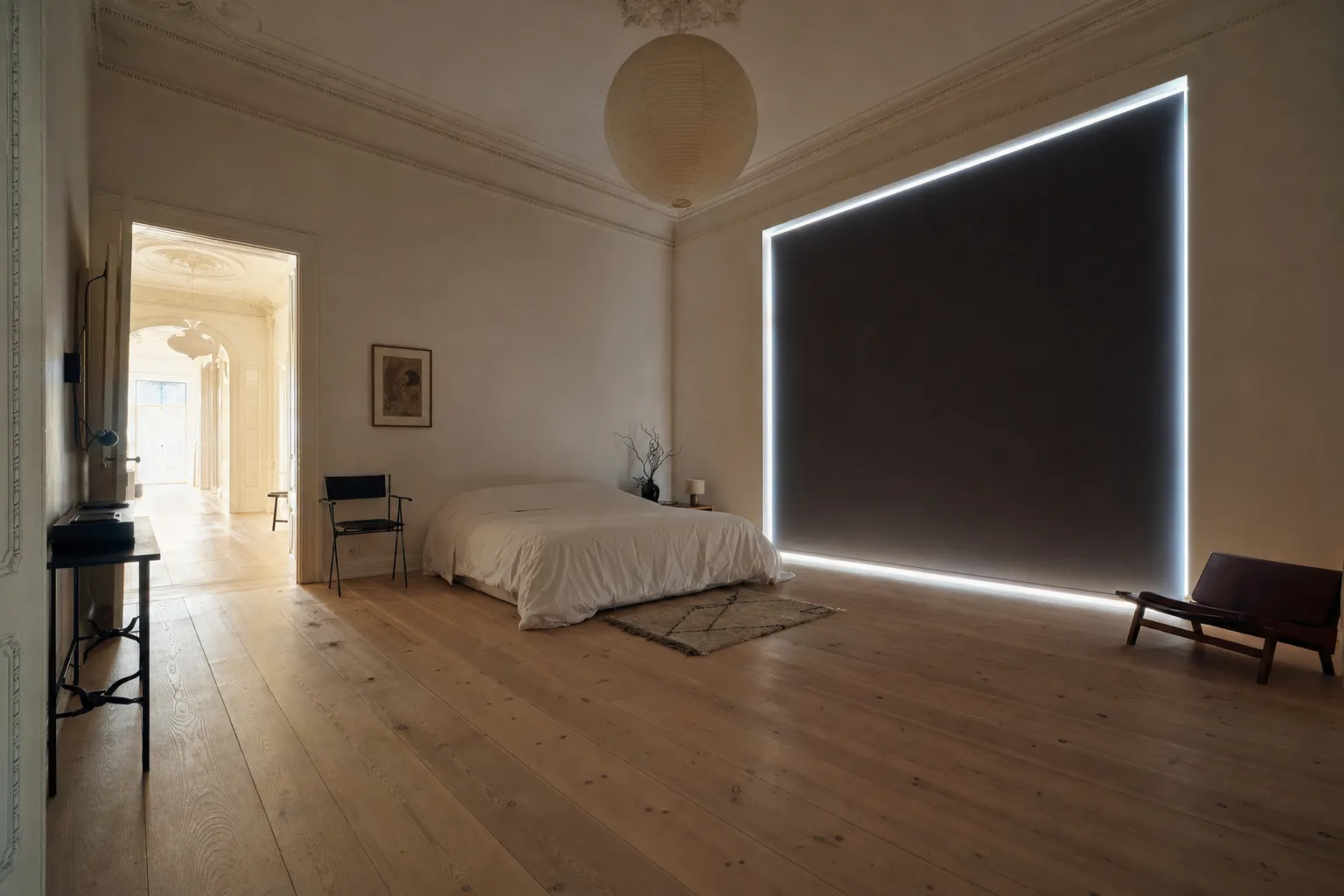
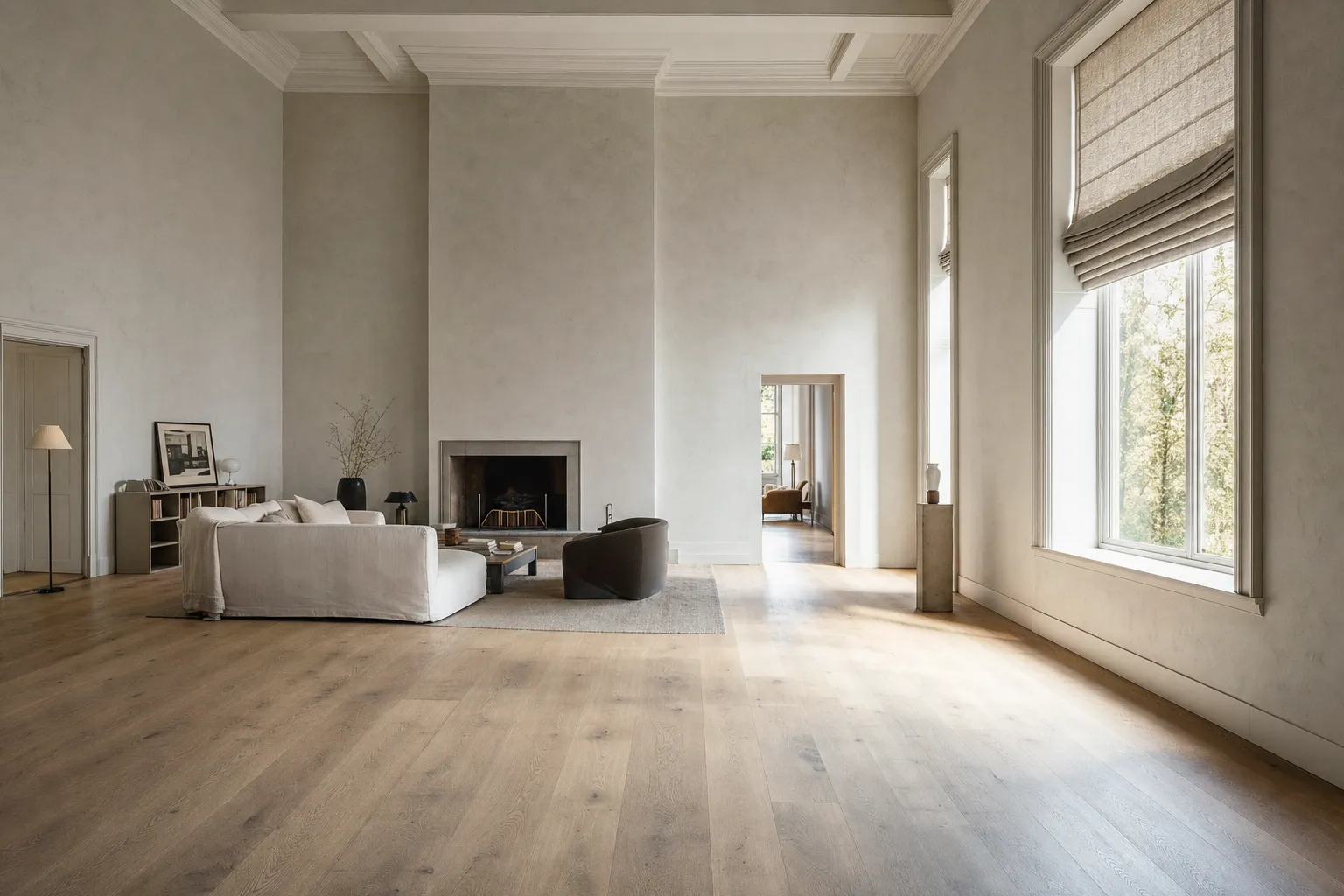
What bedroom blinds and curtains look like once they are up.
The product, not our installations — a gallery of rooms we did not fit would be somebody else's portfolio with our name on it.
Four jobs, and only one of them is about how it looks
Every room asks its window for something. A bedroom asks for four things at once, and they do not have equal weight.
Light, at a specific hour. This is the one with a deadline and it is the reason most bedroom coverings get bought.
Privacy, at a different hour. A bedroom is lit from inside at night, which is exactly when the glass turns into a mirror for you and a window for everyone else. A covering that solves the morning does not automatically solve the evening.
Warmth, in February. A bedroom is often the coldest room in a Toronto house, because the heating gets turned down at night and the window is the leakiest part of the wall.
The look. Real, and last. It is the only one of the four that has no number attached to it, which is why it should not be the first thing decided.
Almost every disappointing bedroom window we are called back to was specified on the fourth thing and judged on the first.
The hour, not the look
The useful question is not “how dark do you want it” — everyone says very dark — but “what time do you want to still be asleep”.
Put a number on it and the specification writes itself. In late June the sun is up over Toronto and the GTA at about twenty to six in the morning. If you get up at seven, an east-facing bedroom with an ordinary covering gives you roughly eighty minutes of daylight you did not ask for, every morning, for the weeks either side of the solstice. A west bedroom has the mirror-image problem in the evening, which matters if anybody in the house sleeps before dark.
Three things follow from that number.
It is seasonal, and it is worst when you least expect it. Nobody buys bedroom blinds in June. They buy them in November, when the sun comes up at half seven and any fabric looks adequate, and they discover the gap the following summer.
Which direction the window faces is a specification, not a detail. We ask at the measure and write it on the quote, because an east window and a north window in the same house honestly need different fabrics.
A partial answer is worth real money. Going from “the room is bright at half five” to “the room is dim at half five” is most of the benefit. Going from dim to genuinely dark is a second, smaller step and it costs disproportionately more. The first step is nearly always worth it. The second one is a real decision and we will tell you when we think you are buying it for the word rather than for the sleep.
How dark you actually need, and where that argument lives
There are three honest levels and the words for them are not interchangeable.
Dim. You can see the shape of the room. Ordinary lined fabric does this and it is enough for a great many people.
Dark. You cannot read, colours have gone, and there is a visible outline of light around the blind. A blackout fabric does this. This is where most bedrooms land and it is the best value on the page.
No visible light. The outline is gone too. This needs the blind to be trapped at its edges rather than merely made of the right cloth, and that is equipment rather than fabric.
What separates those three, what the third one costs, why the gap at the top behaves differently from the gaps at the sides, and how the vocabulary is used loosely in the trade — all of it belongs to the blackout blinds page, because it is a property of the product rather than of the room. Read that one before deciding, and come back here for the rest.
The control is the bedroom decision
This is the part that gets left off quotes, and it is the part that decides whether you are still happy in a year.
Think about when a bedroom covering is actually touched. Once at night, in a room you are about to sleep in, often with the light already off. Once in the morning, before your eyes have adjusted, sometimes while somebody else is still asleep. It is the only covering in the house routinely operated by a person who is not fully awake and cannot see it properly.
Every other room’s blind is set at a height and left there for a season. A bedroom blind moves twice a day, every day.
That changes what “a good control” means.
It has to be findable without looking. A chain hanging at one side is fine when you can see it. In the dark it is a thing you pat the wall for. A wand is worse for this, not better, because it swings. A wall switch at a known height, or a blind that runs on a schedule, removes the problem entirely.
It has to be quiet. A chain against a frame at half five is a noise in a room where somebody is still asleep. Modern motors are quieter than a chain and much quieter than a roller let go by accident.
It has to be reachable from where you actually are. Which is usually in bed, not standing at the window. If the window is behind the bed, a hand control at the window is a control you will use once.
That is the honest case for a motor in this room, and it is stronger than the case anywhere else in the house. It is not about luxury; it is that the daily action here is genuinely awkward and the alternatives are worse than they look in a showroom. Where it is not justified — a guest room, a room used for storage, a window somebody opens twice a summer — we say so.
If a motor is out of scope, the next best arrangement is a control at the end of the window nearest the bed, set at a height you can reach sitting up, and the same side in every bedroom in the house so your hand learns one place.
When the bed is under the window
Common in older Toronto bedrooms, where the room is narrow and the window is centred on the only wall long enough for a bed. It changes three measurements.
Height. The covering has to clear the headboard, or every night somebody catches it getting into bed. That usually means mounting above the opening rather than inside it, which has the side benefit of killing the light leak down each side.
Width. Mounted above and outside, the blind should be wider than the opening. On a bedroom window that is not a cosmetic preference: the strip of light down each edge lands at head height when you are lying down, which is the one position from which it is most annoying.
Where it stops. The bottom of the blind wants to finish clear of pillows. Fabric that rests on bedding gets pulled sideways every time the bed is made, and a blind pulled sideways enough times stops hanging square. This is the commonest avoidable damage we see in bedrooms and it is decided at the measure by a centimetre or two, not afterwards.
There is a fourth thing that is not a measurement: a covering directly over a bed is a covering somebody’s head is under all night. Nothing that hangs loose, nothing with a cord, and nothing heavy on a fixing we have not checked.
Two layers, and which one to buy first
A great many bedrooms end up with a blind and curtains on the same window, and it is worth being clear about why, because “both” sounds like being sold twice.
They are not doing the same job.
The blind is the instrument. It sits close to the glass, it has a hard edge, it controls light in a measurable way and it is what decides what time the room gets bright.
The curtain is the room. It covers the frame and the blind’s hardware, it puts a soft folded surface on a wall of hard flat ones, it closes the visual gap between the window and the furniture, and it makes the window read as part of a room rather than as an opening with something fitted in it.
Each is bad at the other’s job. A curtain alone leaks light at the top and sides worse than any blind does, because it hangs rather than fits. A blind alone leaves the room feeling like an office at night.
If you can only do one now, do the blind. It is the half that changes your morning. Curtains are also the easier half to add later, because they hang from a track that does not care what is behind it — whereas retrofitting a blind behind existing curtains means working around a pole that is already up.
One thing to decide at the measure even if the curtains are for later: whether the blind is fitted inside the reveal or above it. That choice determines where a curtain track can go afterwards, and getting it wrong is the reason some rooms end up with a track that fouls the blind’s headrail.
The guest room, where we will talk you down
Worth a section because it is the most common place we quote less than we could.
A guest room is used, in most houses, somewhere between six and twenty nights a year. The window is behind a closed door for the rest of it. Whatever is on it does not need to survive daily operation, does not need to be findable in the dark by somebody who lives there, and does not need to solve a five-forty sunrise for somebody who will be awake anyway because they are away from home.
What it does need: to make the room dark enough that a guest sleeps, to look like somebody thought about it, and to still work in five years when it has been opened two hundred times rather than four thousand.
A room-darkening roller on a simple control does all of that. So does a cellular shade if the room is cold, which guest rooms often are because nobody heats them.
The money that would have gone into the upgrade is better spent on the room you sleep in every night, and if you are doing both rooms at once we will say which is which on the quote rather than quoting the same specification twice.
Cots, children’s rooms, and the fact that furniture moves
Short, because the safety rule is not a preference and the product argument belongs elsewhere.
Cordless is standard in any room a child uses, at no extra charge. That is not a line about this page — it is how we specify, and it applies to a room where a child sleeps occasionally as much as to a nursery.
The part worth adding here is about the room rather than the blind: a cot is furniture and furniture moves. It gets shifted for a decorator, for a second child, for a rearrangement somebody does on a Saturday. Any specification that depends on the cot being where it is today has a shelf life measured in months. We specify as though the bed will end up under the window, because in a fair number of rooms it eventually does.
Where a room needs to be dark for daytime naps, that is the same problem shift workers have and it is answered on the blackout blinds page.
What the visit involves
The window measured, and then a short conversation about your mornings, because most of this page is about the hour rather than the glass.
Which direction the window faces, and what time the sun reaches it. What time you want to still be asleep, and whether anybody in the house sleeps in the daytime. Where the bed is now and whether it has always been there. Whether a light sleeper and a heavy sleeper share the room, because that is a real specification difference and nobody volunteers it.
Then the practical things: whether the headboard fouls the opening, where a hand would naturally reach from the bed, whether there is a socket near the window if a motor is on the table, and whether curtains are coming later — because that decides where the blind is mounted today.
Samples are held at the window rather than shown at a table, and if the room has a sunrise problem we would rather come back at an hour when you can see it than describe it to you.
You keep a written quote with a line per opening, the fabric named, the darkness level stated in plain words rather than in the word blackout, and the control type written down. No deposit, no card, nothing owed either way.
Last updated .
Want to know what your bedroom window actually needs? The measure is free and takes under an hour.
Our commitment
We chose a control you can find in the dark, so a blind you stop using is our mistake, not yours.
If it does not fit, we remake it
You never held the tape.
Nothing owed before you agree
No deposit, no card.
Licensed and insured
Both, before we come in.
Your date, in writing
Set at the quote. It does not move.
We will tell you not to buy
If a stock size does it, you hear so.
Cordless where a child sleeps
Standard, at no extra charge.
Reviews on Google
What people said afterwards.
Rated 4.8 out of 5 — the ones below are quoted in full, with a link to check each on Google.
Highly recommend Nick and his team. They installed blinds in my house. Looks wonderful, cheers
Timur ShafikovNick has delivered the greatest service as I recently moved in to my new townhome and needed to have blinds for all three floor windows. Not only the price was the best, but he accommodated all my requests in the process. Definitely worth every penny
Anton Kovunov
Real names, real dates, and a link to all of them — including the ones we would not have picked.
Read them on GoogleQuestions
Before you book
What is the best blind for a bedroom?
Whichever one you will still be using in a year, which is a question about the control rather than the cloth. In practice a blackout roller does the light job most cheaply, a cellular shade does it while also being the warmest thing we fit, and a roman does it while looking like furniture. All three can be made in a blackout fabric. What separates them in a bedroom is how each feels to operate at six in the morning without turning a light on.
How dark can a bedroom actually get?
Darker than most people have experienced and not as dark as the word blackout suggests, unless you spend on side channels. A blackout fabric stops essentially all light through the cloth; what you are left with is a thin outline where the blind meets the reveal. In a room that is otherwise unlit, that outline is visible and it is enough to read a clock by. Whether that matters is a genuine question and the honest answer differs per person — the detail is on the blackout blinds page.
Do I need both a blind and curtains?
Often, and for two different jobs rather than one job twice. The blind controls light with a hard edge and sits close to the glass. The curtain softens the room, covers the frame, takes the hard sound off the walls and hides the blind when it is up. If you can only do one now, do the blind first: it is the half that changes what time you wake up.
Are cords safe in a child's bedroom?
We do not fit them. Cordless is standard in any room a child uses, at no extra charge, and that includes a room where a child sleeps occasionally. A cot is also a moving object — it gets shifted for a cleaner, a decorator or a second child — so "the cot is not near the window" is a fact with a short shelf life, and we specify as though it will move.
The bed is right under the window. Does that change anything?
Yes, three things. The covering has to clear the headboard, so the mount goes higher and often wider than it would otherwise. The control has to be reachable from lying down rather than standing, which usually decides it in favour of a motor or a wand at the near end. And the bottom of the blind wants to be clear of pillows, because fabric resting on bedding is fabric that gets pulled and eventually hangs crooked.
Is a motor worth it in a bedroom?
This is the one room where we say yes more often than no, and the reason is not laziness. A bedroom covering is operated twice a day, in low light, by somebody who has just woken up or is about to sleep. Every other room's blind gets set and left. If a motor is going anywhere in the house, the argument for it is strongest here — and weakest in a spare room nobody sleeps in.
What about a guest room?
Spend less, deliberately. A room used a dozen nights a year does not need the specification a main bedroom needs, and we would rather say so than quote you the same thing twice. A room-darkening roller on a simple control is usually the right answer, and the money is better spent on the room you sleep in every night.
Not this one?
The rest of the range.
Each of these is the wrong answer somewhere, and its page says where. That is usually the faster way to find the right one.
If a quote for a bedroom names the fabric and says nothing about how you open it, ring before you sign. The fabric is the easy half.