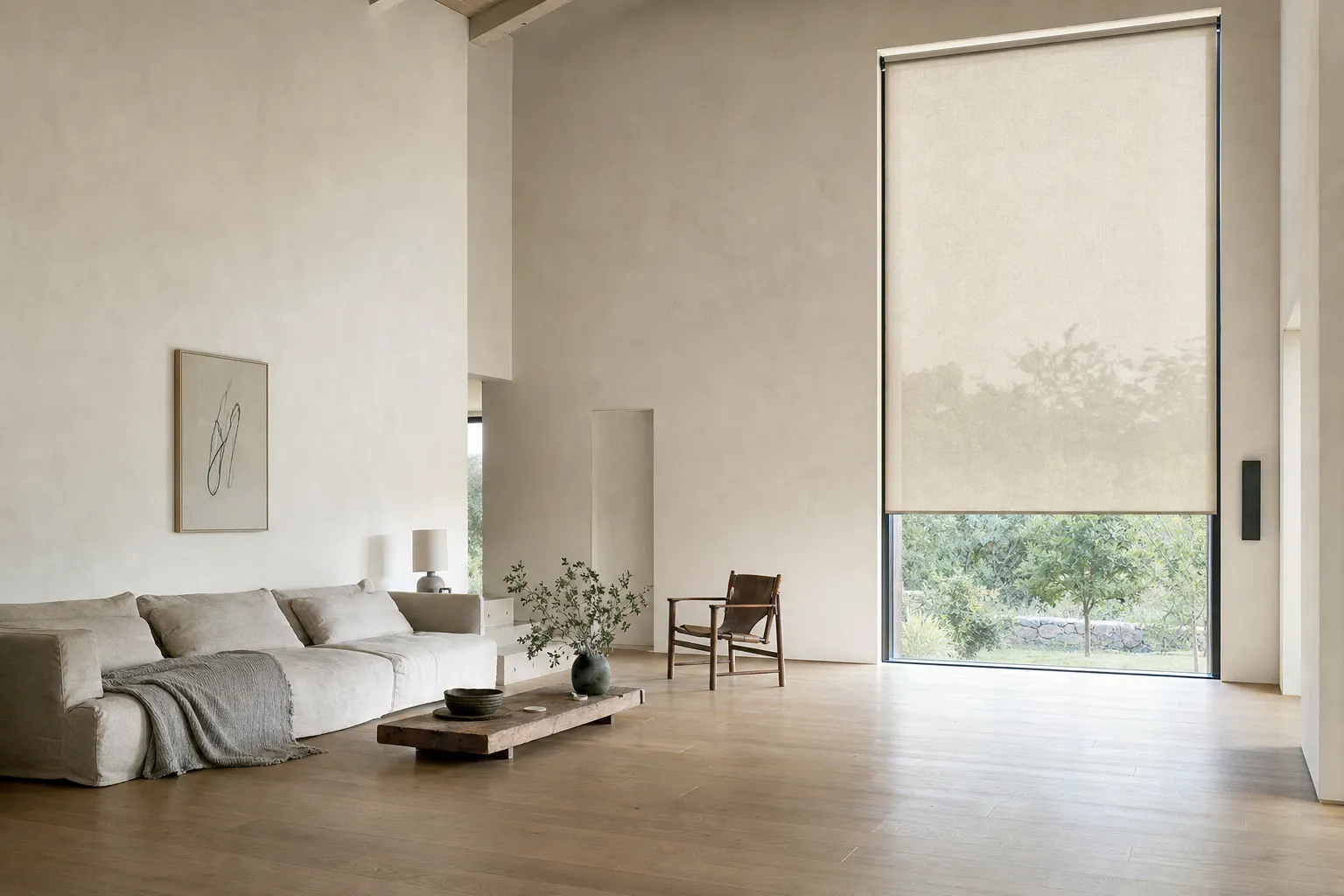
Roller blinds
One flat plane of fabric on a tube. The least visible thing you can put across a window, and the widest fabric choice of anything we make — which is why the decision here is almost never about the mechanism.
Blinds Company · Rated 4.8 out of 5 on Google
Free in-home measure · open 8am–9pm, 7 days
In short
Roller blinds are made to your exact opening and installed across Toronto and the GTA. They suit large modern glass, where slats would read as clutter. The in-home measure is free and carries no obligation.
Book
Let's measure your light.
We come to you, measure at your own windows, and go through fabrics and fits together. The visit costs nothing.
$99 off when you order three or more blindsApplied to your written quote at the measure.
Rather just talk?(437) 782-5452Open 8am–9pm, 7 days
The short version
Is this right for your window?
Yes — if the room is one of these.
- Large modern glass, where slats would read as clutter
- Condos with shallow reveals and a slim cassette
- Any room where the covering should disappear when it is up
Where it is wrong is below, and that half is the useful one.
And this is what you would be getting.
- 01
- Openness from 1% to 10%, or full blackout
- 02
- Cassette or open roll, cordless as standard
- 03
- The slimmest stack of any product when raised
- 04
- Cut to your opening, not trimmed to fit
In a room
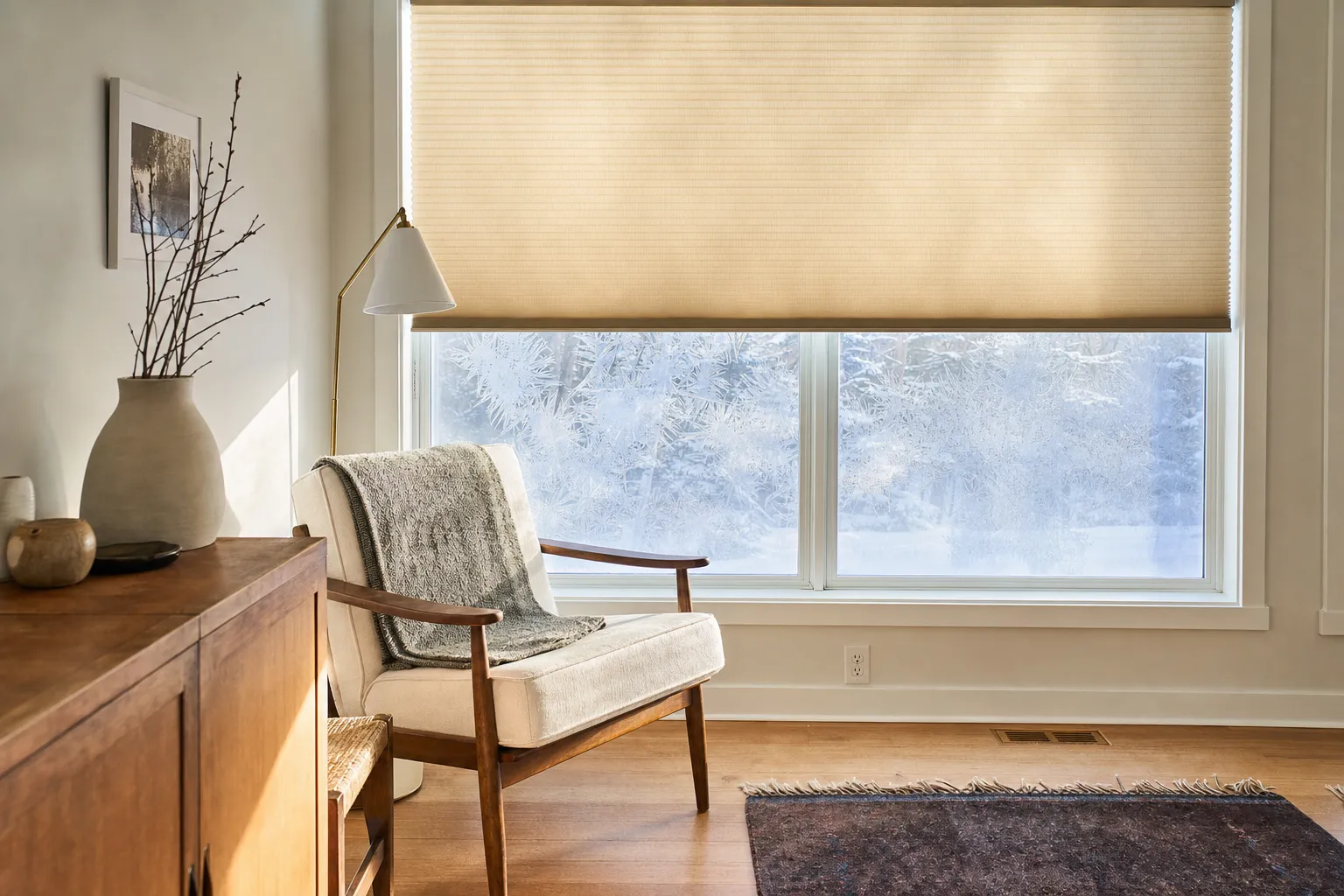
What roller blinds look like once they are up.
The product, not our installations — a gallery of rooms we did not fit would be somebody else's portfolio with our name on it.
Roller blind or roller shade — the same thing
Worth clearing up first, because it sends people looking in two places for one product.
They are the same. “Roller shade” is the North American name and “roller blind” is the British and Australian one, and both describe a single flat piece of fabric wound onto a tube. Canada uses both, often in the same conversation and sometimes in the same showroom. Nobody is describing a different mechanism, a different fabric range or a different price.
The one place the words diverge slightly is in general use rather than in this product. Strictly, a blind has slats or vanes you can tilt and a shade is a continuous piece of material — by that rule a roller is a shade and a venetian is a blind. In practice almost nobody keeps to it, which is why “roller blind” survives for a product that technically is not one.
So if you arrived looking for roller shades in Toronto, this is the page. Nothing below changes depending on which word you used.
The mechanism is the easy part
A roller is the simplest thing in the range: fabric, a tube, a bracket at each end. Almost nothing about the mechanism will change your experience of the room. What will change it is the cloth, and there are more cloth decisions here than in any other product we make.
That is worth saying plainly, because roller quotes are usually compared on the wrong axis. Two quotes for “roller blinds” can differ by three times, and the difference is almost never the hardware.
Openness factor, and what it actually controls
Screen fabrics are woven with a stated percentage of open area. That single number sets three things at once, and they pull against each other.
View out. A 10% screen keeps the street, the trees and the weather. A 1% screen is close to opaque and you will mostly see the fabric.
Glare. Lower numbers cut more. If the complaint is a specific hour of sun on a television or a monitor, you are looking for 1–3%, and going lighter to keep the view will not solve it.
Daytime privacy. A tighter weave makes it harder to see in while it is brighter outside than inside. None of this survives nightfall — with the lights on, the effect reverses and a screen shows silhouettes to the street.
There is no fabric that wins on all three. Anybody selling you one is describing a compromise as a feature.
Colour matters more than people expect
A dark screen gives the best view out and the best glare control, because your eye adapts to the darker frame around the bright glass. A light screen reflects more solar heat back through the window before it enters the room.
So on a west-facing room the choice is genuinely between seeing better and being cooler, and which one wins depends on whether the problem is your eyes or the temperature. We will ask which it is before recommending either.
Where a roller is the wrong answer
A bedroom you sleep in during daylight. A screen passes light by design and a dim-out is not a blackout. If the room must go dark, you want an opaque fabric and, on most windows, side channels — see the blackout page, which is a longer argument about edges rather than cloth.
A room that needs an angle. A roller is up or down. If what you want is to redirect light onto the ceiling and keep the room bright while killing the glare at eye level, that is a venetian, and no roller fabric will do it.
A very wide patio door. Possible, but the tube gets heavy and the split has to fall somewhere. Verticals and drapery stack sideways, which is why they are still the usual answer for that opening.
How we build them
Every blind is cut to the measurement taken in your home — width and drop measured three times each, and cut to the tightest of them, because houses move and half an inch of difference between the top and bottom of the same window is ordinary in older Toronto housing.
They are manufactured under our own name rather than bought in and badged, which is why there is no third-party label on the headrail and no brand markup in the price. Cordless is our default in any room a child uses, at no extra charge.
The measure is free, takes under an hour, and if the honest answer is that your window takes a stock size from a big-box store, you will hear that at the door.
Regular roll or reverse roll
A roller can be built with the fabric coming off the front of the tube or off the back, and it is the one specification people are never asked about even though it changes both how the blind looks and how well it works.
Regular roll brings the fabric down the room side of the tube. The roll sits closer to the glass, the fabric hangs a little further into the room, and the back of the tube is what you see from outside.
Reverse roll brings it down the window side. The fabric hangs nearer the glass, which closes the gap between fabric and window and cuts the light that sneaks around the back — worth having on a screen you are using for glare. It also clears an obstruction on the sill: a crank handle on a casement window, or a deep sill trim, will foul a regular roll and not a reverse one.
The catch with reverse roll is depth. Because the fabric drops on the far side, the assembly needs more room front to back, and a shallow condo reveal may not have it. This is the sort of thing that gets decided by whoever assembles the blind if nobody asks, and then it is decided by the factory’s default rather than by your window.
The tube, the weight, and where a wide roller stops working
A roller is a cantilever. The fabric hangs off a tube supported only at its two ends, and every extra centimetre of width adds both weight and leverage.
Past a certain span the tube visibly deflects at the centre — the bottom bar sits lower in the middle than at the ends, and on a light-coloured wall you can see the curve. The fix is a larger diameter tube, which is why a wide blind is not simply a narrow blind with more fabric in it. A 38mm tube that is perfect at 1.2m is the wrong specification at 2.6m, and using it anyway is how a blind ends up sagging inside a year.
There is a point past which no sensible tube holds the line, and then the opening gets two blinds on a shared bracket line. We position the join deliberately — against a mullion if the window has one, so the seam falls where the eye already expects a vertical.
Fabric weight moves that limit too. A blackout is heavier than a screen of the same size, so the same window can take a wider screen than it can a blackout. If you are comparing quotes and one is noticeably cheaper on a big window, the tube is the first thing to check.
The four fabric families, named properly
“Roller blind” describes a mechanism, not a cloth, and almost every disappointment with this product is somebody who bought the right mechanism with the wrong family of fabric. There are four, and the names get used loosely by everyone including manufacturers.
Screen. A woven mesh with a stated percentage of open area. You can see through it. It cuts glare and solar heat while keeping a view, it gives daytime privacy and none at night, and it never makes a room dark. This is the family for living spaces, offices and anywhere the window is worth looking out of.
Dim-out. A dense weave with no deliberate perforation. You cannot see through it and it is not opaque — on a bright afternoon you will see the shape of the window glowing behind it. It reads softer than a blackout, it gives complete privacy day and night, and in an ordinary bedroom used at night it is frequently all anybody needs.
Blackout. A cloth with an opaque coating or a bonded backing, passing no light through the material at all. This is the only family that can make a room genuinely dark, and even then only if the perimeter is dealt with. It is stiffer, heavier and less pleasant to the hand than a dim-out, which is why it belongs in the rooms that need it rather than throughout a house.
Decorative. Textured, patterned or natural-fibre cloths that are chosen for how they look and behave incidentally. Light control ranges from almost none to moderate. Legitimate in a room where the window is decoration, wrong in a room with a job to do.
Two things follow from the list. The first is that “roller blinds” quoted at one price across a whole house is quoting one family for rooms that need different ones. The second is that the word “blackout” gets applied by retailers to anything dark, so it is worth asking whether a fabric is coated or simply dense — the answer decides whether the room can ever be dark.
The bottom bar, which is the part you actually touch
Every other component on a roller is chosen by us. The bottom bar is the one the person living with it puts a hand on several times a day, and it is almost never discussed at the point of sale.
Three things about it matter.
Weight. The bar tensions the fabric and keeps it hanging flat. Too light and the cloth ripples across the width and lifts in a draught; too heavy and a spring mechanism has to be wound harder to balance it, which makes the blind snappier than it should be. On a wide blind the bar is doing real structural work, and it is one of the quiet differences between a made-to-measure blind and a boxed one.
Whether it is enclosed. A sewn hem hides the bar inside the fabric and gives the cleanest edge — the blind reads as a single plane all the way down. An exposed bar in aluminium is more robust, is the only sensible choice on a heavy blackout, and gives you something definite to grip. On a screen used many times a day, an exposed bar wears better.
Whether it is straight. This sounds like a joke and it is the most common complaint about cheap blinds. A bar that is not stiff enough for the span bows slightly under the fabric tension, and once you have noticed the bow at the centre of a three-metre blind you will notice it every day. Span decides the section, and that is a specification rather than a preference.
Where somebody in the house has weak hands or limited reach, the bar is also the control, and that pushes the answer toward an exposed bar with a definite lip rather than a neat sewn hem you have to pinch.
How long a roller lasts, and what ends it
A well-made roller in an ordinary room lasts a very long time. The mechanism is simple, there is little to wear, and the thing that ends its life is almost never the thing people expect.
It is not the spring. A quality spring mechanism outlives most of the rooms it is fitted in, and where it does weaken it can usually be re-tensioned rather than replaced.
It is not the tube. Aluminium in a dry room does nothing at all for decades.
It is the fabric, and specifically the sun. Ultraviolet breaks down the coating on a blackout and the yarn on a screen, and it does it fastest at the bottom of the blind, because the bottom is the part that is out in the light in every position. On a south or west window a cloth that is left down all afternoon will show its age along the lower third first: stiffening on a coated blackout, and a slight loss of colour on a screen.
Two practical consequences.
If a blind is only ever half down, the exposed half ages and the rolled half does not — so after some years, fully lowering it shows a line. Not a fault; physics. Where a room’s habit is a permanent half-mast position, that is an argument for choosing a fabric with a proper UV rating rather than the prettiest sample.
And in a room where the sun is genuinely brutal, the honest lifespan expectation for a light-coloured screen is shorter than for a dark one, because the visible change is greater on a pale cloth even when the material change is the same.
The second killer is mechanical, and it is entirely avoidable: pulling a spring blind down by one corner. It winds the fabric onto the tube unevenly, the roll starts to telescope toward one end, and after enough of it the blind tracks crooked. If a blind in your house is already running off to one side, that is usually the cause and it is usually recoverable — roll it fully up, pull it down square from the centre, and repeat a few times.
Cleaning, without wrecking the fabric
The advice that comes with most blinds is a paragraph nobody reads. The short version differs by fabric type and getting it wrong is how a good blind is ruined in ten minutes.
Screens. Vacuum on low with a brush head, both sides, blind fully down. For marks, a damp cloth with nothing in it. The open weave means anything soapy runs through and dries as a ring on the other side, and the ring is more visible than the mark was.
Coated blackouts. Wipe with a barely damp cloth on the room side. Never scrub: the coating is a layer on the back of the cloth, and abrasion takes it off in patches that then glow when the sun is behind them. That is permanent.
Dim-out and decorative fabrics. Vacuum only, and spot-treat with as little water as will do the job, blotted rather than rubbed, then left fully down to dry so it does not roll damp.
Never immerse a roller in water. Not the fabric, not the tube. The tube ends carry the spring and the bearings, water gets into both and neither dries.
The one thing that genuinely helps and costs nothing: raise blinds fully when you are cleaning windows or cooking. Almost all of the grime on a kitchen blind arrives in the first fifteen centimetres above the sill, from splash, and none of it lands there if the blind is up.
If it is going to be motorized
A roller is the easiest product in the range to motorise, because the motor lives inside the tube and nothing about the finished blind looks different. Two things about it are roller-specific and worth knowing here.
The motor is sized to the cloth. Fabric weight by area times the size of the blind decides which motor goes in, and a motor running near its limit has a short life. That is why a wide blackout and a small screen do not take the same unit even when the window is the same size.
Motorizing removes the balance question entirely. Everything above about spring tension and how hard a blind is to pull stops applying — the motor does not care what the fabric weighs, within its rating.
Everything else — battery against wired, remotes and wall switches, groups, schedules, and which windows are actually worth it — is on the motorized blinds page, because it applies to every product we make rather than to this one.
Last updated .
One tube, one plane of fabric, and six numbers per window. We will come and take them.
Our commitment
We cut it to your opening, so a roller that fouls the reveal is ours to remake.
If it does not fit, we remake it
You never held the tape.
Nothing owed before you agree
No deposit, no card.
Licensed and insured
Both, before we come in.
Your date, in writing
Set at the quote. It does not move.
We will tell you not to buy
If a stock size does it, you hear so.
Cordless where a child sleeps
Standard, at no extra charge.
Reviews on Google
What people said afterwards.
Rated 4.8 out of 5 — the ones below are quoted in full, with a link to check each on Google.
Highly recommend Nick and his team. They installed blinds in my house. Looks wonderful, cheers
Timur ShafikovNick has delivered the greatest service as I recently moved in to my new townhome and needed to have blinds for all three floor windows. Not only the price was the best, but he accommodated all my requests in the process. Definitely worth every penny
Anton Kovunov
Real names, real dates, and a link to all of them — including the ones we would not have picked.
Read them on GoogleQuestions
Before you book
Can a roller blind be shortened later if I move it to another window?
The drop can, easily — the fabric is trimmed and the bar re-fitted. The width is the problem: shortening a tube means cutting it and re-seating the mechanism, and on a spring blind the tension has to be reset afterwards. So a blind moving to a narrower window is a workshop job rather than a screwdriver job, and it is worth asking before assuming a blind will travel.
Why does my roller not sit flat against the window?
Usually because it is rolling the wrong way for the situation. Fabric coming off the front of the tube hangs further from the glass than fabric coming off the back, and on a window with a deep sill or a handle that gap is where the light gets in. It is decided when the blind is made, so it is worth raising at the measure rather than discovering it afterwards.
What openness factor should I choose?
Lower numbers block more glare and give more daytime privacy; higher numbers keep more of the view. Most west-facing living rooms in the GTA land at 3%. It is genuinely easier to decide with the sample held against your own glass at the hour the problem happens — which is what the free visit is for.
Can a roller be stopped halfway?
It can be parked at any height, but that is not the same as controlling the light. A roller is one plane: wherever you stop it, the glass above is bare and the glass below is covered. If you want to change the quality of the light rather than the amount of window covered, you want a zebra or a venetian.
How wide can one roller go?
There is a width past which the tube deflects and the fabric stops tracking straight. We size the tube to the drop as well as the width, because a tall blind puts more fabric on the roll. Past the limit the opening is split into two blinds on one bracket line.
Do you replace old roller blinds?
Yes — blinds replacement is part of the service, and on rollers the usual reason is the fabric rather than the mechanism: a sun-stiffened coating, a faded lower third, a hem starting to fray. We measure the window again instead of copying the outgoing blind, because that one was often a stock width trimmed close enough, and copying it copies the compromise. Taking the old blind down and disposing of it is part of the installation, and we do not assume the new one hangs where the old one did — a roller a previous installer put on the wall is sometimes better inside the reveal, which gets decided at the measure with the window in front of us.
Cassette or open roll?
A cassette hides the roll and closes the gap at the head, which matters a great deal on a blackout and not at all on a screen. Open roll is cheaper and looks lighter. On a shallow reveal the cassette may not fit, and that is decided at the measure.
Not this one?
The rest of the range.
Each of these is the wrong answer somewhere, and its page says where. That is usually the faster way to find the right one.
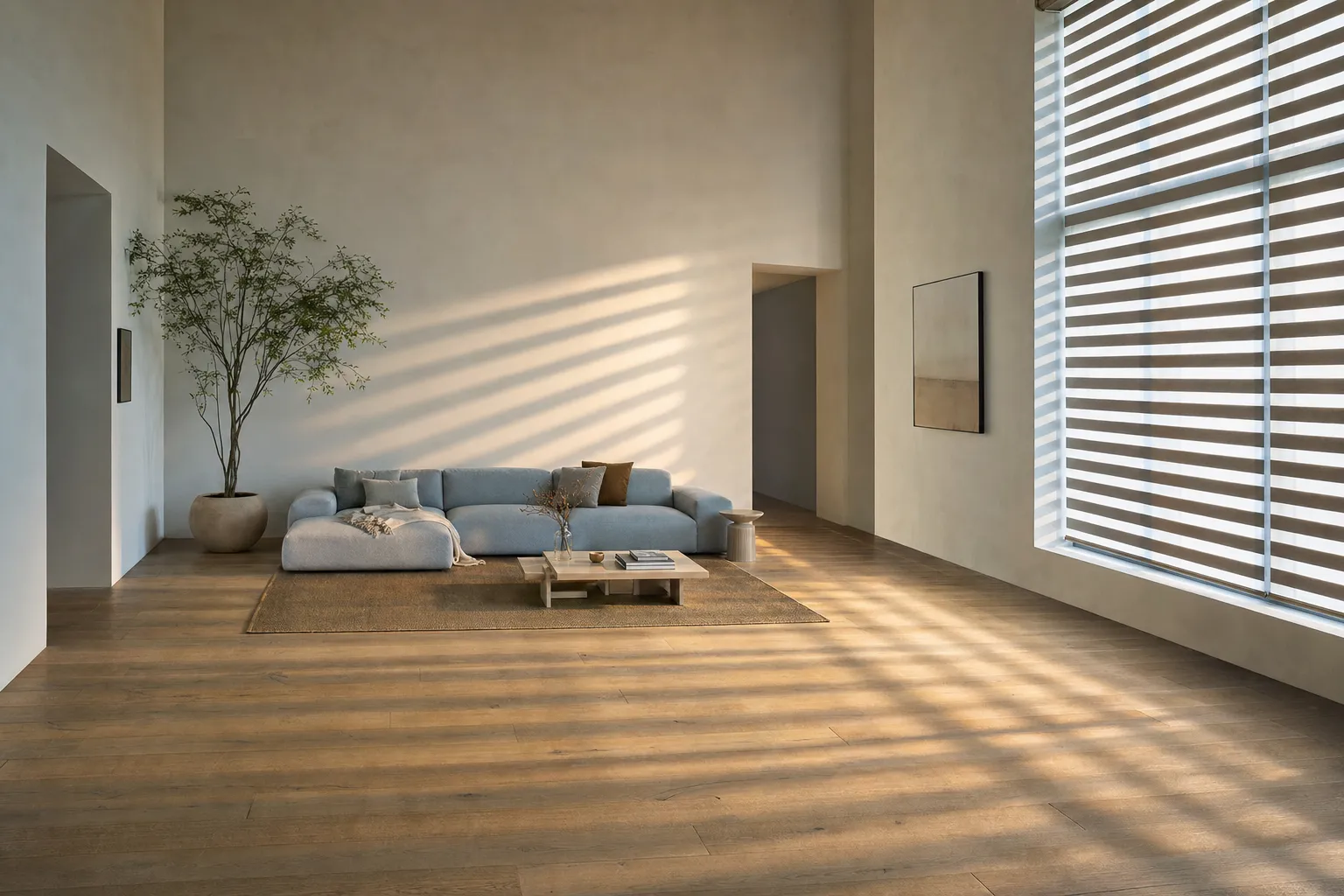
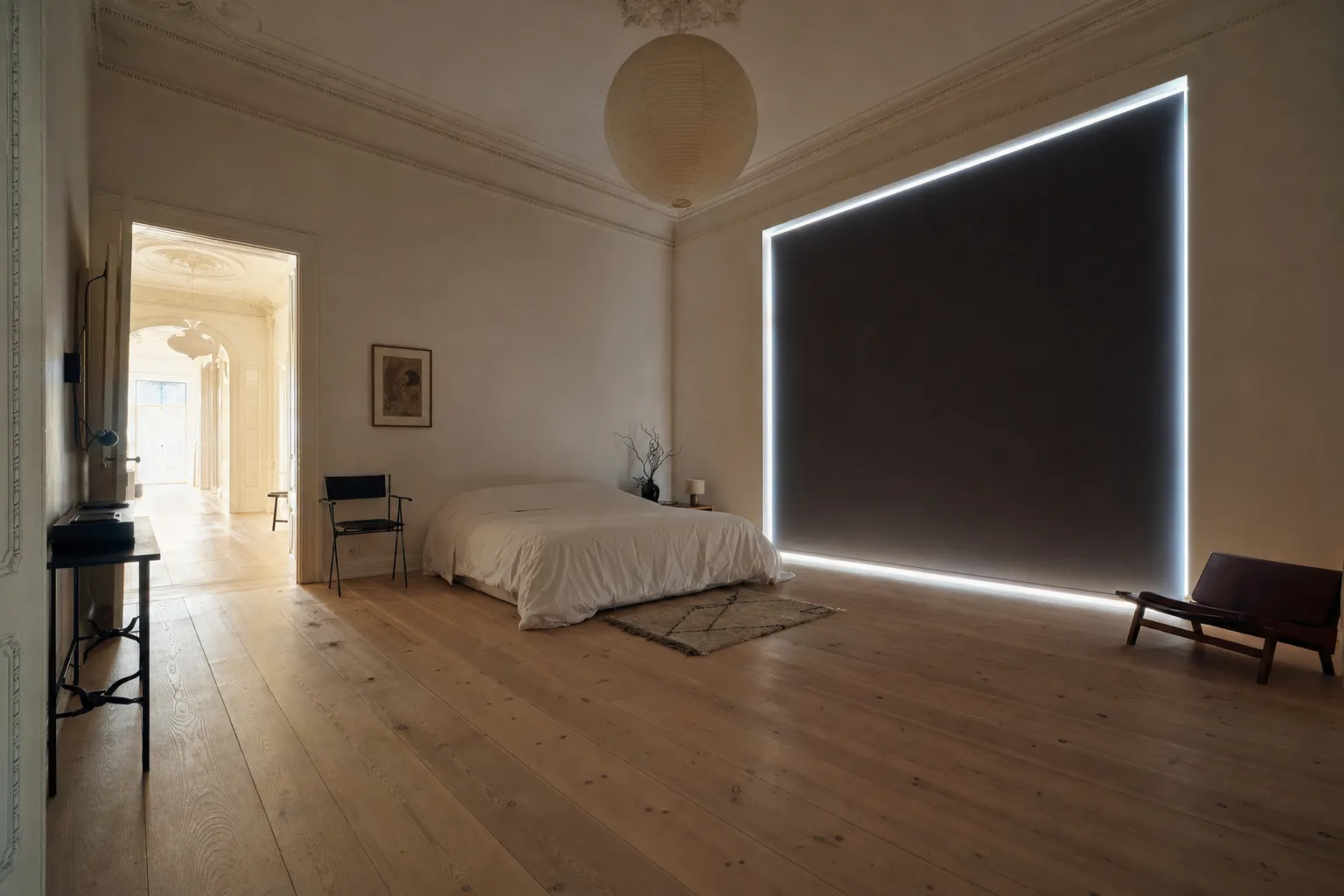
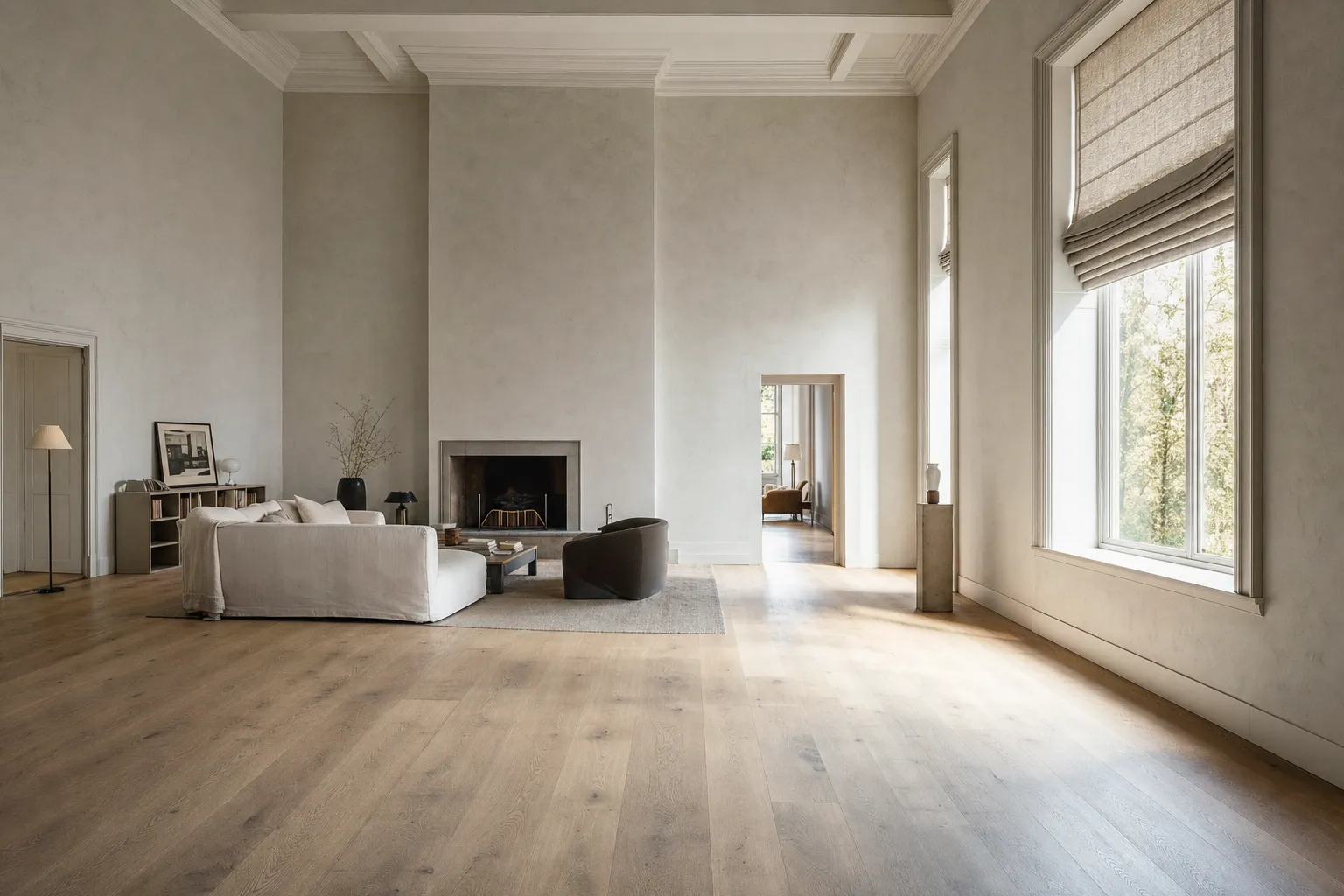
If you cannot decide between a screen and something opaque, that is a question about the room rather than the fabric. Describe the room and we will answer it.